
Philippines CT Scanners Market: AI-Powered Imaging, HEAL Project Expansion & Chronic Disease Surge
How a $59m government initiative, deep learning reconstruction and the nation's cardiovascular crisis are driving a 6.82% CAGR toward a $356m market by 2034

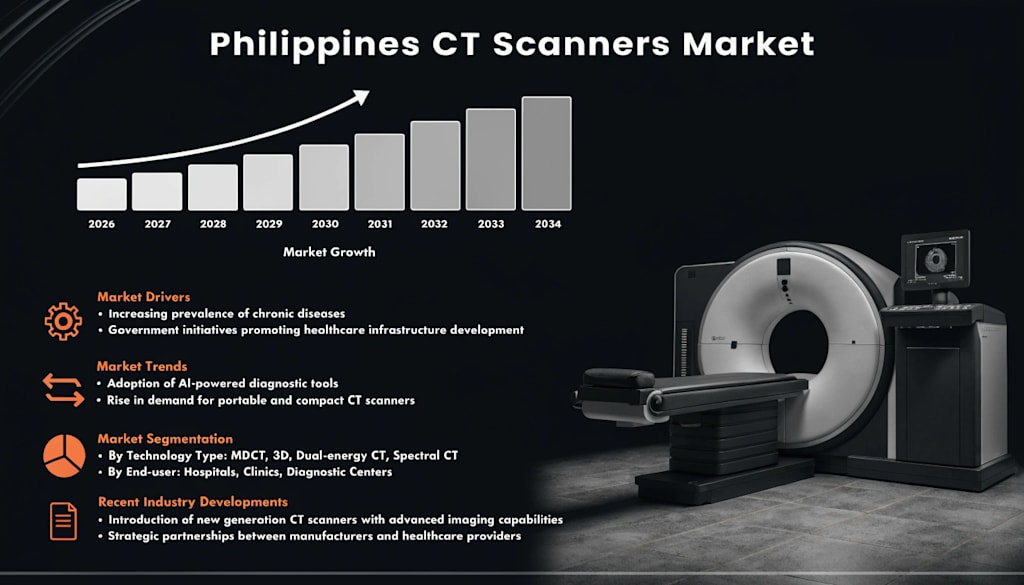
The Philippines CT scanners market size is undergoing a profound transformation as the government's most ambitious healthcare infrastructure programme in decades collides with an escalating burden of chronic disease and the rapid integration of artificial intelligence into medical imaging. According to IMARC Group, the market size reached USD 196.65 Million in 2025 and is projected to reach USD 355.98 Million by 2034, exhibiting a compound annual growth rate (CAGR) of 6.82% during 2026–2034. As the Department of Health deploys CT scanners to provincial hospitals that have never had them, and as AI-powered systems dramatically reduce radiologist workload, computed tomography has become the front line of the Philippines' fight against its most lethal diseases.
What's Driving Market Growth?
Government Infrastructure Investment and the HEAL Project. The single most powerful driver is the unprecedented scale of government investment in diagnostic equipment. The Health System Enhancement to Address and Limit COVID-19 (HEAL) Project, an Asian Development Bank funded USD 59 million initiative, delivered over 45 CT scanners to more than 100 public health facilities across the Philippines in February 2025. At Leyte Provincial Hospital, the CT scanner began operations in January 2024, serving 5 10 patients daily who previously had to travel hours to other hospitals for diagnosis. The Department of Health continues to allocate significant budgetary resources for medical equipment procurement, ensuring that tertiary and secondary hospitals receive state of the art diagnostic tools. This strategic focus is strengthening the entire diagnostic ecosystem, from urban teaching hospitals to remote rural facilities.
The Cardiovascular and Cancer Crisis. The Philippines is experiencing a mounting chronic disease burden that fundamentally drives CT scanner adoption. Ischaemic heart disease is the top cause of death, accounting for 85,868 fatalities (19.4% of total mortality) between January and October 2024, according to the Philippine Statistics Authority. Cancer ranks second, with 22,837 deaths (11.3% of all recorded deaths) from January to April 2025. A 2024 study published in the Journal of the Asia-Pacific Society of Cardiology found that the Philippines had a greater incidence rate of cardiovascular illnesses (11.0 per 1,000 person years) than neighbouring Malaysia, accounting for 58% of all deaths. This epidemiological reality demands sophisticated imaging modalities like multi slice CT scanners capable of providing detailed anatomical visualisation and functional assessment for cardiac scoring, oncological staging and neurological emergencies.
AI-Powered Imaging Revolutionising Diagnostic Workflows. The integration of deep learning algorithms and artificial intelligence is fundamentally transforming CT imaging. AI powered CT systems now offer automated patient positioning, intelligent protocol selection, dose optimisation and real time image quality enhancement. Deep learning based reconstruction algorithms enable substantial radiation dose reduction without compromising image quality, addressing critical patient safety concerns. As of 2024, approximately 35% of newly installed CT scanners globally are AI enabled, with studies demonstrating 30 40% reduction in radiologist reading time, improved noise reduction, and enhanced detection accuracy for abnormalities. For the Philippines, where the radiologist to population ratio remains far below international standards, these innovations are particularly valuable. In June 2025, the Ilocos Training and Regional Medical Center became the first public hospital in La Union province to install a PHP 130 million GE Revolution Maxima 128 slice CT scanner featuring AI automation, deep learning reconstruction and auto positioning capabilities, funded by the Department of Health.
Expanding Private Healthcare and Medical Tourism. The Philippines' private hospital networks are increasingly investing in advanced diagnostic imaging to differentiate their service offerings and attract both domestic and international patients. In December 2024, the University of the Philippines Philippine General Hospital inaugurated the country's first government owned PET CT scanner alongside a new 128 slice CT scanner. The PHP 150 million diagnostic equipment aims to provide advanced cancer diagnostics primarily to indigent patients (80% allocation versus 20% for paying patients), accommodating up to 15 patients daily at the lowest rates in the country. This combination of public infrastructure expansion and private sector modernisation is accelerating market penetration across all regions.
Market Segmentation & Key Insights
By Technology, the market includes 16 slice, 32 slice, 64 slice, 128 and above slice, 8 slice, and less than 8 slices systems. Higher slice counts are gaining share as hospitals seek faster scan times and superior cardiac and neurovascular imaging capabilities. By Modality, fixed systems dominate, but mobile CT scanners are emerging as a solution for archipelagic logistics and disaster response.
By Application, cardiology, oncology and neurology represent the largest segments, reflecting the country's disease burden. By End User, hospitals command the majority share, though diagnostic centres are growing rapidly as private imaging networks expand beyond Metro Manila. By Region, Luzon leads, but Visayas and Mindanao are experiencing accelerated growth as the HEAL Project and similar initiatives extend diagnostic access to previously underserved provincial areas.
What the Opportunities Are?
AI Integrated CT Platforms for Radiologist Workflow. With the country's severe radiologist shortage constraining effective CT utilisation, AI powered systems that automate patient positioning, protocol selection and preliminary image analysis are positioned for strong demand. As Philippine hospitals increasingly adopt CT systems with features like auto positioning, protocol suggestions and real time optimisation, vendors offering advanced deep learning reconstruction and computer aided detection will capture market share.
Public Private Equipment Procurement Partnerships. The government's preference for manufacturers offering competitive pricing, local service capabilities and technology transfer commitments creates opportunities for international vendors willing to invest in local infrastructure and workforce training. Manufacturers that can provide financing solutions and favourable leasing arrangements will gain advantage in resource constrained public hospital procurement.
Refurbished and Pre owned Equipment Segment. Emerging market dynamics include growing interest in refurbished and pre owned equipment among smaller healthcare facilities seeking cost effective diagnostic solutions. With new multi slice CT scanners representing million dollar investments that strain capital budgets, certified refurbished systems offer a viable pathway for provincial hospitals and diagnostic centres to acquire advanced imaging capabilities at reduced cost.
Mobile CT Services for Remote and Disaster Prone Areas. The Philippines' archipelagic geography creates logistical challenges for equipment transportation and installation. Mobile CT units that can serve multiple remote facilities address the economic viability challenge of operating advanced imaging equipment in low volume rural settings. Providers offering mobile CT services under government contracts or public private partnerships can capture underserved markets that cannot support fixed installations.
Workforce Training and Technical Support Services. The shortage extends beyond radiologists to include radiologic technologists, medical physicists and equipment maintenance engineers. There is strong opportunity for training programmes, certification courses and ongoing technical support services that help facilities maximise equipment utilisation and minimise downtime. Annual service and maintenance contracts, essential for equipment reliability, typically cost 10 15% of the initial purchase price, creating substantial recurring revenue opportunities for vendors with strong local service networks.
Recent News and Developments in Philippines CT Scanners Market
June 2025: Ilocos Training and Regional Medical Center installed a PHP 130 million GE Revolution Maxima 128 slice CT scanner with AI automation, deep learning reconstruction and auto positioning capabilities, making it the first public hospital in La Union province to offer this advanced technology.
February 2025: Over 45 CT scanners were installed at over 100 public health facilities across the Philippines as part of the Health System Enhancement to Address and Limit COVID-19 (HEAL) Project. The USD 59 million Asian Development Bank funded initiative transformed diagnostic access in previously underserved areas, with facilities like Leyte Provincial Hospital and Biliran Provincial Hospital receiving their first CT scanners.
December 2024: The University of the Philippines Philippine General Hospital inaugurated the country's first government owned PET CT scanner alongside a new 128 slice CT scanner. The PHP 150 million diagnostic equipment accommodates up to 15 patients daily at the lowest rates in the country, with 80% of capacity allocated to indigent patients.
2025: Bangui District Hospital in Ilocos Norte unveiled a new cutting edge CT scan unit, with officials stating that the scanner would significantly improve the detection and management of stroke, trauma, cancer, cardiovascular disease and other critical illnesses.
Why Should You Know About Philippines CT Scanners Market?
You should know about this market because it captures how public health infrastructure investment, chronic disease demographics and artificial intelligence intersect to transform diagnostic imaging across an entire archipelago. CT scanners are no longer confined to Metro Manila's tertiary hospitals — they are now operating in Leyte, La Union and Ilocos Norte, serving patients who previously travelled for hours or days for a scan. The combination of the USD 59 million HEAL Project, the rising toll of ischaemic heart disease claiming 19.4% of deaths, and AI powered systems that cut radiologist reading time by 30 40% represents a foundational shift in Philippine healthcare delivery.
For investors, the CT scanners market offers exposure to a high growth medical device category anchored in enforceable government procurement pipelines, the Department of Health's continued budget allocation for diagnostic equipment, and the structural shift toward AI integrated imaging platforms. The projected CAGR of 6.82% reflects steady baseline demand, while higher growth sub segments — including AI powered reconstruction systems, refurbished equipment for provincial facilities, mobile CT services and workforce training — offer differentiated upside potential.
For medical equipment manufacturers, distributors, healthcare investors and procurement specialists, understanding segmentation across slice counts and modalities, the emerging role of AI in addressing workforce shortages, and the evolving landscape of public private procurement partnerships helps shape intelligent investment decisions, supply chain strategies and market entry plans.
In essence, the Philippines CT scanners market captures how engineering precision, digital intelligence and healthcare equity converge — making it a compelling area for investors, manufacturers and healthcare leaders seeking smarter approaches to diagnostic access, early disease detection and sustainable healthcare modernisation across one of Southeast Asia's most dynamic and rapidly transforming healthcare systems.
About the Creator
Thomas
Market Research Analyst | Industry Trends & Forecasting | Turning market data into clear, actionable business insights across global sectors.
Enjoyed the story? Support the Creator.
Subscribe for free to receive all their stories in your feed.
Comments
There are no comments for this story
Be the first to respond and start the conversation.