
Philippines Cryogenic Equipment Market 2026: LNG Surge, Semiconductor Demand & Cold Chain Expansion
How the Malampaya transition, high-purity industrial gas facilities and food security mandates are driving the Philippines' cryogenic equipment sector

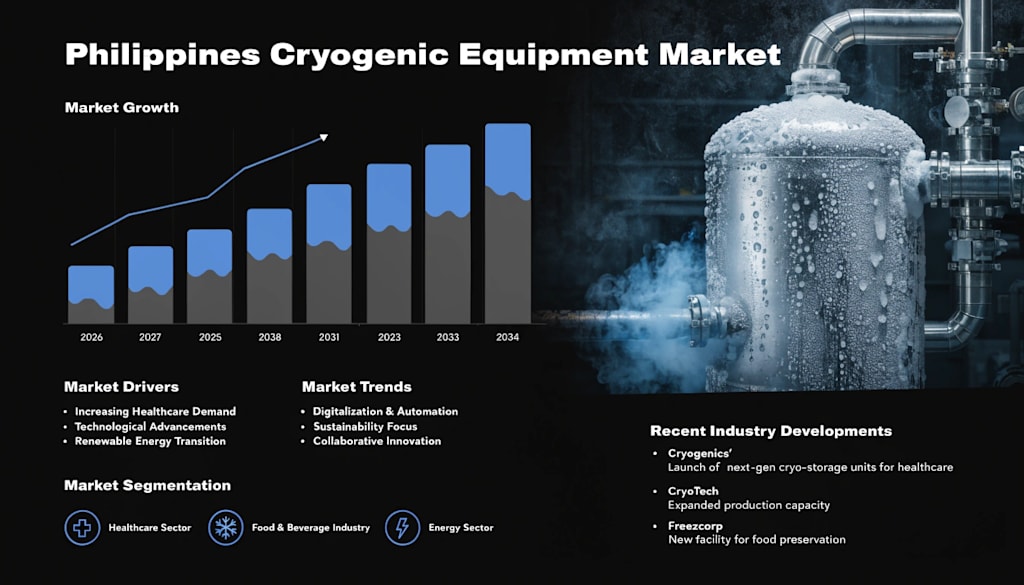
The Philippines cryogenic equipment market is steadily expanding as energy developers, healthcare providers, semiconductor manufacturers and food logistics operators increasingly adopt ultra-low temperature technologies essential for storing, processing and transporting liquefied gases. Cryogenic equipment — including storage tanks, dewars, pumps, heat exchangers, vaporizers, freezers and valves — operates at temperatures below -150°C (-238°F) to safely handle gases such as liquid nitrogen (LIN), liquid oxygen (LOX), liquid argon (LAR) and liquefied natural gas (LNG). According to IMARC Group, the market size reached USD 472.93 Million in 2025 and is projected to reach USD 674.99 Million by 2034, exhibiting a compound annual growth rate (CAGR) of 4.03% during 2026–2034. As the Philippines undergoes multiple structural transitions — from domestic gas depletion to LNG import dependency, from cold chain underdevelopment to modernised food logistics, and from assembly to advanced semiconductor localisation — cryogenic equipment has become an indispensable enabler of industrial, energy and healthcare progress.
What's Driving Market Growth?
LNG Infrastructure Acceleration for Energy Security. The impending depletion of the Malampaya gas field — the country's primary domestic natural gas source — has fundamentally reshaped the Philippines' energy strategy. The country began LNG imports in 2023 and now operates two LNG import terminals, with plans to add four more by 2026, boosting regasification capacity to 10.72 mtpa. A landmark 10-year LNG supply agreement between global energy trading firm Vitol and the LNGPH terminal in Batangas, signed in March 2025, will deliver up to 0.8 million tons of LNG annually, marking the country's first long-term LNG supply contract. Each LNG terminal requires extensive cryogenic infrastructure — storage tanks, vaporizers, heat exchangers, pumps and cryogenic valves — creating persistent demand for specialised equipment. The country currently has five LNG infrastructure projects under development, representing a total capacity of 13.72 mtpa across the region.
High-Purity Industrial Gas Demand for Semiconductor Manufacturing. The Philippines is on a strategic trajectory to become a regional semiconductor and electronics hub. The government has launched a **110 billion roadmap** targeting 70 billion in semiconductor exports and $40 billion in electronics exports annually by 2030. In April 2026, the United States and the Philippines selected New Clark City in Tarlac as the site for a 4,000-acre technology economic zone under the Pax Silica Initiative, hosting industrial facilities for critical minerals processing, semiconductors, advanced manufacturing and artificial intelligence systems. Semiconductor fabrication requires ultra-high-purity industrial gases — nitrogen, oxygen and argon — which must be delivered through cryogenic systems to ensure contamination-free processing.
Industrial Gas Production Capacity Expansion. Leading domestic industrial gas producer Pryce Corp. is aggressively scaling infrastructure to meet growing demand. The company's industrial gas sales volume surged by 71.3 percent in the first half of 2025, driving revenues to ₱547 million. In October 2025, Pryce announced a ₱6 billion (approximately USD 120 million) investment to build three new air separation plants in Pangasinan (Luzon), Bacolod (Visayas) and Davao (Mindanao), each costing around ₱2 billion and designed to serve all three major island groups. The expansion is intended to establish Pryce as the largest industrial gas company in the Philippines within three years, directly fuelling demand for cryogenic storage, processing and transportation equipment.
Healthcare Cold Chain and Biomedical Preservation Modernisation. The healthcare sector's reliance on cryogenic systems for vaccine storage, biological sample preservation and advanced therapies continues to expand. The Department of Health (DOH) issued a ₱200 million procurement contract for cold chain logistics services covering vaccine hauling and delivery in 2026. Provincial governments are investing in cold chain infrastructure: Negros Occidental unveiled a supply chain warehouse equipped with a cold storage system serving as a central hub for medicines, vaccines and medical supplies. Cryogenic freezers and ultra-low temperature storage units are essential for maintaining vaccines, tissues, reproductive cells and advanced biological therapies at temperatures reaching -196°C, enabling broader healthcare and research capabilities across hospitals, laboratories, blood banks and biobanks.
Food Security Cold Storage and Agriculture Infrastructure. The Department of Agriculture (DA) has prioritised cold storage expansion as a core component of national food security strategy. The ₱500 million Bicol Mega Cold Storage Facility in Camarines Sur — the first completed project under the DA Cold Storage Expansion Program — features six refrigerated warehouses with 2,688 pallet positions, a blast freezer, processing and packing areas, and an integrated solar power system. The facility has a combined annual capacity exceeding 200,000 metric tons, storing pork, beef, poultry, fish, fruits and vegetables. Additional food hubs with integrated cold storage are planned in Manolo Fortich, Bukidnon, and adjacent to the Bicol facility, creating sustained demand for cryogenic cooling systems and cold chain equipment.
Semiconductor Fabrication and Advanced Electronics Manufacturing. Beyond high-purity gases, the Philippines semiconductor roadmap explicitly targets the establishment of wafer fabrication facilities, which require advanced cryogenic systems for process cooling and inerting applications. The semiconductor and electronics industry currently contributes approximately 60 percent of the country's total exports, and the government is fast-tracking reforms and investments to scale up the sector. The partnership with the United States on the Pax Silica technology hub signals a long-term commitment to upgrading domestic production capabilities, with cryogenic equipment positioned as essential infrastructure for advanced manufacturing.
Market Segmentation & Key Insights
By Equipment Type, the market includes tanks, pumps, heat exchangers, valves and other components. Tanks represent the largest segment, driven by LNG storage requirements and industrial gas distribution networks. By Cryogen Type, the market covers nitrogen, LNG, helium and other gases. LNG is the fastest-growing cryogen segment, reflecting the energy sector pivot toward imported gas. By Application, the market is segmented into storage, transportation, processing and other applications. Storage leads due to LNG terminal expansion and cold chain development. By End-Use Industry, key sectors include oil and gas, energy and power, food and beverages, healthcare, marine and aerospace, chemicals and others. Oil and gas and energy and power together account for the largest share, driven by LNG infrastructure investment and industrial gas production facilities. By Region, primary markets include Luzon (dominated by Metro Manila, Batangas LNG terminals and New Clark City semiconductor hub), Visayas (with air separation plant in Bacolod) and Mindanao (Davao industrial gas expansion).
What the Opportunities Are?
AI-Powered Predictive Maintenance for Cryogenic Systems. Artificial intelligence is transforming cryogenic equipment operations through IoT sensor integration and predictive maintenance systems that enable real-time monitoring of ultra-low temperature environments. AI-powered anomaly detection algorithms can predict potential equipment failures before they occur, cutting maintenance costs by up to 40 percent and unexpected downtime by 30 to 50 percent. Edge computing capabilities processing data at the equipment level deliver sub-second response times critical in safety applications, while digital twin technology creates virtual replicas of cryogenic systems enabling simulation-based optimisation and extended equipment lifespan.
Marine Cryogenic Pumps and Vessel-Based LNG Infrastructure. With the Philippines operating floating storage and regasification units in Batangas, there is growing demand for marine cryogenic pumps and associated vessel-based cryogenic systems. Nikkiso's partnership with Exion Asia to launch a Southeast Asia marine hub specifically addresses this market segment, recognising that over 1,400 cryogenic pumps are already installed on vessels worldwide. Suppliers offering marine-certified cryogenic equipment for offshore and terminal applications are positioned to capture energy sector infrastructure investment.
Hydrogen and Clean Fuel Cryogenic Infrastructure. As global momentum behind clean energy accelerates, cryogenic infrastructure supporting hydrogen and bio-LNG presents long-term opportunities. Equipment designed for hydrogen, bio-LNG and low-emission gas handling can position suppliers as strategic partners to energy developers as the Philippines explores future hydrogen power facilities alongside its LNG transition path.
Aftermarket Services and Preventive Maintenance Contracts. Cryogenic systems require periodic calibration, safety checks, component replacement and maintenance services to ensure reliable operation. Companies offering comprehensive aftermarket support, preventive maintenance contracts and emergency response services can secure sustained income from existing installations. With multiple LNG terminals, three new air separation plants, and expanded cold storage infrastructure coming online, the installed base of cryogenic equipment will generate significant recurring service demand.
Smart IoT-Enabled Monitoring and Remote Management. Integration of IoT sensors, remote monitoring tools and cloud-based data analytics platforms enables centralised management of distributed cryogenic assets. Systems that provide real-time visibility into temperature stability, fill levels and equipment health across multiple locations appeal to healthcare networks, pharmaceutical distributors and food cold chain operators managing decentralised cold storage facilities.
Specialised Semiconductor-Grade Cryogenic Solutions. The government's semiconductor roadmap targets $110 billion in exports by 2030 and includes establishing wafer fabrication facilities within the country. Semiconductor fabrication requires ultra-high-purity cryogenic gas delivery systems, point-of-use filtration, and precise temperature control equipment. Suppliers offering validated, contamination-free cryogenic solutions for semiconductor cleanrooms can capture high-margin opportunities as advanced manufacturing localises.
Recent News and Developments in Philippines Cryogenic Equipment Market
October 2025: Pryce Corp. announced a ₱6 billion investment to build three new air separation plants in Pangasinan, Bacolod and Davao. The facilities separate atmospheric air to produce liquid oxygen, nitrogen and argon, with each plant costing approximately ₱2 billion and completion targeted within three years.
March 2025: Global energy trading firm Vitol signed a 10-year LNG supply agreement to deliver up to 0.8 million tons of LNG annually to the LNGPH terminal in Batangas, marking the Philippines' first long-term LNG supply contract.
July 2025: A GIIGNL report confirmed the Philippines has two operational LNG terminals with plans to add four more by 2026, boosting regasification capacity to 10.72 mtpa as the country compensates for declining Malampaya gas field production.
January 2026: The Department of Agriculture (DA) announced that the ₱500 million Bicol Mega Cold Storage Facility would open in early 2026, featuring six refrigerated warehouses with 2,688 pallet positions, a blast freezer, processing and packing areas, and a solar power system. The facility is the first completed under the DA Cold Storage Expansion Program.
January 2026: The Department of Health issued an Invitation to Bid (IB No. 2026-009) for cold chain hauling and delivery services with an approved budget of ₱200 million, covering vaccine transport and other temperature-controlled logistics.
February 2026: Negros Occidental unveiled a supply chain warehouse for the Provincial Health Office, equipped with a cold chain storage system serving as a central hub for medicines, vaccines and medical supplies to improve storage and distribution reliability.
March 2026: President Ferdinand R. Marcos Jr. inspected the Bicol Mega Cold Storage Facility in Camarines Sur, confirming that the facility's combined annual capacity exceeds 200,000 metric tons and that it serves as a flagship project under the DA Cold Storage Expansion Program.
April 2026: The Philippines cryogenic equipment market was valued at USD 472.93 million in 2025, projected to reach USD 674.99 million by 2034, growing at a CAGR of 4.03% during 2026–2034. The IMARC report identified LNG infrastructure, healthcare cold chain and industrial gas expansion as primary growth drivers.
April 2026: The United States and the Philippines announced the selection of New Clark City in Tarlac as the site for a 4,000-acre technology economic zone under the Pax Silica Initiative, hosting industrial facilities for critical minerals processing, semiconductors, advanced manufacturing, and AI — creating future demand for high-purity cryogenic gases.
April 2026: The Department of Trade and Industry (DTI) rolled out a **110 billion semiconductor and electronics export roadmap**, targeting 70 billion in semiconductor exports and $40 billion in electronics exports by 2030, reinforcing the long-term demand for high-purity industrial gas infrastructure.
Why Should You Know About Philippines Cryogenic Equipment Market?
You should know about this market because it captures how energy security imperatives, semiconductor localisation goals and food supply chain modernisation intersect to create sustained growth in a specialised but mission-critical industrial equipment sector. Cryogenic equipment is no longer confined to industrial gas plants and research laboratories — it now underpins LNG import terminals securing the country's power generation, cold storage facilities preserving the nation's food supply, and ultra-low temperature freezers protecting vaccines and biological therapies.
For investors, the cryogenic equipment market offers exposure to a stable-growth industrial technology category anchored in structural transitions: the replacement of Malampaya gas with LNG imports, the government's $110 billion semiconductor roadmap, the Department of Agriculture's Cold Storage Expansion Program, and the industrial gas sector's ₱6 billion production capacity expansion. The projected CAGR of 4.03% reflects steady baseline demand, while higher-growth sub-segments — including AI-powered predictive maintenance systems, marine cryogenic equipment for vessel-based LNG infrastructure, hydrogen-ready cryogenic systems, and semiconductor-grade ultra-high-purity gas delivery solutions — offer differentiated upside potential.
For industrial engineers, equipment suppliers, logistics planners, energy developers and policymakers, understanding cryogenic segmentation, LNG infrastructure dynamics, high-purity gas specifications for semiconductor fabrication, healthcare cold chain standards and aftermarket service models helps shape intelligent procurement decisions, technology roadmaps and strategic partnerships that deliver measurable safety, efficiency and reliability outcomes in the Philippines' evolving industrial landscape.
In essence, the Philippines cryogenic equipment market captures how low-temperature engineering, national infrastructure development and advanced industrial capability converge — making it a compelling area for investors, engineering firms and technology partners seeking smarter approaches to energy storage, biological preservation, semiconductor manufacturing and food security in one of Southeast Asia's most dynamic economies.
About the Creator
Thomas
Market Research Analyst | Industry Trends & Forecasting | Turning market data into clear, actionable business insights across global sectors.
Enjoyed the story? Support the Creator.
Subscribe for free to receive all their stories in your feed.
Comments
There are no comments for this story
Be the first to respond and start the conversation.