
Philippines Corrugated Boxes Market: E Commerce Surge, EPR Mandates & Packaging Resilience
How a $36bn digital economy, 56% plastic waste recovery and FMCG growth are driving corrugated packaging adoption across the archipelago

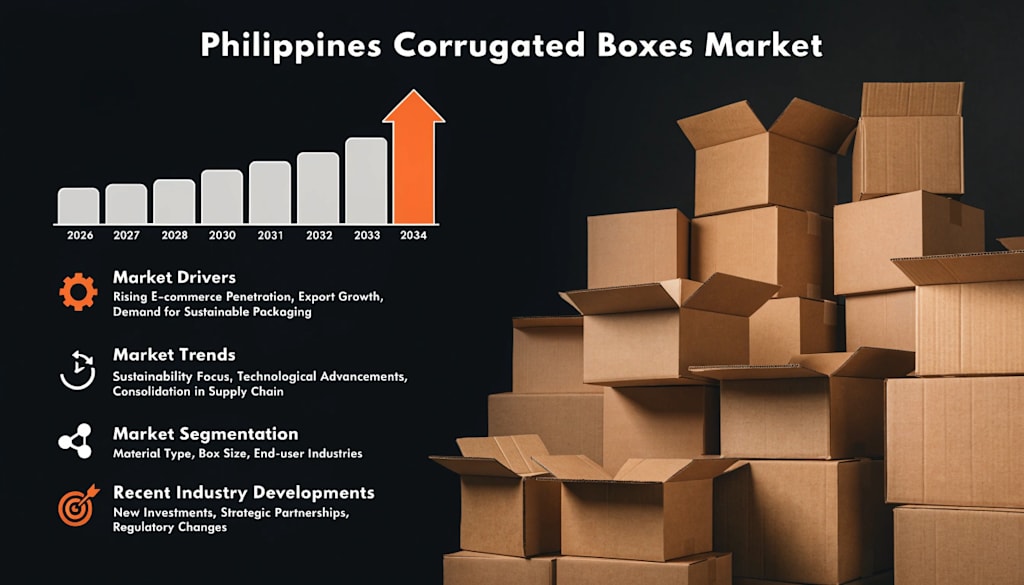
The Philippines corrugated boxes market size is expanding steadily as e commerce platforms, food and beverage manufacturers, and logistics providers increasingly depend on durable, cost effective, and eco friendly shipping and storage solutions. Corrugated boxes — including single wall, double wall, and triple wall constructions in standard and customised formats — are deployed across online retail, fresh produce distribution, pharmaceutical transport, and industrial supply chains to protect goods during inter island transit, support brand presentation, and meet tightening environmental regulations. According to IMARC Group, the market size reached USD 970.07 Million in 2025 and is projected to reach USD 1,315.95 Million by 2034, exhibiting a compound annual growth rate (CAGR) of 3.45% during 2026 2034. As the Philippines accelerates toward digital first commerce and circular economy targets, corrugated packaging has become an essential enabler of safe, sustainable and resilient domestic trade.
What's Driving Market Growth?
E Commerce Boom Transforming Packaging Demand. The Philippine digital economy is set to reach USD 36 billion in gross merchandise value (GMV) in 2025, growing 16 percent year on year, with e commerce — the largest sector — accounting for more than 60 percent of total GMV. E commerce GMV alone grew to USD 24 billion in 2025, up from USD 20 billion in 2024. Video commerce has emerged as a major growth engine, now accounting for a quarter of the Philippines' e commerce GMV, comprising approximately 475,000 sellers and stores — a 90 percent year on year increase — and generating 1.2 billion transactions. Online platforms such as Lazada and Shopee have fundamentally changed how consumers shop, leading to increased demand for dependable and protective packaging solutions. Their automated sortation centres, powered by over 300 high speed sorting lines, ensure rapid order fulfillment, and the growth of online shopping and digital transactions is enhancing e commerce accessibility nationwide, which in turn is increasing the need for corrugated packaging.
EPR Mandates and Sustainability Imperatives. The Extended Producer Responsibility (EPR) Act of 2022 (Republic Act No. 11898) mandates that large enterprises establish and implement EPR programmes for plastic packaging waste recovery and diversion, encouraging businesses to redesign packaging using reusable and paper based corrugated solutions. The national diversion rate has already exceeded targets — registering 55.98 percent in 2025, well above the mandated 40 percent target, with over 246 million kilograms of plastic waste diverted as a result of 1,017 entities registering their EPR programmes. Under the EPR Act, the country targets recovery of plastic product footprint by 20 percent in 2023, 40 percent by 2024, 50 percent in 2025, 60 percent in 2026, 70 percent in 2027, and 80 percent by 2028. Consumers and businesses are increasingly adopting recyclable and biodegradable packaging to reduce environmental impact, and corrugated boxes — typically crafted from recycled paper — bolster circular economy efforts.
Manufacturing Infrastructure and Industry Consolidation. The corrugated packaging manufacturing landscape in the Philippines is anchored by established players. San Miguel Yamamura Packaging Corporation (SMYPC) stands as the largest packaging company in the Philippines — a joint venture between San Miguel and Yamamura that produces a full range of corrugated boxes, cartons and industrial packaging. Pakoro, a custom packaging manufacturer serving the Philippine market, offers cost effective, personalised packaging with eco friendly practices. United Pulp and Paper Co., Inc. (UPPC), Liberty Corrugated Boxes Mfg. Corp. , and Prime Worldwide Paper Packaging Corporation round out the competitive landscape, with the latter supplying clients across electronics, foodstuff and furniture sectors. Beyond manufacturing, digital printing technologies allow short production runs, high resolution graphics and personalised packaging solutions — innovations particularly beneficial for SMEs and e commerce sellers seeking enhanced brand visibility.
FMCG, Food & Beverage Sector Expansion. The sectors of fast moving consumer goods (FMCG) and food & beverage play a significant role in driving market demand. Growing urbanization, higher disposable incomes and evolving lifestyles are fuelling demand for packaged goods. Corrugated cartons are commonly utilised for packing and shipping food, cartons for beverages, and retail suitable packaging. The food and beverage segment holds a significant share due to high packaging demand, and the overall packaging sector in the Philippines is also growing, driven by urban development and an increasing need for convenience items.
Market Segmentation & Key Insights
By Material, the market includes recycled corrugates and virgin corrugates. Recycled corrugates dominate due to cost efficiency and sustainability benefits. By Application, corrugated boxes are used across multiple industries: food and beverages, electrical and electronics, personal care and household goods, chemicals and industrial goods, textiles and others. By Function, primary packaging boxes hold a significant share, driven by increasing demand for direct product packaging to ensure protection and safety. By Region, the market is segmented into Luzon, Visayas and Mindanao. Luzon — particularly Metro Manila and surrounding industrial zones — dominates due to its concentration of manufacturing activities, population density, and the presence of major e commerce fulfillment hubs. Visayas and Mindanao are emerging as key consumption and distribution centres, with growing industrial bases, logistics hubs and expanding online retail activity.
What the Opportunities Are?
Recycled and Bio Based Corrugated Innovation. With EPR compliance requiring obligated enterprises to implement recovery programmes, there is strong opportunity for manufacturers to develop high strength recycled corrugates with advanced moisture resistance and biodegradable coatings. Companies that invest in water based inks, recycled fibre optimisation and circular economy certifications can differentiate in a market where plastic waste recovery is already exceeding national targets.
AI Powered Supply Chain and Production Automation. AI is transforming corrugated packaging operations through automated production processes, inventory optimisation and defect detection. AI algorithms analysing historical sales data can forecast demand with greater accuracy, reducing waste and improving supply chain efficiency. Computer vision systems enable real time quality inspections, detecting defects before boxes leave the factory. Manufacturers integrating AI driven solutions can reduce labour costs, improve workplace safety and capture efficiency focused clients.
Customised Short Run Branded Packaging for E Commerce. As SMEs and online sellers seek distinct brand presentation without bulk ordering, digital printing technologies enable manufacturers to offer high resolution, customised boxes in small batches. This trend is particularly valuable for e commerce sellers on platforms like Shopee and Lazada, where unboxing experience influences customer reviews and repeat purchases. Suppliers offering low minimum order quantities and rapid turnaround times can capture the fast growing segment of micro businesses and social commerce sellers.
Cold Chain and Protective Packaging for Inter Island Logistics. The Philippines' archipelagic geography demands robust packaging solutions capable of protecting goods across multiple modes of transport. Fresh produce, frozen seafood and temperature sensitive pharmaceuticals require specialised corrugated boxes with enhanced moisture resistance, reinforced corners and compatibility with chilled logistics. Suppliers that develop value added corrugated solutions for agricultural exporters and cold chain operators can secure long term contracts with stable recurring demand.
Regional Distribution Hubs and Infrastructure Investment. Infrastructure improvements across Visayas and Mindanao are enhancing distribution efficiency, supporting market penetration in previously underserved areas. Manufacturers that establish regional production facilities or distribution centres in emerging economic zones — particularly near ports and logistics hubs in Cebu, Davao and Clark — can reduce transportation costs and delivery times, capturing market share from Luzon focused competitors.
Recent News and Developments in Philippines Corrugated Boxes Market
February 2026: The DENR reported exceeding its 40 percent plastic waste recovery target for 2025 by registering a national diversion rate of 56 percent, with over 246 million kilograms of plastic waste diverted as a result of 1,017 entities registering their EPR programmes. Recovery rates reached 56.33 percent for flexible plastics and 55.60 percent for rigid plastics.
October 2025: CorruTec ASIA 2025 concluded in Bangkok, welcoming 6,190 trade visitors — a 15 percent increase over 2023 — underscoring ASEAN's rising demand for corrugated packaging technologies, with 20 percent of visitors arriving from outside Thailand and more than 50 international delegations representing FMCG, retail, logistics and e commerce sectors.
May 2025: The Industrial Technology Development Institute (DOST ITDI) showcased eco friendly packaging innovations at ProPak Philippines 2025, including films from polyvinyl alcohol and chitosan, pectin films, and composite cushion made from coconut peat and pineapple fibre.
May 2025: 3D Container & Packaging Phils. Corporation, established in 2011 by Engineer Jaie Floes Ador, continued its growth as a corrugated packaging manufacturer serving the Philippine market.
February 2025: DOST ITDI and DOST NCR participated in ProPak Philippines 2025, displaying Green Packaging Laboratory products including PVA+CS films for extending the shelf life of dry products and BC films as biodegradable, edible packaging materials.
Why Should You Know About Philippines Corrugated Boxes Market?
You should know about this market because it captures how digital retail expansion, circular economy regulation and infrastructure development intersect to create steady growth in a foundational segment of Philippine logistics and manufacturing. Corrugated boxes are no longer just basic shipping containers — they are brand communication tools, sustainability compliance instruments and supply chain performance enablers that help e commerce sellers protect customer satisfaction, enable food exporters to reach international buyers, and support manufacturers in reducing environmental footprint.
For investors, the corrugated boxes market offers exposure to a stable growth packaging category anchored in the Philippines' USD 36 billion digital economy, the enforceable EPR Act with escalating recovery targets up to 80 percent by 2028, and the expanding logistics infrastructure supporting inter island commerce. The projected CAGR of 3.45 percent reflects consistent baseline demand, while higher growth sub segments — including recycled and bio based corrugates, AI powered production automation, customised short run digital printing, and cold chain protective packaging — offer differentiated upside potential.
For packaging manufacturers, e commerce platforms, logistics providers, brand owners and supply chain planners, understanding corrugated box segmentation, EPR compliance pathways, digital printing capabilities and inter island logistics requirements helps shape intelligent procurement decisions, product development roadmaps and strategic investments that deliver measurable product protection, brand differentiation and environmental compliance outcomes.
In essence, the Philippines corrugated boxes market captures how protective engineering, sustainable materials and digital transformation converge — making it a compelling area for investors, manufacturers and logistics innovators seeking smarter approaches to packaging, circular economy participation and supply chain resilience in one of Southeast Asia's fastest growing digital economies.
About the Creator
Thomas
Market Research Analyst | Industry Trends & Forecasting | Turning market data into clear, actionable business insights across global sectors.
Enjoyed the story? Support the Creator.
Subscribe for free to receive all their stories in your feed.
Comments
There are no comments for this story
Be the first to respond and start the conversation.