
Philippines Cooking Oil Market 2026: Price Volatility, Palm Oil Dominance & Health Conscious Premiumisation
How rising coconut oil costs, expanding food service channels and shifting consumer preferences are reshaping the Philippines' edible oils landscape

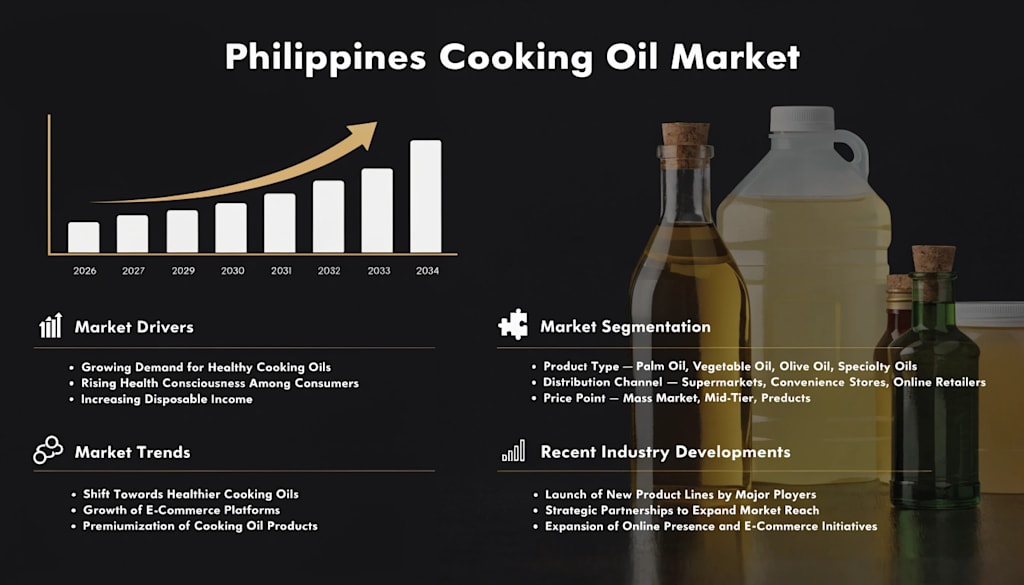
The Philippines cooking oil market is navigating a period of moderate but steady expansion as households, food service operators and industrial buyers grapple with price volatility, supply chain disruptions and evolving dietary preferences. Cooking oil—spanning palm, coconut, soybean, canola and specialty oils—is deployed across residential kitchens, fast food chains, street food kiosks and commercial food processing to serve the daily needs of millions of Filipino consumers. According to IMARC Group, the market size reached USD 4,215.1 Million in 2025 and is projected to reach USD 6,066.19 Million by 2034, exhibiting a compound annual growth rate (CAGR) of 4.13% during 2026–2034 [0†L6-L8]. As the government considers supply side interventions and consumers increasingly trade up to premium, health oriented oils, cooking oil has remained the largest single category within the country's edible oils sector, valued at USD 5.07 billion in 2025 within the broader edible oils and fats market [1†L18-L21] [10†L8-L10].
What's Driving Market Growth?
Coconut Oil Price Surge Driving Substitution Toward Palm Oil. One of the most significant drivers shaping the cooking oil market in 2025 was the sharp increase in coconut oil prices, which triggered a major substitution effect. Coconut oil, traditionally prized for its flavour and perceived health benefits, saw its millgate prices reach a monthly average of P75.34 per kilo, surpassing peak levels recorded during the Russia Ukraine war in 2022. This translated to a suggested retail price of P180.85 per litre for refined coconut oil used as cooking oil [11†L28-L33]. By April 2025, coconut oil prices in Metro Manila markets reached as high as P180 per litre, more than double the P80 per litre recorded during the same period the previous year. The average price settled at around P140 per litre, at least P40 higher than the average price of palm oil at nearly P99 per litre [11†L37-L41]. As a result, the USDA FAS projected that Filipino palm oil demand for food use would expand by more than a fifth to 900,000 MT from 736,000 MT in 2024, driving palm oil imports up by 11% to one million MT [3†L11-L14] [11†L18-L20].
Expanding Food Service Industry and Quick Service Restaurant Growth. The recovery and expansion of the Philippines' food service sector have provided substantial support for cooking oil demand. The food service industry returned to pre pandemic levels in 2025, with sales estimated to grow by 8% to USD 14 billion [15†L8-L11]. The profit sector generated revenues of PHP 918.4 billion (USD 15.9 billion) in 2025, recording a CAGR of 9.4% during 2020 2025 [7†L10-L12]. This growth is driven by the expansion of quick service restaurant chains and international restaurant concepts, which are increasing their market presence by opening new outlets [7†L5-L8]. Limited service restaurants account for 61% of food service sales, with major players such as Jollibee Foods Corp. and McDonald's continuing to drive the sector's rapid development [15†L27-L34].
E Commerce Growth and Modern Retail Expansion. E commerce has emerged as the fastest growing distribution channel for edible oils, with online platforms enabling consumers to compare prices, access premium imported oils, and benefit from convenient home delivery [14†L49-L50]. The sustained growth of modern grocery retail—including supermarkets and hypermarkets—remains the primary channel for edible oils, offering consumers variety and competitive pricing [14†L49]. As retailers increasingly prioritise sustainability, there is growing adoption of eco friendly packaging solutions and plant based inks that align with consumer environmental consciousness [5†L4-L9].
Health Conscious Premiumisation and Specialty Oils. Rising health awareness among Filipino consumers is accelerating the shift toward premium, healthier cooking oils. The specialty oils market is expanding rapidly due to increasing health awareness and the popularity of niche cooking oils such as coconut, avocado, and rice bran oil [16†L6-L10]. Olive oil remains a niche but fast growing segment, with Fly Ace Corp benefiting from consumer shifts toward premium and health oriented products [14†L6-L10]. Canola oil is also gaining traction, as it is lower in saturated fat and higher in heart healthy omega 3 fatty acids compared to traditional oils [1†L10-L13]. The olive market, valued at USD 50 million, is expanding due to rising health consciousness and demand for gourmet products like extra virgin olive oil [17†L16-L20].
Government Policy Interventions and Price Regulation. The government has actively intervened in the cooking oil market to stabilise prices and ensure supply. The Philippine Coconut Authority (PCA) is considering a retention policy that would set aside a portion of coconut oil production for domestic use before exports, aiming to secure local supply and stabilise prices [13†L9-L14]. The agency also convened industry stakeholders to address surging coconut oil prices, with options including a price ceiling on domestic coconut oil [13†L45-L53]. The Department of Trade and Industry (DTI) monitors 726 essential items, including cooking oil, and enforces suggested retail prices during emergencies [4†L32-L37]. In early 2025, only 28% of basic necessities saw minimal price adjustments of 5 10%, while 72% of monitored goods, including many cooking oils, remained unchanged [12†L4-L12].
Market Segmentation & Key Insights
By Type, the cooking oil market is part of the broader edible oils and fats market, which is segmented into oils (palm, coconut, soybean, and others) and fats (butter, tallow, margarine, and others) [8†L7-L9]. Palm oil dominates the market, accounting for approximately 70% of total consumption, driven by its lower price point compared to coconut oil and its durability at high temperatures [16†L34-L35]. Coconut oil consumption is expected to drop by 20,000 metric tons to 200,000 MT in market year 2024 2026 due to price driven substitution [11†L12-L14]. The Philippines remains the world's largest coconut oil exporter, though export volumes declined by 25.75% between January and August 2025 [2†L5-L7].
By Source, the market is divided into plant and animal sources, with plant based oils commanding the vast majority of consumption [8†L9].
By End Use, the market serves food service and retail channels. The retail segment dominates, but food service is growing rapidly as quick service restaurants and street food kiosks expand their footprint [8†L9-L10].
By Distribution Channel, the market is segmented into supermarkets and hypermarkets, convenience stores, traditional retail outlets, and online stores. Supermarkets remain the primary channel, while e commerce is the fastest growing segment [14†L49-L50].
By Region, major markets include Luzon (Metro Manila and surrounding provinces), Visayas and Mindanao. Metro Manila represents the largest consumer base, driven by dense population, higher disposable incomes, and concentrated food service activity.
What the Opportunities Are?
Domestic Coconut Oil Retention and Supply Chain Resilience. The proposed retention policy under consideration by the PCA presents a significant opportunity for domestic cooking oil producers. If implemented, the policy would ensure a more stable and predictable supply of coconut oil for the local market, reducing exposure to export price volatility [13†L9-L14]. Producers that secure long term supply agreements with domestic coconut oil sources or invest in vertical integration will be better positioned to manage price fluctuations and meet retail demand.
Sustainable Packaging and Eco Friendly Solutions. The shift toward sustainable packaging is gaining momentum in the Philippines cooking oil market, driven by consumer demand and tightening environmental regulations. Tetra Pak is launching smaller, more sustainable packaging formats for the Philippine market [5†L44-L47]. Oikos Biodegradable Packaging offers eco friendly business packaging made from renewable, biodegradable materials like cassava and corn starch [5†L49-L54]. Cebu based packaging firms are shifting to greener solutions as regulators tighten restrictions on single use plastics [5†L56-L57]. Companies that invest in recyclable, compostable and zero waste packaging will differentiate themselves in an increasingly environmentally conscious market [5†L23-L29].
Health Oriented Product Lines and Nutritional Fortification. With growing consumer health consciousness, there is strong opportunity for manufacturers to introduce fortified cooking oils with vitamins A, D and E, as well as low fat and low calorie formulations [8†L19-L24]. The World Health Organization's recommendation that total fat intake be less than 30% of total calories is driving innovation in healthier product development [8†L49-L54]. Olive oil, canola oil and avocado oil are poised for continued growth as consumers actively trade up to premium, health oriented options [14†L8-L10] [1†L10-L13].
E Commerce Direct to Consumer Models. The online channel is the fastest growing distribution route for cooking oil, offering opportunities for manufacturers to bypass traditional retail intermediaries and build direct relationships with consumers [14†L49-L50]. Subscription based cooking oil delivery, bundled product offerings and educational content about oil usage and health benefits can build brand loyalty and recurring revenue.
Cold Chain and Bulk Logistics for Food Service. As the food service industry expands, particularly quick service restaurants and street food kiosks, demand for bulk, cost effective cooking oil supply is growing. Companies that invest in efficient bulk packaging, reliable cold chain logistics and flexible delivery schedules for institutional clients will capture growing B2B market share. Street stalls and kiosks—accounting for 13% of food service sales—represent a particularly price sensitive but volume rich segment [15†L39-L43].
Biodiesel Blend Compliance and Industrial Applications. The mandated increase in biodiesel blend to 4% by October (from 3%) has created additional demand for coconut oil for industrial applications, affecting the supply available for the cooking oil market [13†L43-L44]. However, this also presents opportunities for producers who can secure dedicated coconut oil supplies for both food and industrial applications through diversified sourcing strategies and long term contracts.
Recent News and Developments in Philippines Cooking Oil Market
April 2025: The USDA FAS projected that Filipino palm oil demand for food use would expand by more than a fifth to 900,000 MT from 736,000 MT in 2024, driving palm oil imports up by 11% to one million MT as consumers shifted to cheaper alternatives amid soaring coconut oil prices [3†L11-L14].
April 2025: The PCA convened major industry players to address the surge in coconut oil prices, with millgate prices reaching P75.34 per kilo, surpassing 2022 peak levels. The agency is considering a retention policy to reserve a portion of coconut oil production for domestic use before exports [13†L9-L14].
April 2025: PCA Data revealed that the national average farmgate price of copra reached P58.10/kg as of March 31, 2025, a staggering P30.41 increase compared to the same period last year [4†L17-L20].
December 2025: Euromonitor International reported that San Pablo Mfg Corp retained leadership in edible oils in 2025, anchored in the continued strength of Minola within coconut oil. Fly Ace Corp was the most dynamic company overall, benefiting from consumer shift towards olive oil [14†L4-L8].
December 2025: The USDA estimated that Philippine food service sales in 2025 would grow by 8% to $14 billion, returning to pre pandemic levels, driven by expansion of QSR chains and international restaurant concepts [15†L8-L11].
December 2025: Euromonitor reported that edible oils posted moderate value gains while volume remained flat in 2025, as inflation kept shoppers focused on core essentials, with growth driven more by pricing and selective trading up [14†L41-L44].
January 2025: The DTI announced that only 28% of basic necessities and prime commodities would see price adjustments of 5 10%, while 72% of monitored goods would see no price hike. Cooking oil is classified as a basic necessity under the Price Act [12†L4-L12].
February 2025: The PCA continued studying the viability of a retention policy for coconut oil exports to secure local supply and stabilise domestic cooking oil prices [13†L17-L18].
August 2025: The international coconut community revised its global coconut oil production outlook upward by 65,000 MT, projecting 2025 global output to reach 3.564 million MT [2†L10-L12].
September 2025: Philippine coconut oil export volumes declined by 25.75% between January and August 2025 to 803,881 metric tons. However, export revenues rose sharply by 45.7%, supported by strong international prices and firm demand [2†L20-L23].
November 2025: The DTI enforced an automatic price freeze on basic necessities, including cooking oil, following a calamity declaration, effective for 60 days in affected areas [4†L22-L25].
Why Should You Know About Philippines Cooking Oil Market?
You should know about this market because it illustrates how commodity price dynamics, dietary evolution and regulatory intervention intersect to shape one of the Philippines' most essential consumer staples categories. Cooking oil is no longer just a uniform commodity—it is a product where palm oil offers cost effectiveness, coconut oil carries cultural and flavour significance, and premium oils cater to health conscious consumers willing to trade up for perceived nutritional benefits.
For investors, the cooking oil market offers exposure to a stable growth consumer essentials category anchored in the Philippines' growing population, expanding food service sector and sustained household demand for affordable frying and cooking mediums. The projected CAGR of 4.13% reflects steady baseline consumption, while higher growth sub segments—including premium health oriented oils, specialty imports, sustainable packaging lines and e commerce distribution models—offer differentiated upside potential. The broader edible oils and fats market, expected to reach USD 7.76 billion by 2034 at a CAGR of 4.85%, reinforces the foundational strength of this sector [1†L18-L21].
For food manufacturers, importers, retail buyers, food service operators and supply chain planners, understanding cooking oil segmentation, import dynamics, government policy interventions and emerging health trends helps shape intelligent procurement strategies, product development roadmaps and distribution investments that deliver measurable affordability, quality and consumer satisfaction outcomes.
In essence, the Philippines cooking oil market captures how price sensitivity, nutritional awareness and supply chain resilience converge—making it a compelling area for investors, manufacturers and distributors seeking smarter approaches to staple food security, premium product differentiation and sustainable growth in one of Southeast Asia's largest consumer markets.
About the Creator
Thomas
Market Research Analyst | Industry Trends & Forecasting | Turning market data into clear, actionable business insights across global sectors.
Enjoyed the story? Support the Creator.
Subscribe for free to receive all their stories in your feed.
Comments
There are no comments for this story
Be the first to respond and start the conversation.