
Philippines Construction Chemicals Market 2026: Infrastructure Surge, High Rise Growth & Green Formulation Shift
How the Build Better More program, skyscraper construction and sustainable building codes are reshaping the Philippines’ specialty chemical sector

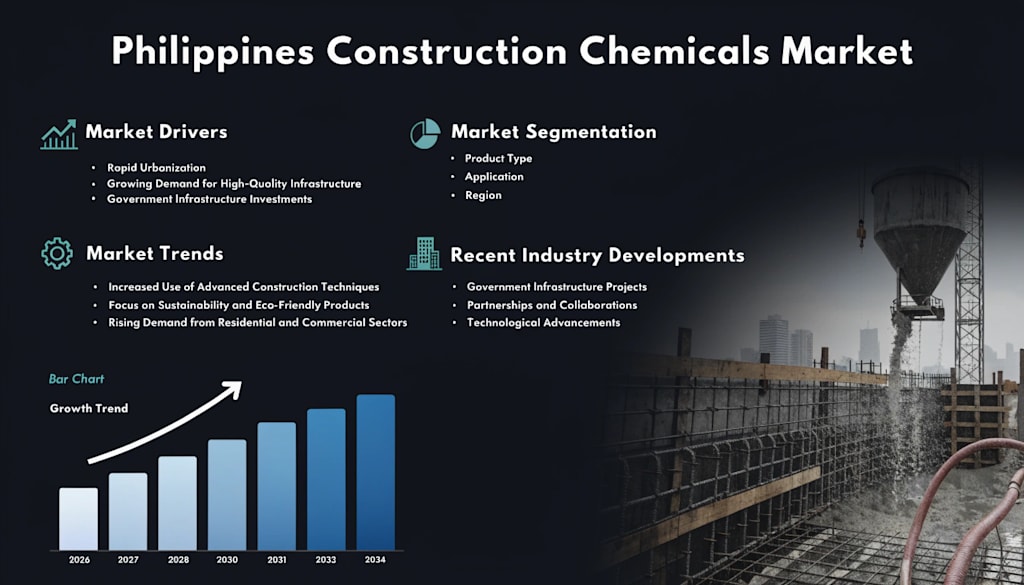
The Philippines construction chemicals market is expanding steadily as infrastructure contractors, residential developers, and industrial facility owners increasingly deploy high performance specialty chemicals to accelerate project timelines, extend the service life of buildings and public works, and meet tightening environmental standards. Construction chemicals—including concrete admixtures, waterproofing systems, repair mortars, flooring compounds, sealants, adhesives, and protective coatings—have become essential inputs for everything from high rise condominiums in Metro Manila to strategic toll roads and bridges in the regions. According to IMARC Group, the market size reached USD 919.47 Million in 2025 and is projected to reach USD 1,392.91 Million by 2034, exhibiting a compound annual growth rate (CAGR) of 4.72% during 2026–2034.
What’s Driving Market Growth?
Massive Government Led Infrastructure Pipeline. The administration’s Build Better More (BBM) program continues to be the single largest driver of construction chemical demand. In 2025, 124 new projects were added to the country’s Public Private Partnership (PPP) pipeline, bringing the total to 251 projects with an estimated value of ₱2.81 trillion ($47.4 billion). The Department of Budget and Management released ₱46.22 billion for connectivity and mobility projects across the regions, including the Davao City Bypass Construction Project which received over ₱288 million for fiscal year 2026. The NEDA Board has also given the green light to major BBM projects such as the TPLEX Extension and the PBBM Bridges Project, reinforcing the demand for high performance admixtures, waterproofing membranes, and corrosion resistant coatings on large scale civil engineering works.
Robust Residential and Commercial Construction. Rapid urbanization and a persistent housing backlog are pushing residential construction to record levels. The construction market is expected to grow 8.4% annually to reach PHP 1.94 trillion in 2026, following a historic CAGR of 11.8% during 2020 2024. In January 2026 alone, the Philippines issued building permits for 13,577 constructions; residential buildings accounted for roughly 50% of the total floor area. The proliferation of condominium towers, mixed use developments, and large scale subdivision projects directly increases the uptake of concrete admixtures, flooring chemicals, and sealants.
Sustainable and Green Construction Practices. The enforcement of the Philippine Green Building Code is shifting developer preferences toward low VOC adhesives, water based coatings, and bio based admixtures. Sustainable construction chemicals not only help meet environmental regulations but also enhance building durability and energy efficiency. The global sustainable construction chemicals market is projected to grow at about 6.5% CAGR through 2034, and the Philippines is expected to follow this trajectory as more private developers pursue green building certifications.
Technological Advancements & Specialty Formulations. Rapid advances in material science are reshaping the sector. Nanotechnology based coatings, smart waterproofing systems, and even self healing concrete solutions are entering the market—offering longer lifespans and lower maintenance costs. Adoption of digital tools such as Building Information Modeling (BIM) enables more accurate material application, further increasing the value of advanced construction chemicals.
Market Segmentation & Key Insights
By Type, the market is segmented into concrete admixtures, waterproofing and roofing, repair materials, flooring, sealants and adhesives, and others. Concrete admixtures—including superplasticizers, accelerators, and retarders—account for the largest share, driven by the scale of infrastructure and residential projects that demand high strength, workable concrete.
By Application, the market is divided into residential and non residential segments. Non residential applications currently lead, fueled by major infrastructure and commercial construction, but the residential segment is growing quickly due to the government’s housing initiatives and private sector condominium development.
By Region, major zones are Luzon, Visayas, and Mindanao. Luzon dominates due to the concentration of infrastructure flagship projects, industrial zones, and the Metro Manila conurbation; however, Visayas and Mindanao are seeing accelerated activity as road, bridge, and irrigation works expand nationwide.
By Distribution Channel, products reach end users through specialty chemical distributors, hardware chains, direct project supply, and e commerce platforms—with direct supply growing in importance for large scale government tenders.
What the Opportunities Are?
Green & Low Carbon Formulations. The shift toward eco friendly construction creates substantial opportunity for low carbon cement additives, recycled content waterproofing, and plant based sealants. Developers increasingly seek solutions that support LEED or BERDE certification, and companies that can certify their products’ environmental footprint will capture premium segments. Taiheiyo Cement’s shift to blended cement using industrial by products like fly ash is one example of how sustainable positioning is becoming a market differentiator.
AI Powered Supply Chain & Smart Manufacturing. While direct AI application in chemical formulation remains nascent, AI is already improving supply chain management, demand forecasting, and inventory optimization. Philippine based or regional manufacturers that invest in predictive analytics, dynamic pricing tools, and automated quality control systems will gain cost advantages and more reliable delivery performance.
High Performance Concrete Admixtures. The expansion of the Bataan and Malvar data center corridors—each requiring specialized high performance flooring and precision leveling chemicals—represents an emerging high margin opportunity. The construction of two data centers in Malvar and another in Bataan province demands ultra flat floors, static dissipative coatings, and high strength admixtures, creating a specialized sub market for advanced chemical solutions.
Repair & Retrofitting Solutions. The Philippines has an aging inventory of public buildings, bridges, and irrigation facilities. For example, the ₱455 million PAMANA program is rehabilitating infrastructure in conflict affected areas. Repair mortars, corrosion inhibitors, structural strengthening epoxies, and rapid setting patching compounds will see sustained demand as the government shifts toward maintenance and resilience spending.
Foreign Investment & Localization. Increasing foreign investor interest in Philippine manufacturing is opening doors for joint ventures and technology transfer. The construction chemicals segment has already attracted significant global players: Switzerland’s Sika opened a ₱980 million plant in Taguig producing adhesives and sealants, while Fosroc expanded its presence through Prime Star Global as its official distributor. Local manufacturers such as Magna Prime Chemical Technologies (parent of Buildrite and Maxbond) and Chryso Philippines are also scaling up.
Recent News and Developments in Philippines Construction Chemicals Market
April 2026: The PPP Center reported that 124 new projects were added to the national PPP pipeline in 2025—nearly doubling the previous total—bringing the overall project value to ₱2.81 trillion ($47.4 billion), reinforcing the long term demand outlook for construction chemicals.
March 2026: JICA announced additional financing for the Metro Manila Subway Project (MMSP), one of the country’s most complex underground transit systems, which will require substantial volumes of high performance waterproofing and grouting chemicals.
February 2026: President Marcos rolled out investment and relief measures that indirectly boost the construction sector, including the streamlining of tariff and logistics procedures, creating a more predictable environment for construction material procurement.
February 2026: The Bureau of Customs enforced Cement Safeguard Duties (CMC 42 2026) to protect local manufacturing capacity, a move that supports the broader construction supply chain by ensuring stable local cement and construction chemical demand.
December 2025: Sinclair Paint and Buildrite Construction Chemicals (both under Magna Prime) partnered with the Philippine Institute of Architects – Quezon City Section at their 2025 General Membership Meeting, underscoring the industry’s focus on professional education and specification development.
November 2025: The Philippine Department of Environment and Natural Resources (DENR) proposed adding 59 new chemical substances to the Philippine Inventory of Chemicals and Chemical Substances (PICCS), signaling tighter regulatory oversight that will favor manufacturers already investing in compliance and green chemistry.
July 2025: Taiheiyo Cement Philippines Inc. announced it is on track to open its ₱3.72 billion Batangas cement terminal by early 2026. The facility is designed to supply up to 700,000 tonnes per annum of blended cement—a more environmentally friendly alternative that is expected to boost the market for compatible concrete admixtures.
Why Should You Know About Philippines Construction Chemicals Market?
You should know about this market because it captures how government led infrastructure expansion, residential construction demand, and environmental regulation intersect to create steady, multi year growth for specialty chemical suppliers. Construction chemicals are no longer mere industrial auxiliaries—they are essential performance enablers that determine how quickly a bridge can be opened, how long a building will resist tropical corrosion, and whether a high rise can meet international sustainability standards.
For investors, the construction chemicals market offers exposure to a stable growth industrial segment anchored in the Philippines’ multi trillion peso infrastructure pipeline, expanding real estate development, and the accelerating adoption of green building codes. The projected CAGR of 4.72% reflects dependable baseline demand, while high growth sub segments—including eco friendly admixtures, AI optimized supply chains, and repair & retrofitting formulations—offer differentiated upside potential.
For contractors, developers, chemical distributors and technology partners, understanding construction chemical segmentation, regulatory trends, manufacturer capabilities, and emerging green formulation requirements helps shape intelligent procurement decisions, project specifications, and strategic alliances that deliver measurable durability, safety and environmental performance.
In essence, the Philippines construction chemicals market captures how construction scale, material science innovation, and climate resilience converge—making it a compelling area for investors, manufacturers, and project developers seeking smarter approaches to Philippine infrastructure and building excellence.
About the Creator
Thomas
Market Research Analyst | Industry Trends & Forecasting | Turning market data into clear, actionable business insights across global sectors.
Enjoyed the story? Support the Creator.
Subscribe for free to receive all their stories in your feed.
Comments
There are no comments for this story
Be the first to respond and start the conversation.