
Philippines Commercial Vehicles Market 2026: Infrastructure Surge, Logistics Expansion & Green Mobility Shift
How major public works, e commerce growth and electrification incentives are reshaping the Philippines' commercial transport sector

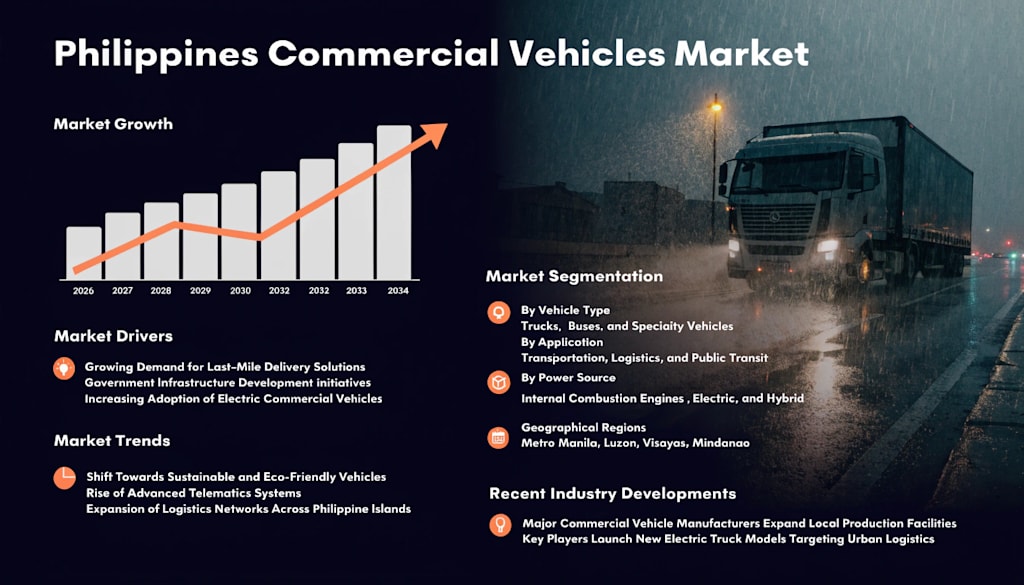
The Philippines commercial vehicles market is expanding steadily as construction fleets, logistics operators and public transport providers increasingly invest in robust, fuel efficient and environmentally compliant transport solutions. Commercial vehicles — including light duty trucks, medium duty carriers, heavy duty dump trucks, buses, vans and pick ups — are deployed across infrastructure projects, last mile delivery networks, public utility routes and agricultural supply chains to support the nation's rapid development. According to IMARC Group, the market size reached USD 17,206.37 Million in 2025 and is projected to reach USD 22,935.22 Million by 2034, exhibiting a compound annual growth rate (CAGR) of 3.24% during 2026–2034. As the government pushes forward with its "Build Better More" infrastructure programme and e commerce transforms domestic logistics, durable and technologically advanced vehicles have become indispensable for keeping the Philippine economy moving.
What's Driving Market Growth?
Sustained Infrastructure Spending Under "Build Better More". The Philippine government has committed heavily to public works and transport connectivity, creating direct demand for heavy duty and specialised vehicles. The Department of Economy, Planning and Development has 209 infrastructure flagship projects (IFPs) in its pipeline with a combined project cost of ₱10.52 trillion — a clear signal of sustained construction activity . Among these, physical connectivity accounts for the largest number of projects (140) costing ₱8.993 trillion, covering expressways, roads and bridges . The Budget of the Philippines for 2025 allocated ₱1.645 trillion (or 5.7 percent of GDP) to infrastructure, funding railways, airport expansions and port upgrades that necessitate dump trucks, concrete mixers and other construction grade vehicles .
E Commerce Expansion & Last Mile Logistics Boom. The rapid growth of online retail and digital commerce has dramatically increased demand for light commercial trucks, vans and specialised delivery vehicles. The light commercial truck market is being propelled by the expansion of e commerce, logistics and small scale businesses, with these vehicles providing efficient transportation solutions for last mile delivery and urban freight distribution . The Philippine Postal Corporation (PHLPost) introduced new trucks to offer enhanced e commerce and logistics delivery services for the government and private sector, confirming that the newly acquired postal vehicles will beef up the logistics delivery business of the postal service .
Public Utility Vehicle Modernization Program (PUVMP). The government is systematically modernising the country's public transport fleet, replacing traditional jeepneys and dilapidated buses with modern, road worthy and environmentally compliant alternatives. The PUVMP requires LGUs to develop Local Public Transport Route Plans that specify required numbers of modern PUV units, creating a steady stream of demand for new buses and utility vehicles . This fleet upgrade programme encourages better road safety, improved fuel efficiency and the adoption of greener technologies .
Official Development Assistance (ODA) & International Funding. Bilateral and multilateral partners continue to support Philippine infrastructure development. Notably, the Japan International Cooperation Agency (JICA) is funding the Metro Manila Subway Project, while the Asian Development Bank and World Bank are co financing various road and bridge initiatives. ODA projects often specify vehicles as part of programme implementation or disaster response prepositioning, providing additional demand channels for commercial vehicles.
Market Segmentation & Key Insights
By Vehicle Type, the Philippines commercial trucks market covers light duty carriers, medium duty carriers and heavy duty carriers . Light duty trucks dominate in volume, driven by e commerce delivery and small scale business use, while heavy duty carriers see strong demand from construction and mining sectors.
By Application, key segments include construction, mining and excavation, freight carriage and other transport applications . Construction holds the largest share, reflecting the government's infrastructure push and private sector real estate activity.
By End User, the market serves commercial fleets and government fleets . Commercial fleet operators represent the majority, but government fleet purchases — particularly for LGU service vehicles and national agency transport — also contribute significantly.
By Region, Luzon — especially Metro Manila, Calabarzon and Central Luzon — accounts for the largest share due to high economic activity and infrastructure concentration. However, Visayas and Mindanao are growing rapidly as regional development accelerates.
What the Opportunities Are?
Electrified Commercial Vehicles & Green Fleets. The shift toward sustainable transport is accelerating, with EV sales surging 36.2 percent to 11,800 units in Q1 2026, raising the xEV market share to 11.1 percent of total vehicle sales . March 2026 alone saw battery EV sales skyrocket 485.9 percent month on month . Foton Motor Philippines introduced battery powered vans and trucks covering light, medium and heavy duty segments , while 2GO Group rolled out electric trucks in partnership with Eclimo Electric Management . The government's Electric Vehicle Incentive Strategy (EVIS) aims to roll out up to nine million EVs between 2028 and 2040 , with EVs already exempted from number coding schemes . Opportunistic suppliers will capture early mover market share.
Truck Financing & Leasing Models. Small scale entrepreneurs and independent operators often struggle with upfront capital for fleet acquisition. Rental and lease to own programmes for delivery vans and light trucks present significant expansion potential. Flexible financing solutions backed by government loan programmes and private partnerships can unlock demand among SMEs who would otherwise rely on used, less reliable vehicles.
After Sales Services & Parts Distribution. As vehicle parc expands, so does the need for reliable maintenance, spare parts and warranty services. Suppliers who invest in authorised service centres, genuine parts networks and mobile servicing units — delivering support across Luzon, Visayas and Mindanao — will build lasting customer loyalty and generate recurring post sale revenue streams.
Local Assembly & Body Building. TMA member companies have expressed commitment to supporting local body application manufacturing and parts suppliers to strengthen the automotive value chain . Companies that partner with local assemblers or establish CKD assembly facilities can qualify for government incentives (such as those under the CARS and EVIS programmes) while reducing import related costs and improving supply chain resilience.
Smart Fleet Management Solutions. Fleet telematics, GPS tracking, route optimisation software and driver safety analytics are growing in importance as operators seek to reduce fuel consumption and improve efficiency. Technology providers offering integrated hardware software solutions for fleet management will find a receptive market among logistics firms and government transport agencies.
Recent News and Developments in Philippines Commercial Vehicles Market
April 2026: The combined CAMPI TMA report revealed that commercial vehicle sales fell 7.8 percent to 85,491 units in Q1 2026 against the prior year, but the sector remained the dominant segment, accounting for the vast majority of total industry sales .
April 2026: President Marcos rolled out relief measures for truckers and shipping operators, including dramatic cuts to terminal fees — slashing roll on roll off fees to just ₱1 for agricultural goods vehicles — along with toll fee waivers for DA accredited cargo trucks . MMDA and LGUs also exempted essential goods vehicles from truck bans .
March 2026: MMDA Resolution No. 26-07 reinstated truck ban exemptions for vehicles transporting essential and perishable goods, following coordination with the Department of Energy and Department of Trade and Industry . The suspension helps ease logistical constraints for commercial vehicle operators during the Middle East induced energy crisis.
February 2026: TMA expressed strong optimism for truck sales in 2026, citing heavy infrastructure spending and consistent economic activity nationwide. TMA President Robert Carlos stated: "Having achieved our industry truck sales targets in 2025, we are confident about the positive outlook for 2026" .
February 2026: Truck sales data for 2025 revealed that 370,722 commercial vehicles were sold, accounting for nearly 80 percent of the automotive industry's total sales . Heavy duty trucks and buses surged by 20.5 percent to 888 units from 737 in the prior year .
October 2025: Pioneer Trucks Philippines was appointed exclusive distributor of Maxus commercial trucks, debuting two all electric models — the ES80 6 Wheeler (2.5 ton payload, 302 km range) and the T1 (4 ton payload, up to 510 km range) — at the 2025 EVAP Summit .
September 2025: Foton Motor Philippines launched its full lineup of battery powered vans and trucks, including the Traveller Sierra EV (303 km range), the Tornado 3.6 EV and the EST 6x4 Tractor Head EV for long haul freight .
Why Should You Know About Philippines Commercial Vehicles Market?
You should know about this market because it illustrates how infrastructure priorities, logistics transformation and green mobility mandates intersect to create stable growth opportunities in one of Southeast Asia's most dynamic consumer and industrial economies. Commercial vehicles are no longer just basic transportation tools — they are mission critical assets that help construction firms complete public works on schedule, enable e commerce platforms to deliver in mere days, and support government modernisation programmes that improve mobility for millions of Filipinos.
For investors, the commercial vehicles market offers exposure to a resilient growth industrial category anchored in the government's multi trillion peso infrastructure pipeline, the relentless expansion of online retail and the accelerating shift toward electric fleets. The projected CAGR of 3.24% reflects steady baseline demand, while high growth sub segments — including electric vans, truck leasing and after sales services — offer differentiated upside potential.
For fleet operators, logistics providers, construction firms, technology partners and policy planners, understanding commercial vehicle segmentation, infrastructure driven demand cycles, EV incentive frameworks and financing models helps shape intelligent investment decisions, fleet acquisition strategies and service offerings that deliver measurable operational efficiency and competitive advantage. In essence, the Philippines commercial vehicles market captures how nation building, digital commerce and sustainable transport converge — making it a compelling area for innovators, investors and organisations seeking smarter approaches to mobility, freight distribution and long term economic connectivity.
About the Creator
Thomas
Market Research Analyst | Industry Trends & Forecasting | Turning market data into clear, actionable business insights across global sectors.
Enjoyed the story? Support the Creator.
Subscribe for free to receive all their stories in your feed.
Comments
There are no comments for this story
Be the first to respond and start the conversation.