
Philippines Co-Working Office Space Market 2026: Hybrid Work Culture, Startup Growth & Flexible Workspace Demand Driving Expansion
How remote work adoption, digital entrepreneurship, and modern office solutions are transforming the Philippines co-working office space industry

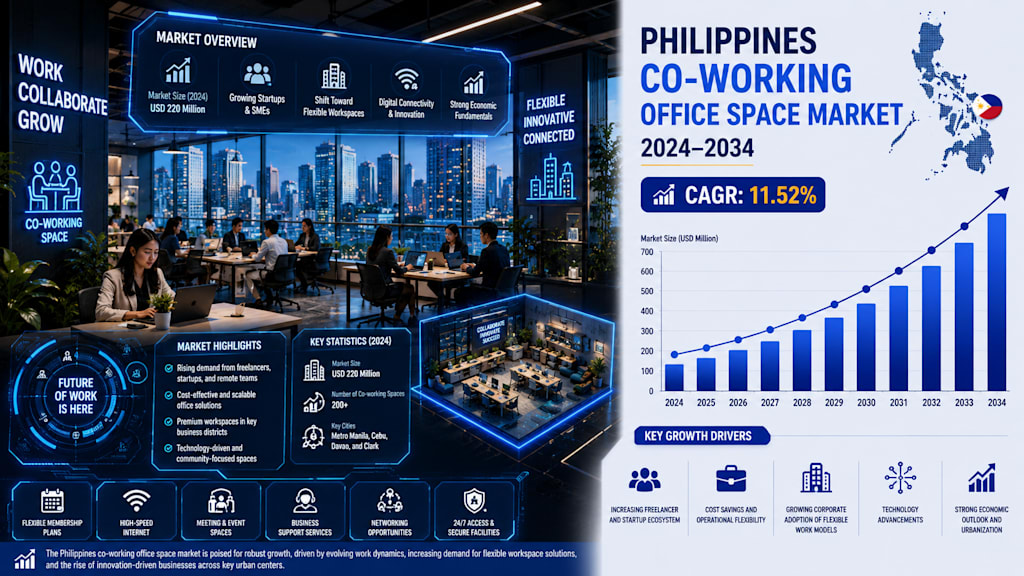
Philippines Co-Working Office Space Market Overview
The Philippines co-working office space market is a rapidly expanding segment of the country’s commercial real estate and flexible workspace industry, offering shared office environments, managed workspaces, virtual offices, and collaborative business facilities for startups, freelancers, SMEs, and large enterprises.
According to IMARC Group, the Philippines co-working office space market size reached USD 187.0 Million in 2025 and is projected to reach USD 513.4 Million by 2034, exhibiting a compound annual growth rate (CAGR) of 11.52% during 2026–2034.
The market is witnessing strong growth driven by rising adoption of hybrid work models, increasing startup and entrepreneurial activity, expanding digital business ecosystems, and growing demand for flexible and cost-efficient office solutions.
Key Market Drivers
Rising Adoption of Hybrid and Remote Work Models
Businesses are increasingly implementing flexible work arrangements, boosting demand for co-working spaces that offer scalable and collaborative office environments.
Growth of Startups and Freelance Professionals
The expansion of the startup ecosystem, digital entrepreneurship, and gig economy workforce is significantly contributing to demand for affordable shared office solutions.
Increasing Demand for Cost-Efficient Office Infrastructure
Companies are increasingly preferring flexible workspace models that reduce long-term leasing commitments and operational expenses.
Expansion of IT-BPM and Digital Industries
The growth of the IT, outsourcing, fintech, and digital services sectors is supporting demand for modern co-working environments equipped with advanced digital infrastructure.
Rising Urbanization and Commercial Development
Rapid urban growth and expansion of business districts across major Philippine cities are encouraging development of premium flexible office spaces.
Request a Sample Report with the Latest 2026 Data & Forecasts
What the Opportunities Are
Expansion of Enterprise Co-Working Solutions
Large corporations are increasingly adopting managed office and hybrid workspace solutions to improve workforce flexibility and optimize operational costs.
Growth of Smart and Tech-Enabled Workspaces
Co-working operators are integrating IoT systems, smart access controls, AI-powered facility management, and digital collaboration tools to enhance user experiences.
Increasing Demand for Niche and Industry-Specific Spaces
Specialized co-working environments tailored for creative industries, technology startups, healthcare professionals, and remote teams are creating new growth opportunities.
Development of Tier-2 and Emerging City Markets
Co-working providers are expanding beyond Metro Manila into secondary cities to address growing regional business demand.
Rising Focus on Wellness and Sustainable Office Design
Operators are increasingly investing in eco-friendly workspaces, wellness amenities, and productivity-focused office environments.
Recent News and Developments
May 2026: The Philippines co-working office space market continues expanding as hybrid work models and startup activity drive demand for flexible office solutions. Businesses are increasingly shifting away from traditional long-term office leases toward scalable workspace arrangements that reduce operational costs and support remote collaboration. Metro Manila, Cebu, and Davao remain the primary hubs for co-working expansion.
April 2026: Flexible workspace providers are increasingly expanding beyond Metro Manila into secondary cities and emerging business districts. Co-working operators are targeting locations such as Clark, Iloilo, and Cagayan de Oro as infrastructure development and decentralization trends encourage businesses to establish satellite offices closer to residential areas.
February 2026: The Philippine office market showed signs of recovery as co-working demand contributed to improving occupancy levels across Metro Manila. Colliers Philippines reported that Metro Manila office vacancy rates declined to approximately 19.4% in 2025, compared to 19.8% in 2024, while net office space take-up reached around 309,000 square meters, exceeding earlier forecasts. Shared services firms, global capability centers, and flexible workspace operators were among the key contributors to demand growth.
January 2026: Property developers and real estate companies continued increasing investments in flexible office infrastructure. Cebu Landmasters Inc. officially entered the co-working segment in January 2025 to capitalize on growing demand for hybrid workspace solutions, while Filinvest Land partnered with KMC Community to expand co-working operations across the Philippines.
December 2025: Technology integration and digital workplace solutions are becoming major competitive factors within the co-working industry. Operators are increasingly offering smart office systems, cloud-based collaboration tools, cybersecurity features, video conferencing facilities, and app-based workspace management systems to attract enterprise clients and remote workers.
2025–2026 (market trend): The Philippines co-working office space market is being shaped by hybrid work adoption, startup ecosystem growth, digital workplace technologies, and rising demand for flexible leasing models. Businesses are prioritizing cost efficiency, employee flexibility, and decentralized office strategies, while co-working operators continue expanding into mixed-use developments and suburban business districts. At the same time, market saturation in prime business locations, infrastructure limitations in emerging cities, and economic uncertainty remain key operational challenges across the sector.
Why You Should Know About the Philippines Co-Working Office Space Market?
The Philippines co-working office space market is becoming a major component of the country’s evolving commercial real estate and digital business ecosystem.
With projected growth from USD 187.0 Million in 2025 to USD 513.4 Million by 2034, the market demonstrates strong expansion potential driven by hybrid work trends, startup ecosystem growth, and increasing demand for flexible office solutions.
As businesses continue prioritizing agility, collaboration, and technology-enabled workplaces, co-working office spaces are expected to play a critical role in shaping the future of work across the Philippines.
About the Creator
Enjoyed the story? Support the Creator.
Subscribe for free to receive all their stories in your feed.
Comments
There are no comments for this story
Be the first to respond and start the conversation.