
Philippines Cloud Security Market 2026: Hybrid Migration, Zero Trust Surge & AI Defense Transformation
How regulatory mandates, cloud-first infrastructure and the BPO sector's security demands are driving exponential cloud security growth in the Philippines

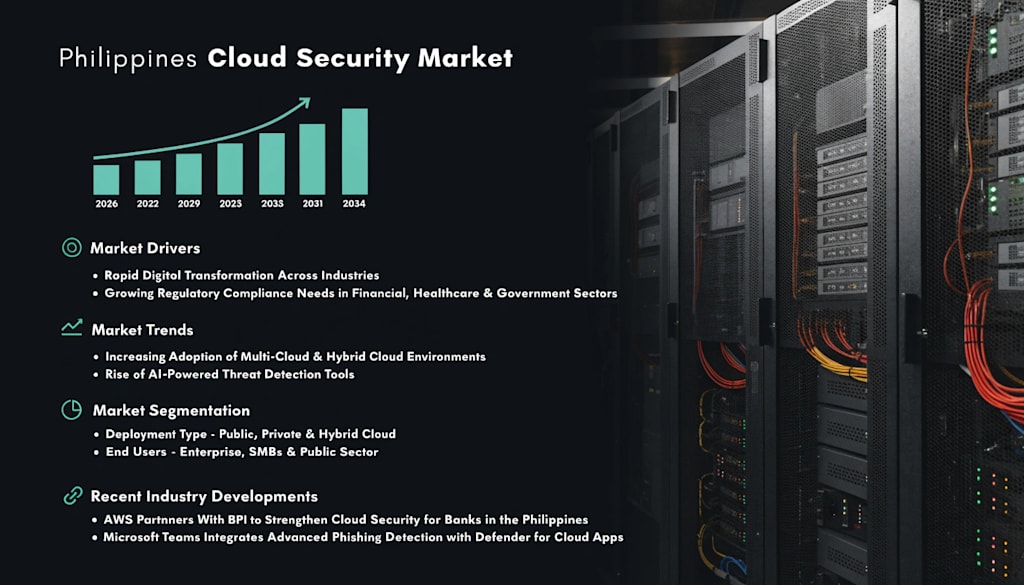
The Philippines cloud security market is undergoing explosive transformation as enterprises, government agencies and digital-native companies in the world's outsourcing and e-commerce hub race to secure rapidly expanding cloud footprints. Cloud security solutions — encompassing Identity and Access Management (IAM), Cloud Access Security Brokers (CASB), Security Information and Event Management (SIEM), Cloud Security Posture Management (CSPM), Zero Trust Architecture (ZTA) platforms and AI-driven threat intelligence systems — are deployed across BPO firms, banks, government offices, e-commerce platforms and telcos to protect sensitive data, ensure regulatory compliance and defend against increasingly sophisticated cyber threats. According to IMARC Group, the market size reached USD 1,752.44 Million in 2025 and is projected to reach USD 4,560.76 Million by 2034, exhibiting a robust compound annual growth rate (CAGR) of 11.21% during 2026–2034[8†L5-L7]. As the Philippines accelerates its digital transformation under national cloud-first policies, cloud security has moved from a discretionary IT expense to a mission-critical strategic imperative across every major industry vertical.
What's Driving Market Growth?
Rapid Cloud Adoption Across High-Value Sectors. The Philippines' overall cloud services market is witnessing exponential growth, driven by widespread digital transformation projects, growing SME adoption and hybrid work models, as both private enterprises and the public sector adopt digital-first strategies. The Philippines ICT market was valued at USD 27.2 billion in 2025 and is projected to reach USD 50.53 billion by 2031 at a CAGR of 10.88%. Banks, BPO companies, e-commerce sites and government-related institutions have adopted cloud computing for mission-critical applications in hybrid-cloud and multi-cloud settings. The Philippines cloud security market valued at USD 1.2 billion, driven by the increasing adoption of cloud services, heightened awareness of cybersecurity threats and the need for regulatory compliance among businesses.
Zero Trust Architecture (ZTA) Mandates Across Government and Finance. The National Cybersecurity Plan 2023 to 2028 sets a firm direction, requiring zero trust architecture for all government systems. The Bangko Sentral ng Pilipinas backs similar steps in banking, raising the standard for cybersecurity governance. Finance, BPO, healthcare and telecom sectors are moving first, shifting from simple perimeter models towards continuous checks, microsegmentation and strict least privilege rules. The Philippines Zero Trust Security Market is projected to grow from USD 25.6 billion in 2025 to USD 82.4 billion by 2031, at a CAGR of 21.7%.
Konektadong Pinoy Act and Mandatory Cybersecurity Compliance. The Konektadong Pinoy Act (Republic Act 12234), which lapsed into law in August 2025, is directed at the development of data transmission infrastructure and the removal of barriers to competition. Crucially, all new entrants must comply with baseline cybersecurity controls before operations begin under the direct supervision of the DICT and the Cybercrime Investigation and Coordinating Center (CICC). Data Transmission Infrastructure Providers must secure ISO-aligned cybersecurity certification within two years of registration. The government allocated approximately PHP 1.5 billion (around USD 27 million) for digital transformation initiatives, aiming to enhance cybersecurity frameworks and promote the adoption of cloud technologies across various sectors.
AI-Powered Cyber Threats and Defenses Becoming Mainstream. Nearly 78 percent of Philippine organizations encountered AI-powered cyber threats in the past year, with 64 percent reporting a twofold increase and 28 percent seeing a threefold surge in threat volume. In response, 92 percent of organizations in the Philippines are now using AI in their cybersecurity systems — proving it's no longer just a buzzword but a business necessity. Attackers are using AI to launch faster and stealthier attacks, exploiting blind spots in governance and internal processes. In response, more than nine in 10 organizations have integrated AI into security operations, using it not just for detection but also for automated response, predictive threat modelling and AI-driven incident management. Detection has become "table stakes," with response and orchestration emerging as the next frontier.
BPO Industry Driving Premium Security Demand. The IT and Business Process Management (IT-BPM) industry in the Philippines generates 38billioninindustryrevenue,employs1.82millionITprofessionalsandoffers60−7038billioninindustryrevenue,employs1.82millionITprofessionalsandoffers60−705.8 billion in export revenue and employs more than 180,000 Filipinos. The BPO industry requires stringent security certifications to maintain contracts with international clients, driving substantial demand for compliance-focused solutions. BPO operations need more flexible infrastructure, and cloud platforms now carry the daily load for a growing number of organizations.
Alarming Surge in Cyber Incidents. The Philippines has seen a significant rise in cyber threats, with reported incidents increasing by 30% in the current year, according to the DICT. Cyber-related complaints crossed 20,000 cases in 2023, signaling escalating enterprise exposure. This surge has prompted businesses to invest heavily in cloud security solutions, with an estimated 60% of organizations prioritizing cybersecurity in their budgets. Healthcare organizations are accelerating cybersecurity spending following high-profile ransomware incidents that exposed vulnerabilities in patient data protection.
Market Segmentation & Key Insights
By Component, solutions dominate the Philippines cybersecurity market with a share of 52% in 2025, owing to the comprehensive protection capabilities offered by integrated security platforms that address endpoint security, network defense and vulnerability management. Enterprises increasingly prefer all-in-one security suites that streamline operations. Within the cloud security segment specifically, Identity and Access Management (IAM) is the leading sub segment due to its critical role in ensuring secure access to cloud resources and compliance with regulations.
By Deployment Type, on premises leads the Philippines cybersecurity market with a share of 55% in 2025, driven by regulatory compliance requirements and data sovereignty concerns that compel enterprises, particularly in banking and government sectors, to maintain direct control over sensitive security infrastructure. However, cloud-based security deployment is the fastest growing segment as organizations increasingly embrace cloud-first strategies.
By User Type, large enterprises represent the biggest segment of the cybersecurity market with a share of 63% in 2025, reflecting substantial cybersecurity budgets, complex IT infrastructures requiring sophisticated protection and stringent regulatory obligations that mandate comprehensive security implementations. SMEs, which comprise 99.5 percent of Philippine businesses, are rapidly closing the gap as they bring more services online and connect additional devices.
By Industry Vertical, Banking, Financial Services and Insurance (BFSI) exhibits clear dominance in the cybersecurity market with 32% share in 2025, driven by the sector's handling of sensitive financial data, stringent central bank cybersecurity mandates and accelerating digital banking transformation requiring robust fraud prevention systems. BFSI-led cybersecurity spending is rising, driven by stricter regulations, digital banking growth and demand for real-time fraud detection.
By Region, Luzon is the largest region with 68% share in 2025, attributable to the concentration of corporate headquarters, financial institutions, technology companies and government agencies in Metro Manila and surrounding economic zones. Metro Manila, being the economic hub, hosts numerous enterprises and tech startups, while Cebu and Davao are emerging as key players due to their growing IT infrastructure and skilled workforce.
What the Opportunities Are?
AI Driven Security Operations and Autonomous Response. With 92 percent of organizations now using AI in cybersecurity systems and detection considered "table stakes," the next frontier is AI powered response and orchestration. Generative AI (GenAI) is being adopted for light touch tasks such as playbook execution, policy updates and social engineering detection. There is strong opportunity for security vendors to offer fully integrated AI driven security platforms that combine real-time threat detection, automated incident response and predictive threat modelling. The most in demand roles now include AI security engineers, data scientists and threat intelligence analysts, creating opportunities for managed security service providers specializing in AI security talent.
Zero Trust Architecture (ZTA) Implementation Services. With the government mandating ZTA for all government systems and BSP backing similar steps in banking, there is substantial demand for ZTA consulting, deployment and managed services. The Zero Trust Security Market in the Philippines is projected to grow at an explosive 21.7% CAGR to reach USD 82.4 billion by 2031. Finance, BPO, healthcare and telecom sectors moving first need partners for policy design, microsegmentation architecture, continuous validation tools and integration across hybrid-cloud environments.
Cloud Security Posture Management (CSPM) and Compliance Automation. As organizations adopt hybrid-cloud and multi-cloud configurations across AWS, Azure and local providers, misconfiguration detection and remediation become critical. Larger organizations and a growing number of smaller ones are putting CSPM tools to the test, as these platforms catch loose configurations and prevent compliance gaps from slipping through in mixed cloud environments. Automated compliance checks that align with the Data Privacy Act, BSP rules and international standards such as ISO and NIST are in high demand. Teams that adopted CSPM early report smoother audits and faster remediation times.
Managed Security Services for SMEs and Government. SMEs comprise 99.5 percent of Philippine businesses but many lack dedicated chief information security officers; only 6 percent of organizations have a dedicated CISO. This creates strong opportunity for subscription-based managed security services that bundle cloud security monitoring, incident response and compliance reporting. The shift from buying tools to building intelligence means organizations are prioritizing identity security, zero-trust frameworks and cloud protection over infrastructure-heavy investments.
Vendor Consolidation and Integrated Security Platforms. While the market features a dynamic mix of international vendors (Trend Micro, Palo Alto Networks, Fortinet, Cisco, Microsoft, Zscaler, Cloudflare, Okta) and regional participants, enterprise buyers are seeking platform consolidation. Demand is shifting from standalone tools toward integrated platforms that combine endpoint, network and identity layers. Multinational firms expanding BPO and fintech operations are requiring global-standard security frameworks with compliance mapping, multilingual support and regional threat intelligence.
Recent News and Developments in Philippines Cloud Security Market
June 2025: PhilSec 2025, the Philippines' premier security show, featured a comprehensive lineup of cyber themes — from Cloud Security and Zero Trust Architecture to Real-Time Threat Intelligence, DDoS Defense and AI-Driven Threat Detection — underscoring the growing sophistication of the local cybersecurity ecosystem.
July 2025: The Department of Information and Communications Technology (DICT) issued an official statement affirming that all new entrants under the Konektadong Pinoy Bill must comply with baseline cybersecurity controls before operations begin under direct supervision of DICT and the Cybercrime Investigation and Coordinating Center (CICC).
August 2025: The Konektadong Pinoy Act (RA 12234) lapsed into law, mandating cybersecurity audits by the DICT Cybersecurity Bureau and requiring ISO-aligned cybersecurity certification within two years for Data Transmission Infrastructure Providers.
August 2025: Tata Consultancy Services (TCS) launched SovereignSecure Cloud™, built on Zero Trust architecture and AI-driven governance, aligning with global trends toward data localization.
October 2025: The Philippines Cloud Security and Zero Trust SaaS Market report by Ken Research valued the market at USD 1.2 billion, driven by cloud adoption, cyber threats and regulations, with remote work and digital transformation further accelerating demand.
February 2025: Globe Telecom strengthened its cybersecurity portfolio by expanding automated security validation with advanced threat detection platforms tailored for Philippine enterprises, focusing on bundling security analytics with connectivity contracts.
2025: The Philippines cybersecurity market was valued at USD 1.4 Billion, projected to reach USD 2.8 Billion by 2034 at a CAGR of 8.08%, reinforcing the security ecosystem's rapid expansion that directly fuels the cloud security segment.
Why Should You Know About Philippines Cloud Security Market?
You should know about this market because it captures how regulatory transformation, digital infrastructure modernization and AI-powered threat evolution intersect to create one of the fastest growing security markets in Southeast Asia. Cloud security is no longer just a technical control — it is a strategic enabler that helps Philippine enterprises protect BPO client data, secure digital banking transactions, maintain government compliance and defend against AI generated attacks.
For investors, the cloud security market offers exposure to a high growth technology category anchored in the Philippines' massive IT-BPM industry, accelerating public cloud adoption across government, BFSI and SME sectors, and tightening regulatory mandates for zero trust and compliance certification. The projected CAGR of 11.21% — nearly double the growth rate of the broader cybersecurity market [8†L5-L7] — reflects strong confidence in cloud-specific security needs, technological differentiation and recurring service opportunities tied to managed security and subscription models.
For security vendors, technology partners, enterprise IT planners and government agencies, understanding cloud security segmentation, zero trust adoption drivers, AI defense integration and regulatory compliance pathways helps shape intelligent investment decisions, procurement strategies and solution designs that deliver measurable protection, compliance and business resilience outcomes.
In essence, the Philippines cloud security market captures how digital sovereignty, threat intelligence and regulatory enforcement converge — making it a compelling area for innovators, investors and organisations seeking smarter approaches to securing the cloud-first future of one of Asia's most dynamic digital economies.
About the Creator
Thomas
Market Research Analyst | Industry Trends & Forecasting | Turning market data into clear, actionable business insights across global sectors.
Enjoyed the story? Support the Creator.
Subscribe for free to receive all their stories in your feed.
Comments
There are no comments for this story
Be the first to respond and start the conversation.