
Philippines Clinical Laboratory Services Market 2026: Chronic Disease Burden, Digital Diagnostics & Healthcare Expansion
How rising disease prevalence, technological advancements, and universal healthcare initiatives are driving the Philippines clinical laboratory services industry

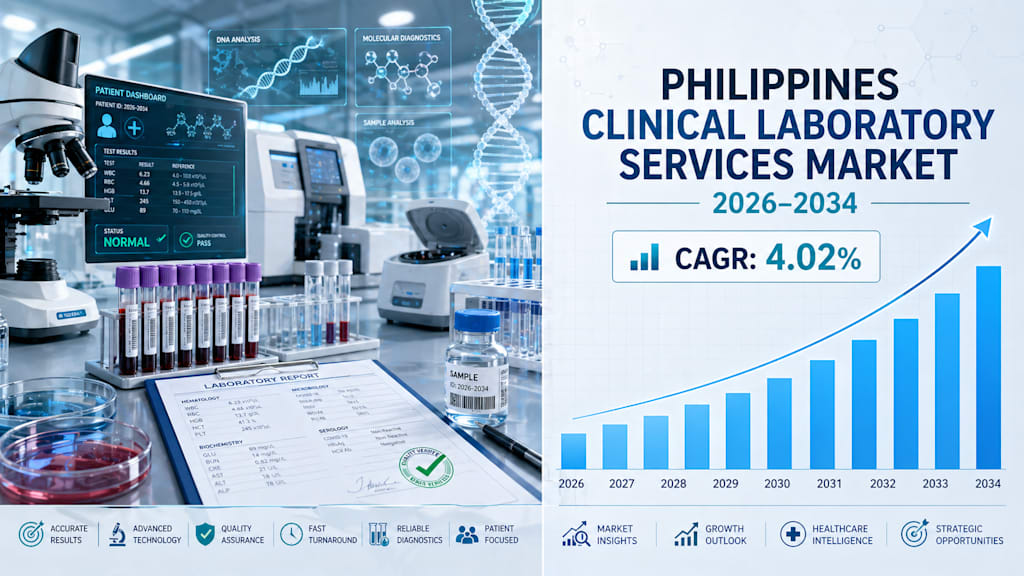
Philippines Clinical Laboratory Services Market Overview
The Philippines clinical laboratory services market is a vital segment of the country’s healthcare ecosystem, encompassing diagnostic testing services such as clinical chemistry, microbiology, genetics, and pathology. These services play a crucial role in disease detection, monitoring, and treatment planning.
According to IMARC Group, the Philippines clinical laboratory services market size reached USD 1.2 Billion in 2025 and is projected to reach USD 1.7 Billion by 2034, exhibiting a compound annual growth rate (CAGR) of 4.02% during 2026–2034.
The market is driven by increasing prevalence of chronic diseases, advancements in laboratory technologies, and expanding access to healthcare services through national insurance programs.
Key Market Drivers
Increasing Prevalence of Chronic Diseases
Rising cases of non-communicable diseases such as diabetes, cardiovascular conditions, and cancer are significantly increasing demand for diagnostic testing and regular monitoring services.
Advancements in Laboratory Technology and Automation
Technologies such as PCR, next-generation sequencing (NGS), and automated analyzers are improving diagnostic accuracy, speed, and efficiency, enabling laboratories to offer more advanced testing services.
Expansion of Health Insurance Coverage
The implementation of universal healthcare policies has expanded access to diagnostic services, increasing the number of patients undergoing laboratory tests and boosting overall market demand.
Growing Healthcare Infrastructure Investment
Government and private sector investments in hospitals, diagnostic centers, and healthcare facilities are strengthening laboratory service capacity nationwide.
Aging Population and Disease Pattern Shift
The increasing elderly population is driving demand for frequent health screenings, chronic disease monitoring, and specialized diagnostic services.
Request a Sample Report with the Latest 2026 Data & Forecasts
What the Opportunities Are
Integration of Digital Health and Laboratory Systems
The adoption of electronic health records (EHRs), laboratory information systems (LIS), and AI-based diagnostics is enhancing efficiency and enabling real-time data sharing across healthcare providers.
Growth of Personalized Medicine and Genetic Testing
Rising interest in precision medicine is creating demand for genetic testing, biomarker analysis, and targeted diagnostic services.
Expansion of Medical Tourism
The Philippines is emerging as a medical tourism destination, creating opportunities for laboratories to offer high-quality, internationally accredited diagnostic services.
Development of Mobile and Rural Laboratory Services
Innovative solutions such as mobile labs and point-of-care testing are helping expand access to diagnostic services in remote and underserved regions.
Increased Demand for Preventive Healthcare
Growing awareness of early disease detection is encouraging individuals to undergo routine health screenings and diagnostic tests.
Recent News and Developments
February 2026: Government policy is playing a major role in boosting laboratory demand. The PhilHealth Konsulta program covers 18 essential laboratory tests (such as blood count, urinalysis, and glucose testing) with no co-payment, significantly increasing utilization of diagnostic services. This shift is transforming lab testing from optional spending into a routine part of preventive healthcare, especially among lower-income populations.
January 2026: Technological transformation is accelerating in the sector, with increasing adoption of automation and advanced diagnostics such as PCR, next-generation sequencing (NGS), and AI-enabled lab systems. These technologies are improving efficiency, reducing turnaround times, and enabling high-throughput testing, allowing laboratories to handle rising patient volumes while maintaining accuracy.
2026 (industry structure update): The market remains moderately fragmented, with hospital-based laboratories dominating due to integrated patient access, while independent and reference laboratories are the fastest-growing segment with ~5.9% CAGR. Routine testing accounts for around 60% of total services, reflecting strong demand for basic diagnostics such as blood tests and metabolic panels.
2025–2026 (market trend): The Philippines clinical laboratory sector is being driven by rising healthcare awareness, with non-communicable diseases accounting for around 68% of total deaths, significantly increasing demand for diagnostic testing. At the same time, affordability remains a challenge, as 44.4% of healthcare spending is still out-of-pocket, which can limit testing frequency among some patients.
Why You Should Know About the Philippines Clinical Laboratory Services Market?
The Philippines clinical laboratory services market is a foundational component of the country’s healthcare system, supporting accurate diagnosis and effective treatment.
With projected growth from USD 1.2 Billion in 2025 to USD 1.7 Billion by 2034, the market demonstrates steady expansion driven by rising healthcare demand, technological innovation, and improved access to diagnostic services.
As healthcare systems continue to evolve toward preventive care and precision medicine, clinical laboratory services are expected to remain a critical pillar of the Philippines’ medical and diagnostic ecosystem.
About the Creator
Enjoyed the story? Support the Creator.
Subscribe for free to receive all their stories in your feed.
Comments
There are no comments for this story
Be the first to respond and start the conversation.