
Philippines Cat Food Market: Pet Humanisation, Condominium Culture & Digital Commerce
How a 10.5% annual feline population surge, rising urbanisation and the TikTok Shop effect are driving cat food adoption across the Philippines

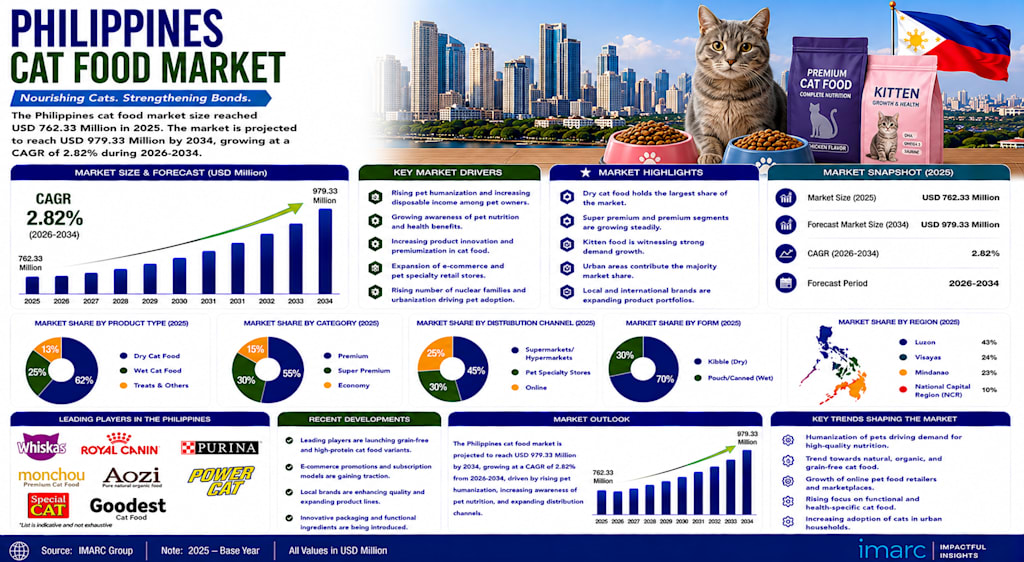
The Philippines cat food market is quietly but decisively undergoing a transformation. While dogs remain the dominant pet in terms of household penetration, the fastest-growing companion animal segment is cats. According to IMARC Group, the cat food market size reached USD 762.33 Million in 2025 and is projected to reach USD 979.33 Million by 2034, exhibiting a steady compound annual growth rate (CAGR) of 2.82% during 2026–2034. Beneath the headline numbers lies a more dynamic story: a structural shift in Filipino pet ownership patterns where small living spaces, dual‑income urban households, and the powerful cultural force of pet humanisation are rewriting the economics of feline nutrition.
What's Driving Market Growth?
Urbanisation and the Condominium Effect. The Philippines is experiencing a profound demographic shift that directly favours cats over larger pets. Between 2020 and 2024, the cat population grew at a CAGR of approximately 10.5%, with cats now numbering 2.74 million nationwide. The expansion of condominium developments in Metro Manila, Cebu and Davao has made cats the practical choice for young professionals, singles and newly married couples who live in space‑constrained apartments where dogs are less suited. Generation Z and millennials are the most pet‑centric generations in recent market research, and they increasingly treat their cats as family members rather than utilitarian animals. This cultural shift has driven a 5.2% compound annual growth in the cat population over the past four years, outpacing dogs.
Pet Humanisation and Premiumisation. Filipino cat owners are becoming increasingly discerning about feline nutrition, recognising cats as obligate carnivores with unique dietary requirements. Sales of premium dry cat food have surged in recent years, demonstrating growing willingness to invest in superior nutrition despite economic headwinds. Pet owners are actively seeking products with probiotics, taurine for heart and vision support, grain‑free options, and formulations devoid of artificial flavours and preservatives. Cat food's bright outlook is tied directly to the rising cat population and the strength of the pet humanisation trend, with cat food demand expected to grow at a 10.2% CAGR over the forecast period.
E‑Commerce and Digital Channel Explosion. The digital transformation of retail is revolutionising how Filipino pet owners discover and purchase cat food. Online purchases have grown significantly as digital literacy improves and smartphone penetration deepens. Major platforms — Shopee, Lazada, and the rapidly ascending TikTok Shop — have become primary distribution channels, offering convenience, competitive pricing and doorstep delivery unmatched by brick‑and‑mortar stores. TikTok Shop's in‑app shopping feature has become particularly popular among users aged 16‑34 who value seamless integration of content discovery and purchase transactions, often facilitated by influencer marketing and authentic product demonstrations. These platforms have also enabled smaller domestic brands and international premium players to reach consumers across the archipelago, including remote areas where physical pet stores are limited.
Expanding Domestic Manufacturing. Local manufacturing initiatives are reducing import dependency and offering competitively priced alternatives. Major Filipino companies have expanded into cat food, launching budget‑friendly and premium lines formulated to international standards. Other domestic players have entered the pet food market leveraging their expertise in export manufacturing to create affordable wet cat food formulas with essential nutrition at competitive price points. These domestic entrants are building a local supply chain that supports sustained market expansion and improved product availability across all price segments.
Market Segmentation & Key Insights
By Product Type, the market includes dry food, cat treats, and wet cat food. Dry food leads in volume share due to its cost‑effectiveness and convenience, while wet cat food maintains a significant presence, providing hydration benefits in the tropical climate.
By Pricing Type, the market is divided into mass products and premium products. Mass products dominate in volume, driven by price‑sensitive consumers, but premium products are the fastest‑growing segment as pet humanisation deepens in urban centres.
By Ingredient Type, the market covers animal derivatives and plant derivatives.
By Distribution Channel, key routes include supermarkets and hypermarkets, specialty stores, online stores, and others. While offline channels still account for the majority of sales, e‑commerce is the fastest‑growing channel, having increased its market share substantially between 2021 and 2025.
By Region, the market covers Luzon, Visayas and Mindanao. Luzon represents the largest market, driven by the concentration of urban condominium developments in Metro Manila and higher disposable incomes.
What the Opportunities Are?
Subscription‑Based Delivery Models for Urban Pet Owners. As e‑commerce matures, major pet food manufacturers are expected to introduce subscription‑based pet food delivery services to build brand loyalty among time‑constrained urban consumers. Subscription models that combine automatic replenishment, personalised recommendations and loyalty rewards represent a scalable, high‑margin growth avenue.
Affordable Premium Formulations Bridging the Price Gap. Economic constraints remain a formidable challenge, with only a small percentage of cats in the Philippines fed commercial pet food. There is substantial opportunity for manufacturers to develop mid‑priced products that bridge the gap between economy dry food and premium imported brands. Products that deliver functional benefits — taurine enrichment, urinary tract health, joint support — at accessible price points can capture the large underserved segment of budget‑conscious pet owners who are gradually shifting from table scraps to commercial options.
Targeted Education Campaigns Through Veterinary and Digital Channels. The severe shortage of veterinary professionals severely limits access to professional guidance on feline nutrition. There is strong opportunity for manufacturers to invest in consumer education campaigns delivered through social media, in‑store demonstrations, and partnerships with veterinary associations. Content that demonstrates the long‑term health benefits and cost‑effectiveness of balanced feline nutrition can address the widespread practice of feeding cats table scraps.
Private Label and Sachet Packaging for Rural Expansion. In grocery retail, small local stores are gaining importance, especially among budget‑conscious consumers, providing affordable, repackaged products sold by weight. Manufacturers that offer sachet‑packaged products or private label solutions for these outlets can capture the rural and peri‑urban segments where commercial pet food penetration remains low.
Hypoallergenic and Functional Ingredient Innovation. There is an increasing shift toward hypoallergenic formulations in pet food products among Filipino pet parents. Brands that develop products targeting specific feline health concerns — urinary tract health (a common issue in cats), obesity management, and skin allergies — can differentiate in a market where veterinary guidance is scarce and owners seek self‑managed solutions.
Recent News and Developments in Philippines Cat Food Market
2025: Increased cat ownership continued to fuel growth, with a leading brand maintaining its leadership through mid‑priced offerings backed by innovation. Pet shops and superstores remain the go‑to option for cat food, though e‑commerce is steadily gaining ground.
2025: The Bureau of Animal Industry continued to warn the public against unregistered pet food products sold on e‑commerce platforms, underscoring the rapid expansion of online pet food sales and the regulatory challenges that accompany it.
2025: Major retail groups accelerated pet retail store openings, enhancing merchandise assortment and introducing grooming services to drive category growth. Warehouse clubs expanded their footprint, introducing bulk‑pack purchasing that reduces per‑unit costs for price‑sensitive consumers.
2025: The total pet population in the Philippines reached an estimated 68.1 million, up 15.1% since 2021, with cats numbering 2.74 million.
Why Should You Know About Philippines Cat Food Market?
You should know about this market because it captures how demographic shifts, lifestyle trends and digital commerce are quietly reshaping one of Southeast Asia's most dynamic pet care economies. The Philippines cat food market is no longer a dog‑dominated story — it is a market where the cat population has grown at 10.5% annually, where condominium culture in Metro Manila and Cebu has made felines the pet of choice for space‑constrained urbanites, and where TikTok Shop has turned impulse pet food purchases into a daily digital habit. Yet the market remains profoundly underpenetrated: only a small fraction of cats are fed commercial pet food. This gap between emotional humanisation (treating cats as family) and actual nutritional investment represents the single largest growth opportunity in the category.
For investors, the cat food market offers exposure to a steady‑growth consumer goods category anchored in rising urbanisation, a young and digitally native pet‑owning population, and the accelerating shift from table scraps to prepared food across both economy and premium segments. The projected CAGR of 2.82% for the cat‑specific market underestimates the opportunity for well‑positioned brands, as cat food demand is growing at over 10% within the broader pet food sector.
For pet food manufacturers, distributors, e‑commerce strategists and agricultural investors, understanding the segmentation between dry and wet food, the economics of premium versus mass products, and the unique constraints of consumer education and price sensitivity helps shape intelligent product development, channel strategies and marketing investments that deliver measurable adoption, loyalty and health outcomes.
In essence, the Philippines cat food market captures how urban density, digital convenience and emotional connection converge — making it a compelling area for investors, brands and entrepreneurs seeking smarter approaches to feline nutrition, consumer education and sustainable growth across one of the region's most rapidly evolving pet ownership landscapes.
About the Creator
Thomas
Market Research Analyst | Industry Trends & Forecasting | Turning market data into clear, actionable business insights across global sectors.
Enjoyed the story? Support the Creator.
Subscribe for free to receive all their stories in your feed.
Comments
There are no comments for this story
Be the first to respond and start the conversation.