
Philippines Cargo Handling Equipment Market 2026: Port Mega Projects, Air Cargo Corridors & Smart Logistics
How the $800 M Batangas terminal, Clark Airport’s second runway and AI powered material handling are transforming the Philippines’ logistics backbone

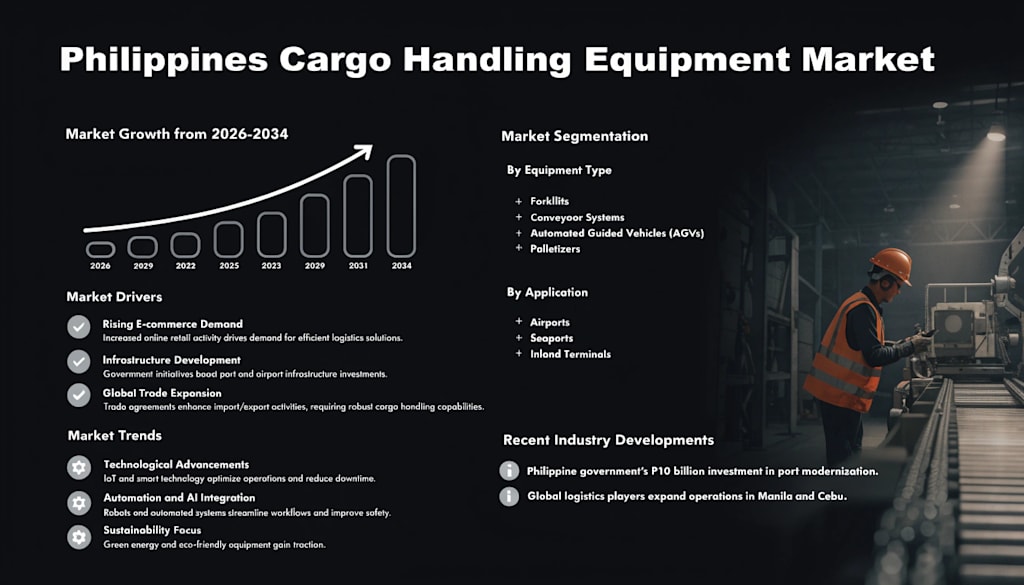
The Philippines cargo handling equipment market is expanding at a steady pace as seaport operators, airport logistics hubs and warehouse developers increasingly invest in modern cranes, automated guided vehicles and AI enabled material handling solutions. Cargo handling equipment — including industrial trucks, port cranes, stackers, tow tractors, conveying systems and forklifts — is deployed across marine terminals, air cargo facilities, road rail intermodal yards and distribution centres to load, unload and store the rising volume of goods that moves through the country’s trade dependent economy. According to market estimates, the Philippines cargo handling equipment market size reached USD 651.63 Million in 2025 and is projected to reach USD 959.02 Million by 2034, exhibiting a compound annual growth rate (CAGR) of 4.39% during 2026 2034.
Cargo handling equipment is the invisible backbone of Philippine trade. Without it, containers pile up at Manila’s gates, perishables spoil at airport warehouses and e commerce orders fail to reach customers on time. As the government pushes deeper into its “Build Better More” infrastructure drive and private terminal operators spend billions on automation and port expansion, the country’s cargo handling fleet is undergoing a fundamental transformation from manual, diesel powered machines to smart, electric and data driven systems.
What’s Driving Market Growth?
Government Infrastructure Investment at Record Levels. The Philippine government’s unprecedented commitment to infrastructure development stands as the primary catalyst for cargo handling equipment demand. Through the Build Better More programme, the administration allocated over USD 26 billion to infrastructure projects in 2025, representing more than five percent of national GDP. The 2026 National Expenditure Programme earmarks ₱1.5 trillion (roughly 5.0% of GDP) for infrastructure, maintaining high speed construction while navigating fiscal consolidation. The comprehensive initiative encompasses 207 Infrastructure Flagship Projects valued at PHP 10.2 trillion (USD 176.7 billion), targeting ports, airports, railways and intermodal facilities that directly drive demand for cargo handling equipment across the archipelago. The Luzon Economic Corridor, which represents approximately 50 percent of GDP, further concentrates logistics investment in the country’s economic engine.
Port Expansion Mega Projects Driving Equipment Modernisation. The Philippines, an archipelago heavily dependent on maritime transport, is witnessing historic investments in port infrastructure. The Manila South Harbor has undergone a ₱5.7 billion private sector upgrade by Asian Terminals Inc. and DP World, extending Pier 3’s berth to over 600 metres, expanding yard capacity to accommodate 20,000 TEUs, and installing the country’s largest fully electric ship to shore cranes, which are also the most environmentally responsible in the nation. This expansion increases Manila South Harbor’s annual capacity from 1.4 million to over 2 million TEUs.
Most significantly, International Container Terminal Services Inc. (ICTSI) is building a new USD 800 million international container terminal in Bauan, Batangas — the largest privately funded marine terminal investment in the country’s history. With construction well under way and the first berth scheduled for completion by the end of 2027, the terminal will feature up to 900 metres of quay, at least eight ship to shore gantry cranes and an estimated capacity of over 2 million TEUs per annum. The South Luzon Container Terminal (SLCT) is designed as a smart technology driven facility, equipped with eight remote controlled ship to shore cranes, 20 rail mounted gantries, and 32 diesel hybrid carriers and handlers, with a projected annual capacity exceeding 2 million TEUs. This facility will become the premier gateway for shippers based in the CALABARZON region, easing congestion in Metro Manila ports.
Beyond container terminals, the Department of Transportation is allocating ₱1.4 billion for 14 new RoRo ports across five clusters in Northern Luzon, Eastern Luzon, East West Lateral, Central Visayas and Mindanao, alongside a ₱550 million expansion of the Sorsogon RoRo terminal — a critical backbone for passenger and cargo transport from Luzon to Visayas and Mindanao. The government’s vision includes completing at least 10 deepwater ports to form a logistics network that will boost economic growth and generate investments, further expanding the installed base of cargo handling equipment.
Air Cargo Hubs and Airport Logistics Expansion. Air cargo infrastructure is developing in parallel with seaports. The Subic Bay Metropolitan Authority has called for challenge bids to transform Subic Bay International Airport into a modern, high capacity cargo hub under a 25 year PPP concession, with proposals due by August 2026. Meanwhile, Clark International Airport (CRK) is advancing a second runway project — a ₱206.9 million detailed engineering design contract awarded in April 2026, with full operation targeted for the fourth quarter of 2029 — designed to boost logistics hub ambitions and provide redundancy for the existing runway. The Department of Transportation and Bases Conversion and Development Authority have signed an agreement to make CRK one of the country’s premier hubs for industrial, manufacturing and transport services.
Private logistics investment at Clark exceeds USD 600 million, with FedEx investing an estimated USD 240 million to transform its existing Clark operations into an Asian hub, while Lufthansa Technik is seeking at least 15 hectares for its own expansion. Additionally, UPS is building a new transport hub at New Clark City, with construction that began in February 2025 expected to be operational by the end of 2026. In the Visayas, DHL Express opened a USD 10.5 million Cebu Gateway — a highly automated, 3,875 square metre facility twice the size of its predecessor, capable of handling 825 inbound pieces per hour and featuring 100 percent direct loading positions, energy efficient LED lighting and advanced security imaging systems.
E Commerce and Warehouse Automation Surge. The swift growth of e commerce in the Philippines is greatly increasing the need for cargo handling equipment. The country’s logistics sector reached USD 31.1 Billion in 2025 and is expected to hit USD 42.1 Billion by 2034. Warehouse automation is transforming cargo handling operations, with companies increasingly adopting automated guided vehicles (AGVs), robotics, conveyor systems and IoT enabled equipment monitoring to improve operational efficiency, reduce labour costs and enhance safety. The shift toward electric and hybrid equipment aligns with global sustainability trends and government environmental initiatives, as ports and terminals move to reduce emissions from traditional diesel powered fleets.
Market Segmentation & Key Insights
By Equipment Type, the market includes industrial trucks, tow tractors, conveying equipment, stackers, port cranes and other material handling machinery. By Propulsion Type, equipment is classified into internal combustion (IC) engine and electric categories, with electric solutions gaining share due to lower operating costs and emissions compliance. By Application, the market serves air, road and rail, and marine cargo handling operations. By Region, major zones include Luzon, Visayas and Mindanao, with Luzon accounting for the largest share due to the concentration of container terminals, international airports and industrial zones. By Distribution Channel, equipment reaches end users through direct manufacturer sales, equipment rental companies and third party logistics providers.
What the Opportunities Are?
AI Powered Predictive Maintenance and Smart Crane Operations. Artificial intelligence is beginning to transform cargo handling equipment operations in the Philippines through automation and predictive analytics. AI powered systems are being adopted for automated cargo handling, including AI driven crane operations that reduce human intervention in hazardous environments. Predictive maintenance powered by AI can reduce equipment downtime by up to 30 percent, leading to significant operational savings. Additionally, AI enabled systems optimise warehouse layout, inventory placement and equipment utilisation, while IoT deployments provide live monitoring of material handling equipment. As these technologies mature, Philippine ports and logistics facilities are expected to increasingly leverage AI for route optimisation and demand forecasting, supporting overall market efficiency and growth.
Electric and Hybrid Port Equipment Transformation. The ongoing shift toward electric and hybrid equipment opens significant opportunities for suppliers of eco efficient cargo handling solutions. The Manila South Harbor’s new ship to shore cranes are fully electric and environmentally responsible, and the SLCT will deploy 32 diesel hybrid carriers and handlers. As ports face tightening emissions regulations and seek lower total cost of ownership, manufacturers offering lithium ion powered reach stackers, electric rubber tyred gantries and hybrid terminal tractors will capture growing market share. The liberalisation of foreign ownership regulations and the establishment of new economic zones across Luzon, Visayas and Mindanao are attracting international logistics providers, further stimulating equipment demand and market expansion.
Port and Airport Modernisation Under Public Private Partnerships. The resurgence of public private partnerships (PPP) under Republic Act No. 11966 (the PPP Code) has unlocked institutional capital previously deterred by policy uncertainty. The project pipeline hit 251 projects valued at ₱2.81 trillion by January 2026, nearly doubling from just two years ago. The Ninoy Aquino International Airport modernisation, now under private operation, serves as a litmus test for the government’s ability to hand over critical brownfield assets without past legal entanglements. These PPP frameworks lower the risk profile for high impact ventures and create long term demand for cargo handling equipment across both greenfield and brownfield infrastructure.
Warehouse Automation and E Commerce Fulfilment Solutions. The rapid growth of online retail depends on effective warehousing, sorting and delivery systems to handle rising order quantities. Domestic airfreight forwarders handled 68.45 million kilograms of cargo in 2025, a near equal split between direct shipments (50.65%) and consolidations (49.3%), reflecting a sophisticated mix of speed and cost efficiency. International airfreight forwarders processed 317.377 million kg in 2025, with Nippon Express leading at 15.52% of total volume. AP Cargo Logistics Network continues to dominate the domestic market with a 29.04% share. Suppliers of automated storage and retrieval systems (ASRS), conveyor sortation systems, robotic palletisers and smart forklifts equipped with telematics will capture the growing automation wave in Philippine logistics.
Aftermarket and Fleet Management Services. As the installed base of cargo handling equipment expands across new ports, airports and warehouses, demand is growing for aftermarket services including predictive maintenance, real time fleet management software, operator training and spare parts supply. Equipment finance and leasing models are also gaining traction among SMEs and third party logistics providers seeking to avoid large capital outlays while accessing modern material handling fleets.
Recent News and Developments in Philippines Cargo Handling Equipment Market
May 2025: The Philippine Ports Authority unveiled the completed Manila South Harbour expansion — a ₱5.7 billion private investment by Asian Terminals Inc. and DP World — featuring the country’s largest fully electric ship to shore cranes, a 600 metre extended berth and expanded yard capacity to accommodate 20,000 TEUs.
August 2025: DHL Express opened a USD 10.5 million Cebu Gateway in Mactan — a 3,875 square metre highly automated facility twice the size of its predecessor, with 100 percent direct loading positions, inbound sort capacity of 825 pieces per hour and energy efficient LED lighting.
March 2026: ICTSI officially launched construction of the USD 800 million South Luzon Container Terminal in Bauan, Batangas — the largest privately funded marine terminal investment in the country’s history, designed as a smart technology driven facility with eight remote controlled ship to shore cranes, 20 rail mounted gantries, and 32 diesel hybrid carriers, with full completion targeted by 2028.
April 2026: The Bases Conversion and Development Authority awarded the detailed engineering design contract for Clark International Airport’s second runway — a ₱206.9 million contract to a joint venture between Schema Konsult Inc. and Yooshin Engineering Corp., with full operation targeted for the fourth quarter of 2029.
April 2026: The Subic Bay Metropolitan Authority called for challenge bids to transform Subic Bay International Airport into a modern cargo hub under a 25 year PPP concession, with comparative proposals due by August 2026.
April 2026: The Philippines cargo handling equipment market was valued at USD 651.63 million in 2025, with IMARC Group projecting growth to USD 959.02 million by 2034 at a CAGR of 4.39%, driven by government infrastructure investment, port modernisation and e commerce expansion.
Why Should You Know About Philippines Cargo Handling Equipment Market?
You should know about this market because it captures how infrastructure investment, port automation and logistics transformation intersect to create steady growth in a mission critical industrial sector that underpins Philippine trade. Cargo handling equipment is no longer just heavy machinery — it is an integrated ecosystem of smart cranes, AI enabled predictive maintenance systems, electric reach stackers and automated guided vehicles that help port operators reduce vessel turnaround times, enable e commerce warehouses to fulfil next day deliveries, and support the country’s ambition to become a regional logistics hub.
For investors, the cargo handling equipment market offers exposure to a stable growth industrial category anchored in the government’s ₱1.5 trillion annual infrastructure spend, the USD 800 million Batangas terminal mega project, USD 600 million of private logistics investment at Clark, and the accelerated adoption of smart port technologies. The projected CAGR of 4.39% reflects dependable baseline demand, while higher growth sub segments — including AI powered predictive maintenance systems, electric port cranes, automated warehouse solutions and hybrid terminal tractors — offer differentiated upside potential.
For terminal operators, logistics providers, equipment manufacturers and infrastructure planners, understanding cargo handling segmentation, propulsion technology shifts, PPP delivery models and automation trends helps shape intelligent procurement decisions, capacity planning and technology roadmaps that deliver measurable operational efficiency, safety and profitability outcomes.
In essence, the Philippines cargo handling equipment market captures how engineering, connectivity and digital intelligence converge — making it a compelling area for investors, manufacturers and logistics innovators seeking smarter approaches to goods movement, port efficiency and supply chain resilience in one of Southeast Asia’s most rapidly modernising maritime and air cargo gateways.
About the Creator
Thomas
Market Research Analyst | Industry Trends & Forecasting | Turning market data into clear, actionable business insights across global sectors.
Enjoyed the story? Support the Creator.
Subscribe for free to receive all their stories in your feed.
Comments
There are no comments for this story
Be the first to respond and start the conversation.