
Philippines Carbon Fiber Market 2026: Wind Energy Catalyst, Aerospace Integration & Lightweight Revolution
How the government's 207 GW offshore wind target, EV production incentives and Boeing backed supply chains are driving a 10.41% CAGR toward a USD 309.5 million market by 2034

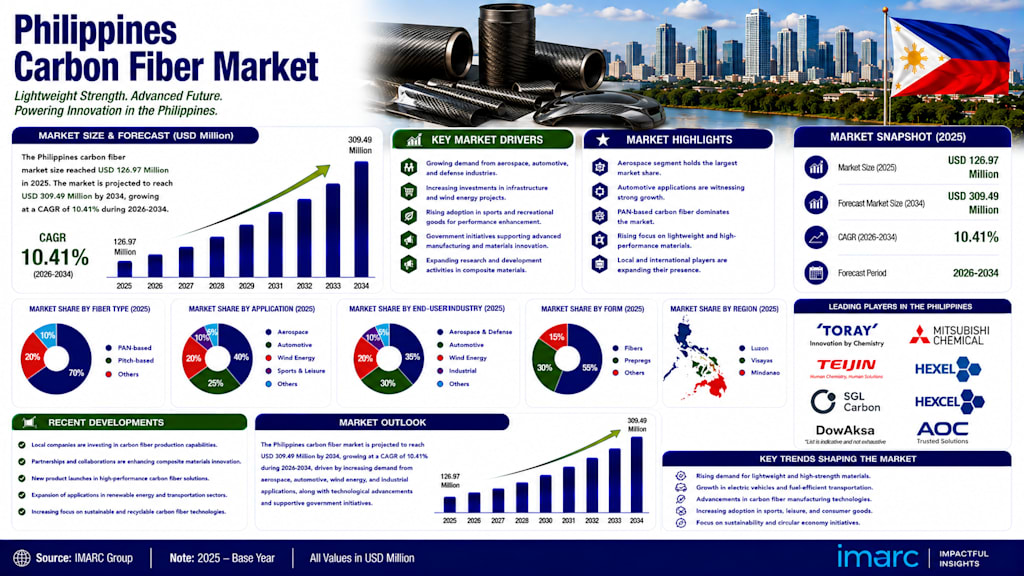
The Philippines carbon fiber market is on a high growth trajectory as the country positions itself as a rising player in the global advanced materials value chain. Carbon fiber — a lightweight, high strength composite — is increasingly deployed across large scale wind turbine blades, next generation aircraft components, electric vehicle battery enclosures and high performance sporting goods. According to IMARC Group, the market size reached USD 126.97 Million in 2025 and is projected to reach USD 309.49 Million by 2034, exhibiting a strong compound annual growth rate (CAGR) of 10.41% during 2026 2034.
Three transformative forces are driving this expansion. The government’s ambitious renewable energy plan is creating massive demand for lightweight turbine blades. A fast growing aerospace ecosystem — with local manufacturers now supplying components to Boeing and Airbus — is accelerating carbon fiber adoption. Meanwhile, the push for local EV production is opening new opportunities for lightweight, fuel saving materials. As composite manufacturing and AI based quality control mature, carbon fiber is moving from a specialty input to a strategic building block for the Philippines’ industrial future.
What's Driving Market Growth?
Renewable Energy Catalyst: 207 GW Offshore Wind Target. The most powerful driver of carbon fiber demand is the Philippine government’s aggressive renewable energy expansion. The Philippines is targeting 5 GW of onshore wind capacity by 2030, with a total offshore wind potential estimated at an enormous 207 GW. Carbon fiber composites are increasingly essential for manufacturing longer, lighter wind turbine blades that are both strong enough to withstand harsh sea conditions and efficient enough to generate optimal power. The shift toward advanced hybrid and carbon fiber turbine blades is reshaping the wind energy market, directly boosting demand for high performance carbon fiber materials.
Aerospace and Defense Manufacturing Maturation. The Philippines has quietly built a robust aerospace supply chain, and carbon fiber sits at its core. Local Tier 1 and Tier 2 aerospace part manufacturers now supply critical components — including flight control actuation systems, aircraft interiors, galley inserts, oxygen systems and seats — to global giants such as Boeing and Airbus. Collins Aerospace, a division of RTX, manufactures aircraft seats for Boeing, Airbus and Embraer, with its first shipment of seats to Airbus beginning in January 2024. The company has since diversified into engineering, oxygen systems manufacturing and aircraft components repair, all relying heavily on lightweight, durable composite materials. The US ASEAN Business Council’s largest ever Aerospace, Defense and Security Mission in August 2025 brought 26 leading U.S. defense and aerospace companies to Manila, reinforcing co production, technology transfer and workforce development — all of which underpin future carbon fiber consumption.
Electric Vehicle Incentives and Lightweight Battery Enclosures. The Philippines is accelerating its transition to sustainable transportation, creating a fresh demand stream for carbon fiber. The government is crafting an incentives program for domestic EV manufacturing, with an executive order expected within three months. Mitsubishi Motors announced plans to establish a dedicated production line for locally manufactured hybrid electric vehicles in its Santa Rosa plant, with production targeted for 2028. The EV Industry Development Act (EVIDA) actively promotes the adoption and manufacturing of electric and hybrid vehicles. Carbon fiber components — particularly lightweight battery enclosures and structural panels — are critical for reducing vehicle mass, improving energy efficiency and extending driving range. The Philippine EV Battery Housing Market now explicitly tracks carbon fiber reinforced plastic applications, signifying a maturing sub segment dedicated to composite based lightweighting.
Technological Breakthroughs and AI Driven Manufacturing. On a global level, artificial intelligence is revolutionizing carbon fiber manufacturing, and the Philippines is positioned to benefit. AI powered image recognition systems detect microscopic flaws during fiber weaving and resin infusion stages, significantly improving detection accuracy and reducing inspection time. Real time monitoring driven by machine learning helps optimize energy intensive production processes, lowering manufacturing costs and improving operational efficiency. As these AI technologies evolve, the Philippine market is expected to benefit from enhanced material quality, cost efficiency and manufacturing precision, making carbon fiber more accessible for a wider range of industrial applications.
Market Segmentation & Key Insights
By Application, the market covers aerospace and defense, automotive and transportation, wind energy, sporting goods and recreation, construction and infrastructure, electronics and others. Wind energy and aerospace currently represent the two most dynamic growth segments.
By End User Industry, key segments include aerospace and defense, automotive, wind energy, sporting goods, construction and industrial applications. The aerospace sector, buoyed by international OEM contracts, remains the largest value driver.
By Type, the market is divided into PAN based carbon fiber, pitch based carbon fiber and rayon based carbon fiber. PAN based fiber — offering the highest strength to weight ratio — dominates the advanced manufacturing sector.
By Raw Material, the market includes polyacrylonitrile (PAN), petroleum pitch and coal tar pitch. PAN remains the industry benchmark for high performance applications.
By Region, the market is concentrated in Luzon, Visayas and Mindanao. Luzon, home to aerospace manufacturing hubs in Batangas and the Subic Clark corridor, accounts for the largest share.
What the Opportunities Are?
Domestic Composite Fabrication and Wind Blade Manufacturing. With the government’s wind capacity targets and the Philippines’ status as one of Asia’s most wind rich nations, there is strong opportunity for local composite fabricators to enter the supply chain for hybrid and carbon fiber turbine blades. International blade manufacturers are actively seeking localized suppliers to reduce logistics costs and meet green energy content requirements.
Localized Carbon Fiber Production to Reduce Import Dependency. The Philippine market remains heavily import dependent for raw polyacrylonitrile (PAN) and finished carbon fiber. However, the CREATE Act offers attractive investment incentives: defense related carbon fiber production qualifies for Tier 2 benefits, offering 15 to 17 years of incentives depending on the project’s location and market orientation. Investors establishing PAN conversion or carbonization facilities in economic zones will secure first mover advantage and reduce supply chain vulnerability.
EV Specific Carbon Fiber Components. As Mitsubishi’s hybrid production scales and the EV incentives program takes effect, demand will accelerate for carbon fiber battery enclosures, door panels, instrument panel skeletons and structural reinforcements. Local manufacturers that develop competency in compression molding and resin transfer molding for automotive composites will capture long term OEM contracts.
Defense Modernization and Self Reliant Posture. The Self Reliant Defense Posture (SRDP) Act and the Armed Forces of the Philippines Modernization Program are driving significant investment in local defense manufacturing. Carbon fiber composites are critical for unmanned aerial vehicles, maritime patrol aircraft components and lightweight soldier systems. The BOI’s Academe Industry Matching (AIM!) Program — which includes AS9100 certification training — directly supports the development of a skilled composite workforce.
Sports Equipment and Recreational Manufacturing. The Philippine sports composites market, valued at PHP 48 billion and growing at 8%, is creating new avenues for carbon fiber in bicycle frames, golf shafts, badminton rackets and padel gear. The rising popularity of high performance bicycles has driven sustained demand for carbon fiber frames. Local brands such as BEWE are already incorporating carbon fiber plates into padel footwear, signaling a maturing domestic sports composite ecosystem.
Recent News and Developments in Philippines Carbon Fiber Market
March 2026: The Board of Investments pitched the Philippines’ high tech aerospace manufacturing strength at the Singapore Airshow 2026, emphasizing the country’s Tier 1 and Tier 2 parts supply chains to Boeing and Airbus. The BOI also highlighted the AIM! Program for AS9100 certification training to build a skilled composite workforce.
August 2025: The US ASEAN Business Council concluded its largest ever Aerospace, Defense and Security Mission to the Philippines, with 26 leading U.S. companies. The mission focused on co production, technology transfer and defense modernization — all of which will directly increase carbon fiber consumption in Philippine manufacturing.
July 2025: 6Wresearch’s Philippine EV Battery Housing Market report explicitly included carbon fiber reinforced plastic as a tracked sub segment, confirming that lightweight composite battery enclosures are emerging as a distinct investment category.
April 2026: The DTI announced that an executive order on EV manufacturing incentives would be released within three months, targeting domestic production of battery electric vehicles, hybrids and plug in hybrids — all of which require lightweight carbon fiber components.
July 2025: The Philippine Sports Equipment Retail Market was valued at USD 570 million, with carbon fiber bicycle frames representing a premium, high growth sub segment.
Why Should You Know About Philippines Carbon Fiber Market?
You should know about this market because it captures how renewable energy ambition, aerospace supply chain integration and EV policy incentives intersect to create one of Southeast Asia’s fastest growing advanced materials markets. Carbon fiber is no longer a niche material reserved for Formula 1 cars and fighter jets — it is a strategic industrial input that enables the Philippines to build longer wind turbine blades for its 207 GW offshore potential, manufacture lighter aircraft seats for Airbus and Boeing, and produce battery enclosures for the next generation of hybrid vehicles.
For investors, the Philippine carbon fiber market offers exposure to a high growth industrial materials category anchored in enforceable renewable energy targets, defense modernization legislation, EV manufacturing incentives and a globally connected aerospace supply chain. The projected CAGR of 10.41% reflects strong confidence in these structural drivers, while higher growth sub segments — including EV specific composite components, local PAN conversion facilities and advanced carbon fiber wind blade manufacturing — offer differentiated upside potential.
For aerospace manufacturers, renewable energy developers, automotive OEMs and advanced materials investors, understanding the segmentation between aerospace, wind and automotive applications, the CREATE Act incentive framework and the emerging local composite fabrication ecosystem helps shape intelligent investment decisions, supply chain strategies and technology roadmaps that deliver measurable weight savings, energy efficiency and export competitiveness.
In essence, the Philippines carbon fiber market captures how green energy transition, aerospace integration and automotive lightweighting converge — making it a compelling area for investors, manufacturers and technology partners seeking smarter approaches to advanced materials, industrial modernization and sustainable growth in one of Southeast Asia’s most dynamic economies.
About the Creator
Thomas
Market Research Analyst | Industry Trends & Forecasting | Turning market data into clear, actionable business insights across global sectors.
Enjoyed the story? Support the Creator.
Subscribe for free to receive all their stories in your feed.
Comments
There are no comments for this story
Be the first to respond and start the conversation.