
Philippines Boilers Market: Industrial Expansion, Clean Fuel Transition & Infrastructure Buildout
How manufacturing growth, power generation demand, and regulatory push for sustainable fuels are driving a 9.94% CAGR toward a $2.28 billion market by 2034

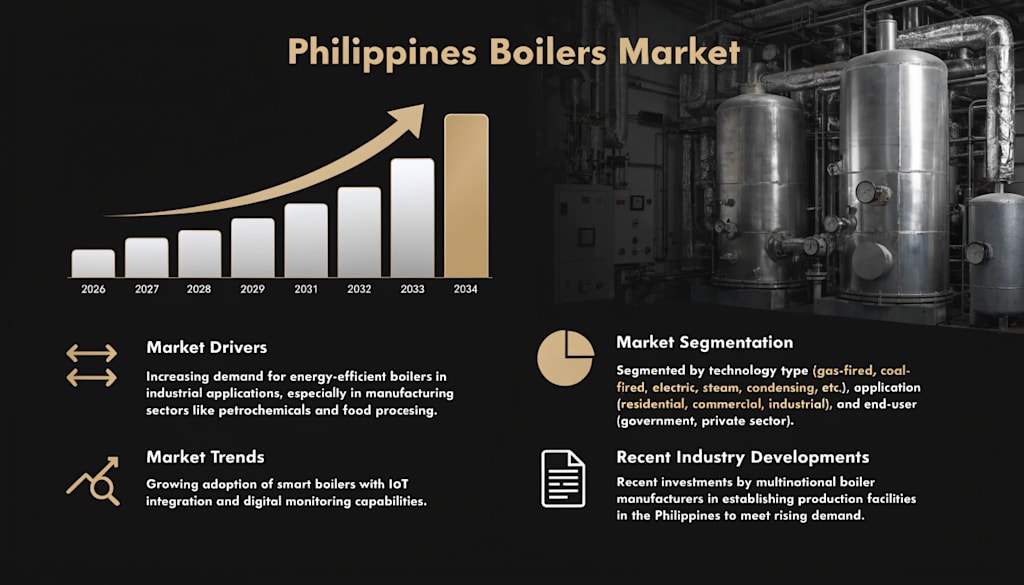
The Philippines boilers market is experiencing robust growth as the nation's accelerating industrialisation, power generation expansion, and regulatory push for cleaner fuels converge to drive sustained demand across multiple sectors. Boilers — encompassing hot water boilers, gas boilers, steam water boilers, and advanced utility systems — are deployed across manufacturing facilities, food processing plants, power generation facilities, and commercial buildings to provide process steam, heating, and hot water for industrial operations and building infrastructure.
According to IMARC Group, the market size reached USD 972.77 Million in 2025 and is projected to reach USD 2,281.75 Million by 2034, exhibiting a strong compound annual growth rate (CAGR) of 9.94% during 2026–2034.
The market is driven by strong industrial growth and corresponding demand for process steam and power, a government-led push for energy efficiency and transition to cleaner fuels in industrial applications, and ongoing development of the commercial and residential real estate markets that will drive demand for heating systems.
What's Driving Market Growth?
Industrial Expansion and Process Steam Demand. The single most powerful driver is the Philippines' ongoing industrial growth, particularly in sectors such as food and beverage, chemicals, and manufacturing, which rely heavily on process steam and hot water. Industries such as manufacturing, power generation, and food processing rely on steam boilers for their operations. As manufacturing output expands across food processing, electronics, textiles, and automotive components, the demand for reliable, high-capacity boiler systems continues to rise. Food processing facilities require steam for cooking, drying, and sterilisation; chemical plants need thermal energy for reactions and distillation; and manufacturing operations depend on steam for heating and cleaning. This sustained demand from industrial process applications forms a solid foundation for market expansion, requiring a diverse range of boiler capacities and technologies to meet specific operational needs.
Power Generation and the CFBC Project Pipeline. The power generation sector is a major catalyst for boiler demand. Currently, more than 15 large-scale circulating fluidized bed (CFBC) boiler construction projects, totaling about 6,000 MW, are planned in the Philippines. These projects reflect the government's push to ensure a stable and self-sufficient energy supply and to support industrial output. CFBC boilers are environmentally friendly thermal power generation facilities compared to conventional pulverized coal boilers, offering a wider range of fuel options and significantly reducing emissions of pollutants such as nitrogen oxides and sulfur oxides. In a landmark contract, BHI signed a deal with San Miguel Global Power Holdings to supply CFBC boilers worth approximately 520 billion KRW, covering boilers, economizers, reheaters, casings, ducts, and enclosures. The Mariveles Phase-2 CFBC Boiler Project commenced construction in November 2025, with a scope of work involving 20,170 tons of steel structures. Shanghai Boiler Works also signed a contract to supply a 470 t/h subcritical CFBC boiler for the Philippines TVI Phase 2 expansion project.
Government Push for Energy Efficiency and Fuel Switching. A significant trend shaping the market is the regulatory and policy-driven shift towards greater energy efficiency and the adoption of cleaner fuels. Government agencies are actively supporting the replacement of antiquated, inefficient boiler systems with new installations of efficient boiler systems that use energy-efficient and sustainable fuels such as natural gas and biomass. The industrial biomass boiler market is witnessing increased adoption due to a growing push toward sustainable and renewable energy solutions. Industries such as sugar and food processing are increasingly turning to biomass boilers to reduce operational costs and carbon footprints. Advanced utility boiler adoption is driven by the need for efficient and cleaner energy generation, with industrial and power plants upgrading to high-efficiency boilers to meet environmental regulations and reduce fuel consumption.
Construction Sector and Real Estate Development. Expansion of the construction sector, including new commercial construction and residential real estate developments, is creating a continuous demand for heating and hot water boiler systems. The residential boiler market, though smaller, is projected to grow annually due to factors such as population growth, urbanisation, and changing consumer preferences for heating solutions. Commercial buildings — including hotels, hospitals, and office complexes — require hot water and heating systems that rely on commercial-grade boilers. As the Philippines' construction market continues its upward trajectory, this segment provides additional support to the market through the forecast period.
AI Integration and Smart Boiler Management. Artificial intelligence is beginning to impact the boiler market through the adoption of AI-powered Building Management Systems and Industrial IoT platforms. These systems use machine learning algorithms to optimize boiler operation in real-time, predicting maintenance needs to prevent downtime, automatically adjusting fuel-air ratios for maximum combustion efficiency, and managing boiler sequencing in facilities with multiple units to match dynamic load demands. This leads to significant energy savings, reduced emissions, and lower operational costs, enhancing the value proposition of modern, connected boiler systems.
Market Segmentation & Key Insights
By Boiler Type, the market includes hot water boilers, gas boilers, and steam water boilers. Steam water boilers represent the largest segment, driven by industrial process steam demand across manufacturing, food processing, and chemical sectors.
By End User, the market is segmented into residential, commercial, and industrial. Industrial accounts for the largest share, driven by strong manufacturing and power generation activity. Commercial is growing due to hotel, hospital, and office construction. Residential, while smaller, is expanding with urbanisation.
By Region, the market is distributed across Luzon, Visayas, and Mindanao. Luzon dominates due to the concentration of industrial parks, manufacturing facilities, and power plants in Metro Manila, Central Luzon, and CALABARZON. Mindanao is an emerging market, supported by biomass power plant development and industrial expansion.
What the Opportunities Are?
CFBC Boiler Supply and EPC Services. With more than 15 large-scale CFBC projects totaling 6,000 MW planned, there is substantial opportunity for boiler manufacturers and EPC contractors to secure contracts. CFBC boilers are characterized by both excellent economic efficiency and eco-friendliness, leading to steadily increasing demand. Suppliers with proven technology and experience in large-scale power plant projects will capture significant market share.
Biomass and Renewable Fuel Boiler Systems. The industrial biomass boiler market is witnessing increased adoption due to the push toward sustainable energy. Industries such as sugar, food processing, and paper are prime candidates for biomass boiler conversion. Government support for biomass power plants and waste-to-energy facilities creates a sustained pipeline for biomass boiler procurement. The growth rate surged by 17.54% in 2024, showcasing a promising uptrend in demand.
Industrial Boiler Replacement and Efficiency Upgrades. Government policy continues to support the replacement of antiquated, inefficient boiler systems with new installations of efficient boiler systems using sustainable fuels. This creates a significant retrofit and replacement market across manufacturing, food processing, and chemical industries. Suppliers offering energy-efficient, low-emission boiler systems with AI-powered controls will capture premium contracts.
Aftermarket Services and Predictive Maintenance. With AI-powered Building Management Systems and Industrial IoT platforms gaining traction, there is growing opportunity for aftermarket services including predictive maintenance, real-time performance monitoring, and boiler optimization consulting. Providers offering remote diagnostics, automated fuel-air ratio adjustment, and condition-based maintenance can build long-term service contracts and recurring revenue streams.
Commercial and Residential Heating Systems. Expansion of the commercial and residential real estate sector creates steady demand for heating and hot water boiler systems. Hotels, hospitals, office buildings, and condominium developments require reliable, efficient boiler systems for space heating and domestic hot water. Manufacturers offering compact, energy-efficient, and smart-enabled commercial boilers will capture this growing segment.
Recent News and Developments in Philippines Boilers Market
April 2025: BHI signed a contract with San Miguel Global Power Holdings to supply CFBC boilers worth approximately 520 billion KRW, covering boilers, economizers, reheaters, casings, and ducts, with the contract period running until September 2028.
May 2025: Shanghai Boiler Works signed a contract with China Energy Engineering Group Northeast No.1 Electric Power Construction Co. for the Philippines TVI Phase 2 expansion project, supplying a 470 t/h subcritical CFBC boiler.
August 2025: Sitong Boiler showcased a series of boiler equipment customized for the food industry at the 25th WOFEX World Food Expo in the Philippines, strengthening its brand presence in the Philippine market.
September 2025: A 4-ton industrial biomass boiler was prepared for shipment to the Philippines, supporting sustainable industrial growth and cleaner energy adoption across South Asia.
October 2025: A 2 t/h gas-fired steam boiler manufactured by Henan Taiguo Boiler arrived in the Philippines and completed installation and commissioning for a local agricultural product processing line.
November 2025: AMECC Mechanical Construction Joint Stock Company officially commenced the Mariveles Phase-2 CFBC Boiler Project in the Philippines, with a scope of work involving 20,170 tons of steel structures.
Why Should You Know About Philippines Boilers Market?
You should know about this market because it captures how industrialisation, energy infrastructure investment, and environmental regulation intersect to create one of Southeast Asia's fastest-growing industrial equipment sectors. Boilers are no longer simple heating devices — they are critical infrastructure that powers manufacturing growth, enables cleaner energy generation, and supports the Philippines' transition to a more sustainable industrial base.
For investors, the boilers market offers exposure to a high-growth industrial equipment category anchored in the Philippines' expanding manufacturing base, the 6,000 MW CFBC project pipeline, and the government's push for biomass and renewable energy adoption. The projected CAGR of 9.94% — transforming a USD 972 million market into a USD 2.28 billion market by 2034 — reflects strong confidence in industrial demand, regulatory tailwinds, and the structural shift toward cleaner, more efficient boiler technologies.
For industrial engineers, plant managers, equipment distributors, and energy investors, understanding segmentation across boiler types, end-user sectors, and regions, the emerging role of CFBC technology in power generation, and the accelerating adoption of AI-powered boiler optimisation helps shape intelligent procurement decisions, investment strategies, and technology roadmaps that deliver measurable efficiency, emissions reduction, and operational cost outcomes.
In essence, the Philippines boilers market captures how thermal engineering, industrial policy, and clean energy transition converge — making it a compelling area for investors, equipment manufacturers, and industrial operators seeking smarter approaches to process steam, power generation, and sustainable industrial growth across one of Southeast Asia's most dynamic manufacturing economies.
About the Creator
Thomas
Market Research Analyst | Industry Trends & Forecasting | Turning market data into clear, actionable business insights across global sectors.
Enjoyed the story? Support the Creator.
Subscribe for free to receive all their stories in your feed.
Comments
There are no comments for this story
Be the first to respond and start the conversation.