
Philippines Blockchain in Supply Chain Market 2026: Anti Counterfeiting, Public Ledgers & Remittance Integration
How government procurement integrity, pharmaceutical traceability mandates and agricultural value chains are driving a 38% CAGR market toward sovereignty in trust technology

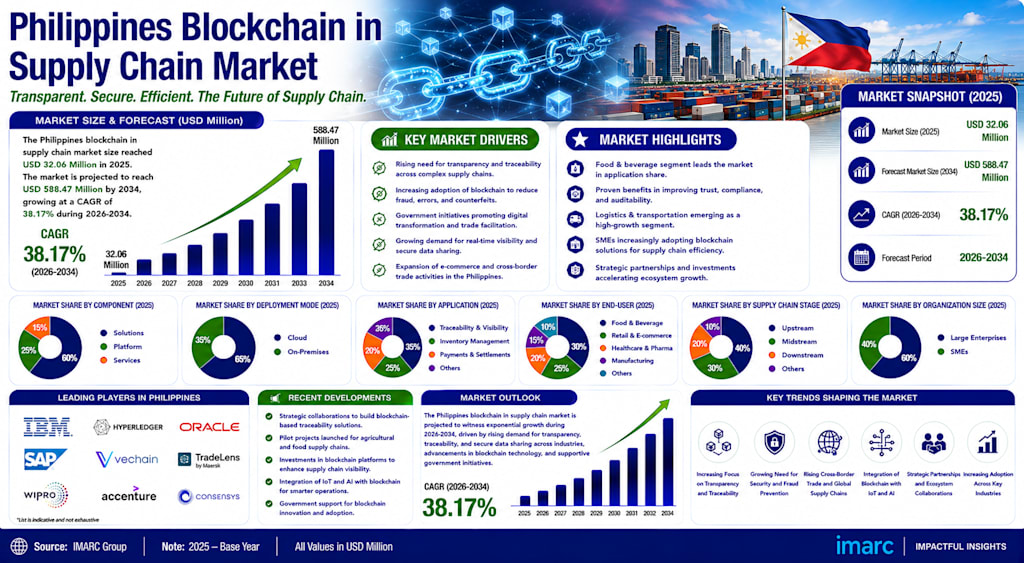
The Philippines blockchain in supply chain market is undergoing an explosive transformation as government agencies, pharmaceutical distributors, logistics providers and agricultural cooperatives increasingly deploy distributed ledger technology (DLT) to combat inefficiency, counterfeit products and opaque governance. Blockchain in supply chain — encompassing counterfeit detection systems, asset tracking platforms, payment and settlement rails, smart contracts, and risk compliance management — is deployed across public infrastructure, pharmaceuticals, fast moving consumer goods, manufacturing and logistics, retail and agriculture to deliver immutable records, real time visibility and verifiable provenance. According to IMARC Group, the market size reached USD 32.06 Million in 2025 and is projected to reach USD 588.47 Million by 2034, exhibiting a stellar compound annual growth rate (CAGR) of 38.17% during 2026 2034. The soaring growth is driven by the Philippine government's assertive digital transformation agenda, surging demand for end to end supply chain transparency and counterfeit prevention, rising integration of blockchain with payment systems — as exemplified by UnionBank's i2i initiative — and the increasing need for trusted, verifiable data across supply chain operations. As the Philippines positions itself as a regional blockchain innovation hub, the technology is moving from experimental pilots to mission critical infrastructure that underpins everything from road contracts to rice distribution and drug safety.
What's Driving Market Growth?
Government Led Digital Transformation & Regulatory Framework. The Philippine government is spearheading a comprehensive digital transformation agenda that positions blockchain as a strategic enabler of economic modernisation. The Bangko Sentral ng Pilipinas (BSP) has established regulatory sandbox initiatives, while the Securities and Exchange Commission launched StratBox for crypto asset service providers, placing the country 8th in the 2024 Global Crypto Adoption Index. Complementing this, the Department of Information and Communications Technology (DICT) secured a grant from blockchain firm Polygon to pilot Veritas, a system that places the entire 2026 national budget on an immutable, decentralised ledger for public verification, making the Philippines the first country to adopt such a measure. The pending e Governance legislation will further drive demand for blockchain to secure government records, enhance transparency in service delivery and protect data integrity across public and private platforms. The BSP's wholesale central bank digital currency roadmap and the SEC's comprehensive regulatory guidelines for crypto asset service providers are creating a favourable environment for blockchain implementation across supply chains.
Logistics Digitalisation & Operational Inefficiency. The Philippine logistics sector remains burdened by fragmented manual systems, creating a compelling business case for blockchain adoption. Industry leader FAST Logistics Group has emerged as a vocal advocate for accelerating end to end supply chain digitalisation and preparing for wider blockchain adoption. At the Logistics Services Philippines Conference & Exhibit 2026, FAST Logistics Group chief information officer Leo Sacamos Jr. highlighted that around 70 percent of trucks in the Philippines return empty after deliveries, with vehicles delivering fast moving consumer goods operating at only 32 percent to 42 percent capacity — inefficiencies that blockchain enabled digital documentation and real time tracking could substantially address. While the broader ecosystem remains largely manual, FAST has already deployed Honeywell powered Voice Pick Technology and is transitioning to the FarEye platform for route optimisation. Sacamos called for enabling laws to support technologies such as blockchain enabled e contracts, which could reduce paperwork, administrative delays and security vulnerabilities across the supply chain.
Counterfeit Detection & Supply Chain Security. The growing threat of counterfeit pharmaceuticals and food products in the Philippines is driving urgent adoption of blockchain based traceability. An estimated 30% of inspected drug stores in the Philippines have been found with substandard, spurious or counterfeit medicines. Blockchain technology offers a powerful countermeasure: by creating a tamper proof digital ledger, every medicine can be traced from manufacturer to patient, providing real time verification of authenticity. The pharmaceuticals and food anti counterfeiting technologies market is witnessing advancements in authentication and traceability solutions, including blockchain based supply chain systems that complement RFID tracking and tamper evident packaging. Regulatory agencies are enforcing stricter serialisation mandates, leading to increased investment in digital authentication technologies that protect consumers while creating verifiable audit trails for regulators and brand owners.
Agricultural Traceability & Export Compliance. Global demand for transparent, verifiable food provenance is driving blockchain adoption across Philippine agriculture, particularly in high value export commodities. The DOST PCAARRD project “Development of Traceability System for Cacao in Southern Philippines” (March 2023 to May 2025) developed a distributed ledger based digital traceability model that captures key data elements and critical tracking events necessary to verify cacao bean movement and quality. The project's Traco mobile app features blockchain backed data storage, enabling producers and traders to maintain permanent, verifiable transaction records. A total of 102 farmers and consolidators were trained in using the system, with the Biao Agrarian Reform Beneficiaries Cooperative (BARBCO) — the country's second largest cacao exporter — granted exclusive commercialisation rights for three years. Beyond cacao, the Department of Agriculture Western Visayas and ISAT U have established a digital hub leveraging blockchain and data analytics to benefit micro, small and medium enterprises struggling with market access and economic fluctuations. The integration of blockchain with price monitoring databases, farmer clusters and commodity harvest projections aims to make agricultural supply chains more efficient, transparent and inclusive.
Remittances, Cross Border Trade & Payment Settlements. With remittances constituting approximately 10% of the country's GDP, cross border trade facilitation through blockchain based payment systems is gaining significant momentum. The BSP's medium term roadmap for wholesale central bank digital currency development and UnionBank's i2i initiative — which enables rural banks to connect with each other using blockchain — are creating a foundation for transparent, traceable payment and settlement infrastructure across supply chains. Blockchain provides a verifiable, immutable record for international shipments that can unite financial and logistical data in a single trusted ledger.
EPR Compliance & Waste Traceability. Republic Act 11898, the Extended Producer Responsibility (EPR) law of 2022, mandates that obliged enterprises — companies with assets over ₱100 million — establish EPR programmes for plastic packaging waste, with recovery targets reaching 80% by 2028. Technology has become essential for EPR compliance tracking, with blockchain creating a secure, immutable ledger of collected plastic volumes. Solutions such as those deployed by Plastic Bank in the Philippines use blockchain to log every transaction with collection members: weight, location, time stamp and conversion into plastic credits. Businesses accessing these blockchain enabled platforms gain auditable traceability that can be directly used for DENR EPR reporting, reducing fraud risk and improving transparency in circular economy supply chains.
Market Segmentation & Key Insights
By Application, the market includes payment and settlement, counterfeit detection, asset tracking, smart contracts, and risk and compliance management. Payment and settlement leads in maturity, driven by the i2i network and cross border remittance use cases, but counterfeit detection is the fastest growing segment as pharmaceutical and retail brands seek to secure their supply chains.
By Provider, the market is segmented into application and solution providers and middleware providers. Enterprise blockchain platforms such as Hyperledger Fabric, Ethereum and Cordova compete alongside local providers offering customised solutions.
By Vertical, key sectors include retail and consumer goods, manufacturing, transportation and logistics, healthcare, FMCG, and agriculture. Retail and consumer goods currently lead, driven by brand protection and traceability demands for export commodities.
By Region, major markets include Luzon, Visayas and Mindanao. Metro Manila serves as the primary technology hub, while Visayas and Mindanao are emerging as centres of agricultural and pilot projects.
What the Opportunities Are?
Public Procurement & Infrastructure Integrity. The launch of Integrity Chain, a blockchain powered platform by the Blockchain Council of the Philippines (BCP) in partnership with the Department of Public Works and Highways (DPWH), represents a landmark opportunity to extend immutable, tamper proof tracking to public infrastructure spending. The platform places critical data — budgets, procurement processes, construction milestones — on a public facing blockchain ledger, enabling real time citizen oversight. “By placing our foreign assisted projects on the Integrity Chain, we welcome the scrutiny of the private sector, academe and civil society,” DPWH Secretary Vince Dizon said. The Integrity Chain enables a real time public dashboard for tracking spending, citizen feedback mechanisms and anomaly reporting, providing a replicable model for other government agencies. As more departments adopt similar platforms, vendors offering enterprise grade blockchain infrastructure for public procurement will capture substantial market share.
Cross Border Trade Documentation. The Philippines is strategically positioned to adopt blockchain enabled trade documentation platforms that digitise and secure bills of lading, certificates of origin and customs declarations. As ASEAN pushes toward digital trade integration, blockchain solutions that provide immutable, verifiable documentation will reduce processing times, lower administrative costs and increase trust among trading partners.
Pharmaceutical Serialisation-as-a Service. With the FDA collaborating with international agencies to strengthen anti counterfeiting measures, small to medium pharmaceutical manufacturers face compliance challenges without internal blockchain expertise. Providers offering serialisation as a service — including track and trace APIs, blockchain based supply chain monitoring and automated verification systems — can bridge this gap and secure recurring B2B revenue.
Farm to Consumer Traceability for Premium Exports. The Traco cacao project proves the viability of blockchain in Philippine agriculture. Beyond cacao, high value exports such as Philippine coffee, coconut products, bananas and pineapple can benefit from similar blockchain traceability models, enabling smallholders to command premium prices in markets that demand verified provenance. The Digital Agriculture Hub in Western Visayas provides a template for replicating blockchain enabled traceability across multiple regions.
Waste to Credits & EPR Verification Platforms. As EPR recovery targets escalate annually through 80% by 2028, obliged enterprises need reliable, auditable proof of plastic waste recovery. Blockchain solutions that automatically log collection transactions — weight, time stamp, location — in immutable ledgers and integrate with DENR reporting dashboards represent a compliance driven growth category. Companies offering ESG reporting tools built on blockchain will gain contracts with both multinational brand owners and local obliged enterprises.
Recent News and Developments in Philippines Blockchain in Supply Chain Market
May 2026: DICT Secretary Henry Aguda announced that the agency secured a grant from blockchain firm Polygon to pilot Veritas, a system placing the entire 2026 national budget on a decentralised ledger for public verification, making the Philippines the first country to adopt such a measure.
May 2026: At the Logistics Services Philippines Conference & Exhibit 2026, FAST Logistics Group CIO Leo Sacamos Jr. called for enabling laws to support blockchain enabled e contracts and digital documentation, noting that 70% of Philippine trucks return empty and operate at only 32 42% capacity.
September 2025: The Blockchain Council of the Philippines (BCP) and the Department of Public Works and Highways (DPWH) signed a memorandum of agreement to launch Integrity Chain, a blockchain platform securing ODA funded project data — budgets, procurement, construction milestones — on an immutable public ledger.
2025 (ongoing): DOST PCAARRD successfully completed the “Traceability System for Cacao in Southern Philippines,” training 102 farmers and consolidators on the Traco app with blockchain backed data storage. BARBCO, the country’s second largest cacao exporter, secured exclusive commercialisation rights.
2025: The Philippines placed 8th in the 2024 Global Crypto Adoption Index, reflecting sustained momentum from BSP sandbox initiatives, the completion of Project Agila (December 2024), and the SEC's StratBox for crypto asset service providers.
Why Should You Know About Philippines Blockchain in Supply Chain Market?
You should know about this market because it captures how public integrity reform, consumer protection mandates and agricultural value chain modernisation intersect to create one of Asia's fastest adopting blockchain ecosystems. The country is not simply piloting blockchain for isolated use cases — it is placing its national budget on a public ledger, using distributed ledgers to fight graft in infrastructure spending, and deploying DLT to authenticate pharmaceuticals that directly affect patient safety. Blockchain in supply chain is no longer experimental technology for early adopters; it is now a compliance instrument for EPR law enforcement, a trust mechanism for cross border trade documentation, and a strategic differentiator for Philippine exporters needing verifiable provenance.
For investors, the blockchain in supply chain market offers exposure to a high growth technology category anchored in enforceable government regulation (EPR Act 2022, FDA serialisation), multi billion peso public procurement transparency initiatives, and the accelerating digitalisation of the logistics sector. The projected CAGR of 38.17% — one of the highest forecast rates in Southeast Asia — reflects strong confidence in regulatory tailwinds, enterprise adoption cycles and the transformative potential of DLT for anti counterfeiting, provenance verification and supply chain optimisation.
For supply chain executives, compliance officers, technology partners and policymakers, understanding blockchain segmentation, the distinction between public/private/hybrid implementations, and the evolving regulatory landscape for crypto asset service providers helps shape intelligent investment decisions, platform selection and risk management frameworks that deliver measurable transparency, accountability and economic inclusion outcomes.
In essence, the Philippines blockchain in supply chain market captures how digital sovereignty, public accountability and supply chain resilience converge — making it a compelling area for innovators, investors and governance reformers seeking smarter approaches to trust based documentation, anti counterfeit protection and the transparent movement of goods across one of the world's most dynamic archipelagic economies.
About the Creator
Thomas
Market Research Analyst | Industry Trends & Forecasting | Turning market data into clear, actionable business insights across global sectors.
Enjoyed the story? Support the Creator.
Subscribe for free to receive all their stories in your feed.
Comments
There are no comments for this story
Be the first to respond and start the conversation.