
Philippines Bleaching Agents Market 2026: Industrial Demand, Hygiene Applications & Sustainable Chemical Trends
Growing demand from textile, paper, and water treatment industries is driving steady expansion in the Philippines bleaching agents market

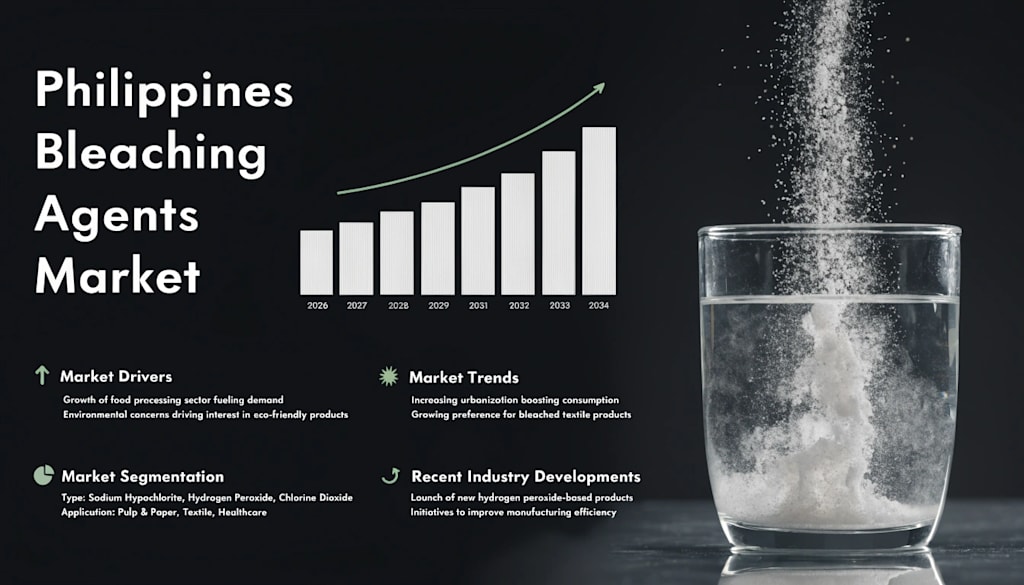
The Philippines bleaching agents market is witnessing steady growth as rising industrial demand, increasing hygiene awareness, and expanding water treatment applications drive consumption across multiple sectors. According to industry insights, the market reached USD 18.74 Million in 2025 and is projected to grow to USD 24.94 Million by 2034, exhibiting a CAGR of 3.23% during 2026–2034.
Bleaching agents are chemical substances used to whiten, disinfect, and remove stains from materials. They are widely used in industries such as textiles, paper and pulp, water treatment, and household cleaning products. As industries expand and environmental standards evolve, the demand for efficient and eco-friendly bleaching solutions is increasing.
The market’s growth reflects a combination of industrial expansion and shifting consumer preferences toward hygiene and sustainability.
What’s Driving Market Growth?
One of the primary drivers of the Philippines bleaching agents market is the growth of the textile and garment industry. Bleaching agents are essential in fabric processing to improve color quality and achieve desired finishes, making them a key component in textile manufacturing.
The expansion of the paper and pulp industry is another major growth factor. Bleaching agents are widely used in paper production to enhance brightness and quality, particularly as demand for packaging materials increases with the growth of e-commerce and retail sectors.
Rising hygiene awareness and demand for cleaning products are also contributing to market growth. Bleaching agents are commonly used in disinfectants, household cleaners, and sanitation products, especially in the post-pandemic environment.
The increasing need for water treatment and sanitation solutions is further boosting demand. Bleaching agents play a crucial role in water purification processes, helping ensure safe and clean water supply for both industrial and municipal use.
Additionally, the shift toward environmentally friendly and sustainable chemical solutions is shaping market dynamics. Manufacturers are developing low-toxicity and biodegradable bleaching agents to meet regulatory standards and consumer expectations.
Market Segmentation & Key Insights
• By Type:
o Oxidizing bleaching agents dominate, including chlorine-based and peroxide-based chemicals.
o Reducing bleaching agents are used in specific industrial applications.
• By Application:
o Textile industry leads due to high demand for fabric processing.
o Paper and pulp industry is a major contributor.
o Water treatment and sanitation applications are growing rapidly.
o Household cleaning products represent a steady segment.
• By End Use:
o Industrial sector dominates consumption.
o Commercial and residential applications are expanding with hygiene awareness.
• By Distribution Channel:
o Direct industrial sales dominate the market.
o Retail and online channels are growing for consumer-oriented products.
What the Opportunities Are?
The Philippines bleaching agents market presents strong opportunities in eco-friendly and sustainable chemical solutions. As environmental regulations tighten, there is increasing demand for biodegradable and low-impact bleaching agents.
Another major opportunity lies in water treatment infrastructure development. With rising urbanization and government investment, demand for efficient water purification chemicals is expected to grow significantly.
The expansion of the packaging and paper industry, driven by e-commerce and sustainability trends, also offers strong growth potential.
Technological advancements in chemical formulations can improve efficiency, reduce environmental impact, and enhance product performance.
Additionally, increasing demand for premium and specialized cleaning products creates opportunities for innovation in both industrial and consumer segments.
Recent News and Developments in Philippines Bleaching Agents Market
January 2025: The Philippine government increased investments in water infrastructure by over PHP 50 Billion, boosting demand for chlorine-based bleaching agents used in municipal water treatment systems.
April 2025: The paper and packaging sector recorded growth of approximately 6–8% YoY, driven by e-commerce expansion, leading to higher consumption of hydrogen peroxide and other bleaching chemicals.
August 2025: Textile manufacturing output increased by around 5.5%, particularly in export-oriented units, accelerating the use of bleaching agents for fabric processing and finishing.
November 2025: Adoption of eco-friendly bleaching agents rose by nearly 10–12%, as manufacturers introduced biodegradable and low-toxicity formulations aligned with sustainability regulations.
Why Should You Know About Philippines Bleaching Agents Market?
The Philippines bleaching agents market is important because it reflects the intersection of industrial growth, hygiene awareness, and environmental sustainability.
For investors, this market offers exposure to a stable chemical segment driven by consistent demand across key industries. The projected CAGR of 3.23% indicates steady growth supported by long-term industrial expansion and consumer trends.
For manufacturers and chemical companies, the market presents opportunities to innovate, develop sustainable solutions, and expand across diverse applications.
For policymakers and stakeholders, it highlights the importance of environmental regulations, water treatment infrastructure, and industrial development in shaping market dynamics.
In essence, the Philippines bleaching agents market represents the convergence of industry, hygiene, and sustainability — making it a steady and evolving segment of the chemical industry.
About the Creator
Thomas
Market Research Analyst | Industry Trends & Forecasting | Turning market data into clear, actionable business insights across global sectors.
Enjoyed the story? Support the Creator.
Subscribe for free to receive all their stories in your feed.
Comments
There are no comments for this story
Be the first to respond and start the conversation.