
Philippines Beverage Packaging Market: E‑Commerce Surge, EPR Mandates & On‑the‑Go Revolution
How a $36bn digital economy, 80% plastic recovery targets and premiumisation trends are driving a $5.57bn market by 2034

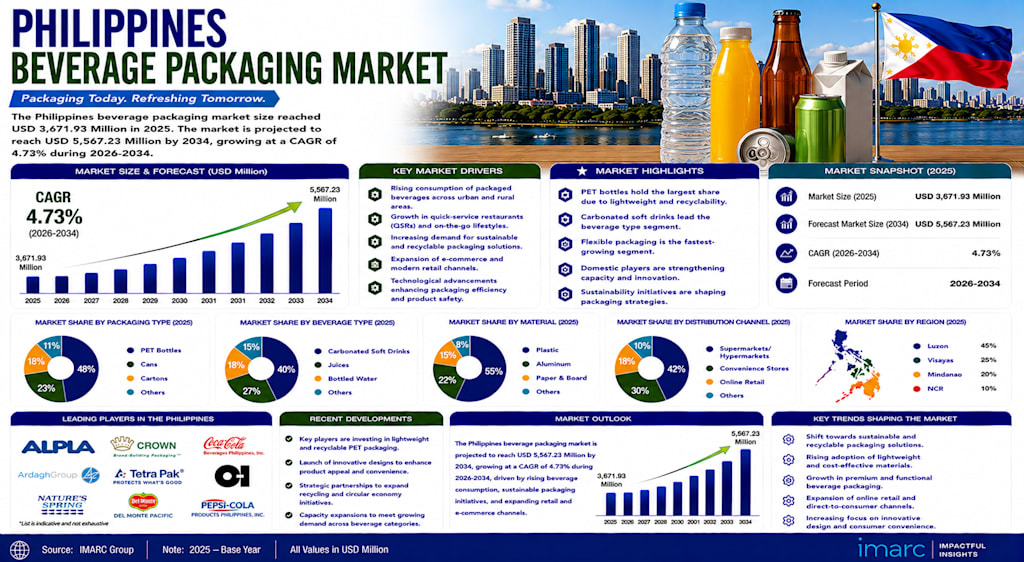
The Philippines beverage packaging market is expanding steadily as the nation's accelerating e‑commerce boom, rising consumer demand for convenience, and stringent environmental regulations converge to reshape the packaging landscape. Beverage packaging — encompassing plastic bottles, metal cans, glass containers, paperboard cartons and flexible pouches — is deployed across alcoholic and non‑alcoholic beverages to protect product integrity, extend shelf life, facilitate logistics and enhance brand appeal in one of Southeast Asia's most dynamic consumer economies. According to IMARC Group, the market size reached USD 3,671.93 Million in 2025 and is projected to reach USD 5,567.23 Million by 2034, exhibiting a compound annual growth rate (CAGR) of 4.73% during 2026–2034. As the government pushes toward an 80% plastic waste recovery target under the Extended Producer Responsibility (EPR) Act and digital platforms redefine distribution channels, beverage packaging has become a strategic asset for brand differentiation and circular economy compliance.
What's Driving Market Growth?
E‑Commerce Expansion Transforming Distribution Channels. The Philippine digital economy is set to reach USD 36 billion in gross merchandise value (GMV) in 2025, growing 16% year‑on‑year, with e‑commerce — the largest sector — accounting for more than 60% of total GMV. The explosive growth of online platforms such as Lazada, Shopee and TikTok Shop has fundamentally changed how consumers purchase beverages. These platforms require packaging that is lightweight, durable and able to withstand multi‑touchpoint logistics networks. E‑commerce growth directly drives demand for shatter‑proof PET bottles, stackable cans and compact cartons that minimise shipping weight and reduce damage during last‑mile delivery. The Philippines beverage packaging market is experiencing significant transformation driven by the accelerated expansion of e‑commerce platforms and online retail channels.
EPR Mandates and Sustainability Imperatives. The Extended Producer Responsibility (EPR) Act of 2022 (Republic Act No. 11898) is fundamentally reshaping packaging strategies across the Philippines beverage industry. The law mandates that large enterprises establish and implement EPR programmes for plastic packaging waste recovery, with escalating targets reaching 80% by 2028. In 2025, the national diversion rate exceeded targets, registering 55.98% above the mandated 40% level, with over 246 million kilograms of plastic waste diverted as a result of 1,017 entities registering their EPR programmes. Companies are investing heavily in recyclable materials, circular economy initiatives and waste management infrastructure to meet regulatory requirements while responding to growing environmental consciousness among Filipino consumers. The government is accelerating adoption of bio‑based plastics, molded fiber and refillable packaging systems. Sustainable packaging is projected to reach approximately PHP 15 billion, reflecting a 20% increase from the previous year.
Urbanisation and the On‑the‑Go Beverage Culture. Rapid urbanisation is creating a massive market for convenient, portable beverage formats. The expanding middle class, rising disposable incomes and the fast‑paced lifestyles of metropolitan professionals are driving demand for single‑serve bottles, resealable closures and lightweight cans that fit seamlessly into daily commutes. Hot drinks total packaging retail volumes in the Philippines rose by 3% to 6.6 billion units in 2024, driven by growing consumer interest in specialty coffee and tea, as well as increasing café culture and at‑home consumption. Total soft drinks packaging retail volumes rose by 8% to 18 billion units, driven by increased urbanisation and growing demand for convenient, on‑the‑go beverages. The alcoholic drinks sector saw total packaging volumes increase by 2% in 2024, with improving economic conditions and stronger consumer spending boosting consumption across all main categories.
Premiumisation and Metal Can Growth. The shift toward premium beverage offerings is creating new opportunities for high‑quality packaging formats. Metal beverage cans are expected to see the strongest growth in alcoholic drinks packaging, driven primarily by expanding consumption of beer and RTDs. Metal cans offer superior protection against light and oxygen, extended shelf life and infinite recyclability. The Philippines aluminium cans market size reached USD 1,137.04 Million in 2025 and is projected to reach USD 1,435.14 Million by 2034, growing at a CAGR of 2.62% from 2026-2034. In the soft drinks segment, premiumisation is driving demand for sleeker can designs, limited‑edition finishes and functional packaging features.
Market Segmentation & Key Insights
By Material, the market includes plastic, metal, glass, paperboard and others. Plastic — dominated by PET — remains the largest segment due to its lightweight properties, cost‑effectiveness and design versatility for carbonated soft drinks and bottled water. Metal cans are the fastest‑growing segment, driven by premiumisation and the RTD boom. Glass maintains a strong foothold in spirits, premium beers and craft beverages, leveraging its premium aesthetic and recyclability. Paperboard packaging is gaining traction in the dairy and juice segments through aseptic carton technology.
By Product Type, the market covers bottles, cans, pouches, cartons and others. Bottles hold the largest share, driven by the scale of the bottled water and carbonated soft drinks markets. Cans are the fastest‑growing product type, supported by the expanding beer and RTD categories.
By Application, the market is divided into alcoholic beverages (beer, spirits, RTD cocktails, wine) and non‑alcoholic beverages (carbonated soft drinks, bottled water, juices, energy drinks, ready‑to‑drink coffee and tea, dairy beverages). Non‑alcoholic beverages account for the majority of volume, but alcoholic beverages are the fastest‑growing application, driven by premiumisation and consumption recovery.
By Region, the market is distributed across Luzon, Visayas and Mindanao. Luzon dominates, driven by the concentration of major manufacturing facilities, population density, and the presence of e‑commerce fulfillment hubs. Visayas and Mindanao are emerging markets, supported by infrastructure investment and expanding logistics networks.
What the Opportunities Are?
rPET Capacity Expansion and Circular Economy Infrastructure. The Philippines is witnessing a wave of investment in PET recycling infrastructure. In May 2026, NSSI announced it will begin commercial operations in Q3 2026 for its first PET bottle‑to‑bottle recycling facility serving Visayas and Mindanao, located in Carmen, Cebu. The facility will process post‑consumer PET bottles into recycled PET (rPET) suitable for food and beverage packaging, expanding food‑grade plastic recovery capacity in the southern Philippines. With EPR targets escalating to 80% by 2028, there is substantial opportunity for investment in advanced sorting technologies, washing lines and rPET pelletising facilities.
Aseptic Carton Expansion for Shelf‑Stable Beverages. The Philippine beverage market has seen growing demand for shelf‑stable products including juices, teas, dairy beverages and cooking creams. Aseptic packaging enables producers to safely distribute products across the archipelago — especially to rural and disaster‑affected communities — while reducing food spoilage and energy consumption. In May 2026, Actron Industries expanded its packaging portfolio with a SIG Midi 12 Aseptic filling line at its Calamba, Laguna plant, capable of filling up to 12,000 aseptic cartons per hour. The investment marks Actron's entry into co‑packing services for shelf‑stable dairy and juice products. Tetra Pak launched its second aseptic carton packaging material production line at its Binh Duong facility in Vietnam, serving the Philippine market with smaller, more sustainable packaging formats.
AI‑Powered Quality Control and Supply Chain Optimisation. Artificial intelligence is beginning to optimise beverage packaging operations in the Philippines. AI‑powered inventory management systems are helping beverage companies predict consumption patterns and optimise packaging material procurement, reducing waste and improving efficiency. Machine learning algorithms are being deployed in manufacturing facilities for real‑time quality inspection of packaging materials, detecting defects in bottles, cans and labels with greater accuracy than traditional methods.
Biodegradable and Bio‑Based Packaging Innovation. San Miguel Corporation announced it will start using biodegradable plastic in grocery bags, food bags, and other single‑use plastic packets used as packaging for its various products, sourcing biodegradable packaging from local firm Philippine Bioresins Corporation. The Department of Science and Technology has showcased pectin films and BC films as biodegradable, edible, and environmentally friendly alternatives to petroleum‑based plastic. The green packaging market in the Philippines is expanding due to rising consumer awareness of environmental issues, with biodegradable, recyclable, and reusable packaging materials gaining popularity across food and beverage industries.
Glass Bottle Refillable Systems and Recycling Infrastructure. Glass packaging remains essential for spirits, premium beers and craft beverages. Coca‑Cola Philippines has sustainably operated using returnable glass bottles for decades, collected, washed and reused across its distribution network. With domestic glass production limited, importers increasingly turn to East Asian manufacturers, creating opportunities for strategic sourcing partnerships and returnable logistics systems.
Smart Packaging and Consumer Engagement Technologies. The growing sophistication of Filipino consumers, particularly among millennials and Generation Z demographics, is creating demand for functional packaging features including resealable closures, portion‑control formats and interactive digital elements that enhance consumer engagement and brand loyalty. Smart packaging incorporating QR codes, NFC tags and augmented reality features enables brands to connect directly with consumers, verify product authenticity and provide traceability information.
Recent News and Developments in Philippines Beverage Packaging Market
June 2026: The IMARC Group report confirmed that the Philippines beverage packaging market reached USD 3,671.93 Million in 2025, with projections to reach USD 5,567.23 Million by 2034 at a 4.73% CAGR.
May 2026: NSSI announced it will begin commercial operations in Q3 2026 for its first PET bottle‑to‑bottle recycling facility serving Visayas and Mindanao, located in Carmen, Cebu, processing post‑consumer PET bottles into food‑grade rPET.
May 2026: Actron Industries expanded its packaging portfolio with a SIG Midi 12 Aseptic filling line at its Calamba, Laguna plant, capable of filling up to 12,000 aseptic cartons per hour, with commercial production scheduled for Q2 2026.
February 2026: The DENR reported exceeding the 40% plastic waste recovery target for 2025 with a national diversion rate of 55.98%, with over 246 million kilograms of plastic waste diverted. Recovery rates reached 56.33% for flexible plastics and 55.60% for rigid plastics.
January 2025: Tetra Pak launched its second aseptic carton packaging material production line at its Binh Duong facility in Vietnam, serving the Philippine market with smaller, more sustainable packaging formats.
2025: San Miguel Corporation announced it will start using biodegradable plastic packaging, sourcing from local firm Philippine Bioresins Corporation, with DOST‑confirmed 65% breakdown in 24 months.
Why Should You Know About Philippines Beverage Packaging Market?
You should know about this market because it captures how digital retail transformation, circular economy regulation and evolving consumer lifestyles intersect to create steady growth in a foundational segment of Philippine manufacturing and logistics. Beverage packaging is no longer just a container — it is a brand communication tool, a sustainability compliance instrument, a supply chain performance enabler and increasingly a smart digital interface between producers and consumers.
For investors, the beverage packaging market offers exposure to a stable‑growth industrial category anchored in the Philippines' USD 36 billion digital economy, the enforceable EPR Act with escalating recovery targets up to 80% by 2028, and the accelerating shift toward premium, convenient on‑the‑go beverage formats. The projected CAGR of 4.73% reflects consistent baseline demand, while higher‑growth sub‑segments — including rPET processing infrastructure, aseptic carton co‑packing, AI‑powered quality control systems, lightweighting innovation and smart packaging — offer differentiated upside potential.
For packaging manufacturers, beverage companies, investors and supply chain planners, understanding segmentation across materials and product types, EPR compliance pathways, the growing role of AI in packaging operations and the emerging circular economy infrastructure helps shape intelligent investment decisions, product development roadmaps and strategic partnerships that deliver measurable protection, brand value and environmental compliance outcomes.
In essence, the Philippines beverage packaging market captures how industrial design, environmental regulation and digital transformation converge — making it a compelling area for investors, manufacturers and brand owners seeking smarter approaches to sustainable packaging, circular economy participation and market differentiation in one of Southeast Asia's most dynamic consumer economies.
About the Creator
Thomas
Market Research Analyst | Industry Trends & Forecasting | Turning market data into clear, actionable business insights across global sectors.
Enjoyed the story? Support the Creator.
Subscribe for free to receive all their stories in your feed.
Comments
There are no comments for this story
Be the first to respond and start the conversation.