
Philippines Beer Market 2026: Volume Retention, Steady Value Expansion & Distribution Dominance
How San Miguel's leadership, resilient sari-sari networks and incremental premiumisation are driving the Philippines' near-USD 14 billion beer industry

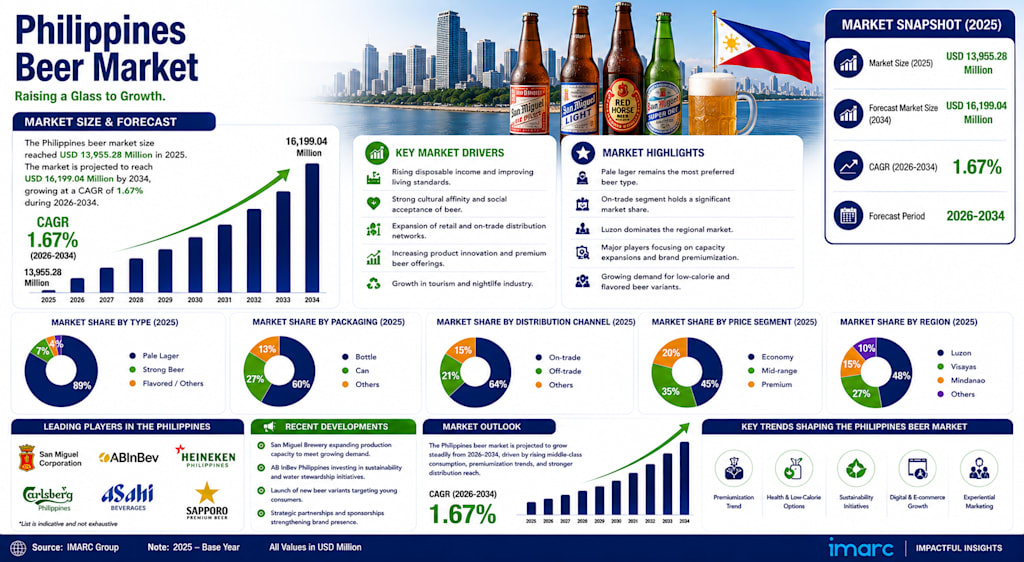
The Philippines beer market continues to demonstrate resilience as the world's third-largest beer economy by consumption volume. According to IMARC Group, the market size reached USD 13,955.28 Million in 2025 and is projected to reach USD 16,199.04 Million by 2034, exhibiting a compound annual growth rate (CAGR) of 1.67% during 2026–2034. Beer dominates Philippine alcohol consumption, accounting for about 74 percent of total alcohol volume in 2024, with spirits at 25 percent and wine minimal. Domestic mid-priced lager remains the dominant choice among Filipinos, with total volume sales in 2025 finally returning to pre-pandemic levels.
What's Driving Market Growth?
San Miguel Brewery's Unassailable Category Leadership. San Miguel Brewery Inc., a wholly owned subsidiary of San Miguel Food and Beverage Inc. (SMFB), continues to maintain undisputed category leadership in the Philippines beer market. In 2025, the beer business recorded consolidated revenues of P155.4 billion (approximately USD 2.7 billion), broadly steady from P153.36 billion posted in 2024, as strong cost control measures helped maintain earnings despite softer domestic demand. San Miguel Brewery's international beer sales grew by 2 percent to USD 144.8 million, led by markets in South China and Vietnam, partially offsetting the 1 percent dip in domestic revenue to P74.6 billion in the first half of 2025.
Sari-sari Stores: The Backbone of Nationwide Distribution. Sari-sari stores remain fundamental to nationwide beer distribution in the Philippines. These ubiquitous neighbourhood outlets, operating from bustling city streets to remote provincial villages, ensure that beer remains accessible to every segment of the population. Red Horse Beer, San Miguel's iconic strong lager recognisable by its bold red label, is a staple everywhere: from bustling city bars and open-air sari-sari stores to karaoke joints and backyard "inuman" sessions. Beyond traditional retail, San Miguel Brewery operates a delivery service in selected Metro Manila and Cebu areas through its "632-BEER" hotline and online ordering platform (www.smbdelivers.com), bridging traditional and digital distribution.
Emerging Craft and Premium Beer Segment. While craft and imported beer together account for around 1 percent of consumption according to recent USDA market data, this segment is growing rapidly. The Philippines craft beer market reached USD 702.5 Million in 2025 and is projected to reach USD 1,610.8 Million by 2034, exhibiting a remarkable CAGR of 9.37%. Urban consumers with rising disposable incomes are driving this premiumisation trend, with breweries introducing new flavors and packaging innovations to attract discerning customers.
Flavour Innovation and New Product Launches. Major brewers are responding to changing consumer preferences with innovative offerings. In January 2026, San Miguel Brewery launched San Miguel Mango Yuzu, a limited-edition beer that will be sold through to 30 September 2026. Distribution channels include selected bars and restaurants, supermarkets and convenience stores nationwide, the direct-to-consumer channel SMB Delivers, and major Philippine e-commerce and quick-commerce platforms. Asia Brewery's introduction of spirit-based RTDs like AB Origins Yuzu High Ball and Pacific Sun Hard Iced Tea in 2025 demonstrates the broadening product landscape.
Emerging Craft Brewery Ecosystem Beyond Manila. Southern Philippines is emerging as a "beer oasis" with craft breweries gaining traction outside the capital region. Crazy Carabao, named after the Philippines' national animal, transformed a modest craft operation into a sprawling 762-square-metre facility with gleaming stainless-steel fermenters, increasing production 36 fold to over 22,000 bottles per week. District Brewing Company launched a new brewpub in Mandaluyong City's Greenfield District in February 2026, hosting Collabrewnation, a two-day craft beer festival designed to showcase collaborative brews with brewing partners from across Asia.
Market Segmentation & Key Insights
By Product Type, the market includes pilsner/lager (overwhelmingly dominant), stout/dark beer, and emerging specialty and flavoured segments. Beer sustains moderate growth, with pilsen remaining hugely popular and consumed at events and special occasions.
By Packaging Type, the market includes can, bottle, and draught beer. Cans and bottles predominate for retail and sari-sari store channels, while draught beer is expanding due to rising consumer interest in craft beers and premium beverage experiences in gastropubs and bars.
By Distribution Channel, the market is segmented into sari-sari stores, supermarkets and hypermarkets, convenience stores, bars and restaurants, and online platforms. Sari-sari stores remain fundamental to nationwide beer distribution.
By Region, major markets include Luzon (National Capital Region and surrounding provinces), Visayas, and Mindanao. The Philippines beer industry is a mature market with established import and export channels, serving both domestic demand and international export markets.
What the Opportunities Are?
Premiumisation and Craft Brand Development. While craft beer represents only 1 percent of consumption today, the segment's double digit growth trajectory (9.37% CAGR through 2034) presents significant opportunities for new entrants and brand extensions. With rising disposable incomes and the growing nightlife culture in urban centres, premium and high-quality beer offerings are positioned for strong growth.
International Export Expansion. San Miguel's success in South China and Vietnamese markets demonstrates the export potential for Philippine beer brands. The Philippines beer export market is projected to grow substantially over the medium term, with opportunities for both established brands and emerging craft players to capture market share in neighbouring Asian economies.
Flavour Innovation and Health Oriented Products. Changing consumer preferences are opening opportunities for flavoured, low alcohol and sober curious product lines. Improving economic conditions and the revival of on trade spending are driving beer sales, while flavoured and low alcohol variants are gaining traction among younger, health conscious demographics.
E Commerce and Direct-to-Consumer Channels. E commerce will make a greater contribution to sales during the forecast period. San Miguel's SMB Delivers platform demonstrates the viability of direct-to-consumer beer sales in select metro areas. Expansion of digital ordering capabilities, integration with on-demand delivery apps and cold chain logistics improvements can unlock new customer segments, particularly among urban millennials and Gen Z consumers.
International Brand Entry and Strategic Partnerships. International brewers continue to see the Philippines as an attractive market. South Korea's Daily Beer entered the Philippines through a strategic partnership with OPV, opening its first 100 seater flagship branch at Arcovia City in November 2025, followed by a location at SM Fairview in December 2025 and Paseo Parkway, Salcedo in April 2026. Similar partnership models could facilitate entry for other international craft and premium brands.
Recent News and Developments in Philippines Beer Market
January 2026: San Miguel Brewery launched San Miguel Mango Yuzu, a limited-edition beer sold through to 30 September 2026. Distribution includes bars, restaurants, supermarkets, convenience stores, SMB Delivers, and major e commerce platforms.
February 2026: District Brewing Company officially launched its new brewpub in Mandaluyong City's Greenfield District, hosting Collabrewnation, a two-day craft beer festival featuring collaborative brews with brewing partners from across Asia.
February 2026: Engkanto Brewery hard opened another taproom in Metro Manila, following the brand's earlier taproom launches in a strategy to steadily build a consumer-facing footprint alongside its wider on- and off-trade distribution.
March 2026: SMFB reported consolidated revenues of P419.1 billion (approximately USD 7.3 billion) for full-year 2025, up 5 percent from P400.87 billion in 2024, with a 13 percent increase in net income to P46.3 billion. The beer business recorded stable revenues of P155.4 billion.
April 2026: StrategyHelix projected Philippine beer market expansion from USD 7.4 billion in 2025 to USD 11.7 billion by 2030, representing a 9.71% CAGR, underscoring the significant growth potential ahead.
April 2026: The broader alcoholic beverages market in the Philippines was valued at approximately USD 7.2 billion in 2025 and is projected to reach USD 8.6 billion by 2034 at a CAGR of 2.00%, reinforcing beer's dominant position.
Why Should You Know About Philippines Beer Market?
You should know about this market because it captures how brand dominance, traditional distribution networks and emerging premiumisation intersect to create one of the most resilient and culturally significant beverage markets in Southeast Asia. Beer is no longer a simple commodity in the Philippines — it is an integral part of social fabric, from humble sari-sari stores to trendy craft taprooms.
For investors, the Philippines beer market offers exposure to a mature but stable consumer staple category anchored in San Miguel Brewery's 90 year leadership, the archipelago's vast and efficient distribution infrastructure, and a youthful population of over 100 million with rising disposable incomes. The projected CAGR of 1.67% reflects steady baseline demand, while higher growth sub segments — including craft beer (9.37% CAGR), flavoured and low alcohol variants, and international export markets — offer differentiated upside potential. San Miguel's brand value of USD 1.7 billion and AAA+ brand strength rating (BSI score 91.4/100) underscore the enduring equity of Philippine beer brands.
For beverage executives, distribution partners, retail planners and strategic investors, understanding segmentation between mass market pilsner, growing premium craft and developing RTD categories helps shape intelligent product development, channel strategies and market entry decisions that deliver measurable volume, brand loyalty and profitability outcomes.
In essence, the Philippines beer market captures how cultural identity, distribution efficiency and premium evolution converge — making it a compelling area for investors, brand managers and strategists seeking smarter approaches to category expansion, export growth and consumer engagement in one of Asia's most vibrant and loyal beer-drinking nations.
About the Creator
Thomas
Market Research Analyst | Industry Trends & Forecasting | Turning market data into clear, actionable business insights across global sectors.
Enjoyed the story? Support the Creator.
Subscribe for free to receive all their stories in your feed.
Comments
There are no comments for this story
Be the first to respond and start the conversation.