
Philippines Banking Software Market: Digital Banking Expansion, Fintech Innovation & Cloud-Based Transformation
Rising adoption of digital banking services, increasing fintech integration, and growing demand for secure cloud-based solutions are driving strong growth in the Philippines banking software market

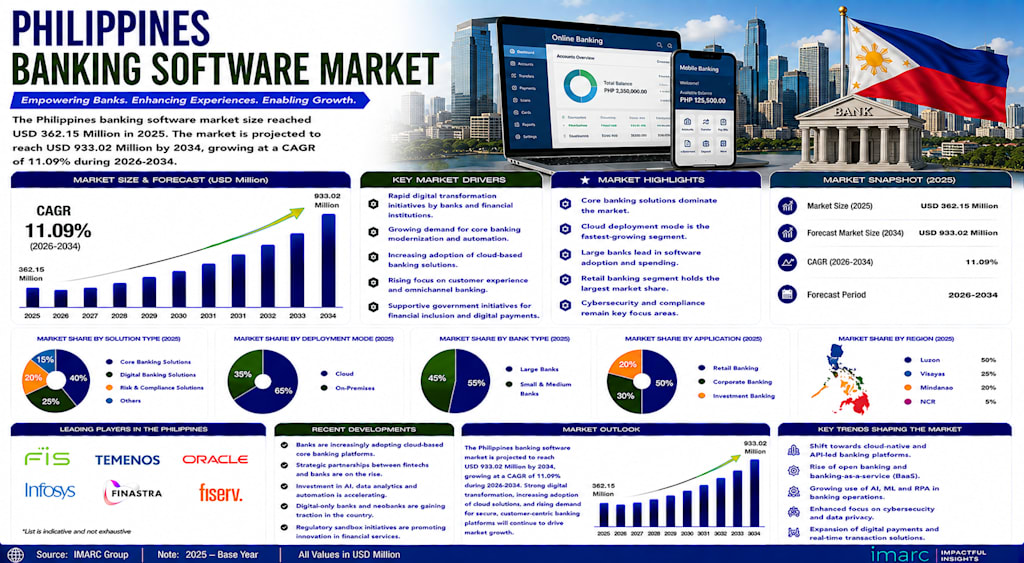
The Philippines banking software market is experiencing a transformative acceleration as financial institutions across the archipelago abandon legacy systems in favour of cloud-native platforms, AI-powered analytics and integrated compliance solutions. Banking software — encompassing core banking systems, digital banking platforms, risk management solutions, compliance software and cybersecurity tools — is deployed across universal banks, digital banks, rural banks and fintech players to enable real‑time transactions, enhance customer experience and meet tightening regulatory requirements. According to IMARC Group, the market size reached USD 362.15 Million in 2025 and is projected to reach USD 933.02 Million by 2034, exhibiting a robust compound annual growth rate (CAGR) of 11.09% during 2026–2034.
The market is driven by government‑led digital payment transformation initiatives accelerating financial inclusion, rapid expansion of cloud‑native digital banking platforms responding to regulatory support, and integration of artificial intelligence for enhanced fraud prevention and risk management across financial institutions. As the Bangko Sentral ng Pilipinas pushes toward digitalisation of retail payments and expands Open Finance frameworks, banking software has become the strategic foundation for the country's financial future.
What's Driving Market Growth?
Government-Led Digital Payment Transformation and Financial Inclusion. The Philippine government, through the Bangko Sentral ng Pilipinas, is orchestrating comprehensive digital transformation across the banking sector. The BSP's 2024-2026 Digital Payments Transformation Roadmap emphasises cross‑border payment interoperability through Project Nexus and Open Finance initiatives, necessitating sophisticated banking software infrastructure. The Paleng-QR Ph programme exemplifies grassroots digital adoption, having enabled digital payments in public markets across numerous local government units. Digital payments via QR Ph now account for over half of total digital transactions, up significantly from previous years. The BSP's lifting of the digital banking moratorium in August 2024 enables up to ten licensed digital banks, spurring competition and software modernisation investments across traditional and digital banking institutions.
Cloud Banking and Core Banking SaaS Expansion. Financial institutions are rapidly migrating from on‑premise legacy systems to cloud‑native platforms that offer scalability, cost efficiency and faster time‑to‑market for new products. The Philippines Cloud Banking and Core Banking SaaS Market is valued at over a billion dollars, driven by digital adoption and fintech growth, with Metro Manila leading the region. This growth is primarily driven by the increasing adoption of digital banking solutions, the rise of fintech companies, and the need for enhanced operational efficiency among traditional banks. The future of the cloud banking and core banking SaaS market appears promising, driven by ongoing digital transformation and regulatory support.
Digital Banking License Expansion and Intensified Competition. The expansion of digital banking licenses from six to ten institutions is intensifying competition and accelerating software modernisation investments. Digital banks are leveraging banking software to offer differentiated services, lower fees and superior user experiences, forcing traditional banks to modernise their core systems. The Philippines Digital Banking and Neo Banks Market is valued at over half a billion dollars, driven by smartphone penetration and cashless transactions, with growth concentrated in Metro Manila, Cebu and Davao. As the government continues to push for financial inclusion, digital banks are likely to expand their services to rural areas, enhancing accessibility.
AI Integration for Fraud Prevention and Risk Management. Artificial intelligence is revolutionising the Philippines banking software market by enabling real‑time fraud detection systems that combat the country's elevated digital fraud rate, predictive credit scoring models utilising alternative data sources for underserved populations, and multilingual conversational AI platforms that streamline customer onboarding and service delivery. The BSP has documented widespread AI adoption across supervised financial institutions, with use cases spanning anti‑money laundering systems, behavioural analytics and hyper‑personalisation. As the Philippine AI‑in‑fintech market surges, banking software vendors are integrating machine learning capabilities for automated underwriting, risk assessment and operational efficiency.
World Bank Funding and Infrastructure Investment. The World Bank's Digital Transformation Development Policy Loan is catalysing infrastructure improvements, enhancing connectivity and promoting secure digital financial services, creating sustained demand for advanced banking software solutions that support financial inclusion objectives while meeting stringent cybersecurity requirements.
Market Segmentation & Key Insights
By Component, the market is divided into Solution and Service. Solutions dominate, encompassing core banking software, risk management platforms and digital banking applications, while services include implementation, integration and managed services.
By Deployment Mode, the market is segmented into On‑premises and Cloud. Cloud deployment is the fastest‑growing segment, driven by scalability, cost efficiency and the rise of digital‑native financial institutions.
By End User, the market serves Banks and Financial Institutions. Banks account for the largest share, but fintech companies and non‑bank financial institutions are rapidly expanding their software investments.
By Region, the market covers Luzon, Visayas and Mindanao. Luzon — particularly Metro Manila — dominates due to the concentration of major banks, fintech headquarters and technology infrastructure.
What the Opportunities Are?
Core Banking Modernisation for Traditional Banks. With the BSP's digital transformation roadmap accelerating, traditional banks are under pressure to modernise legacy core banking systems. Providers offering end‑to‑end core banking solutions — including cloud‑native architectures, real‑time processing and API‑first design — will capture substantial market share as institutions seek to compete with digital‑native challengers.
Open Finance and Data Sharing Infrastructure. The BSP's Open Finance Framework accelerates financial innovation by enabling secure data sharing and interoperability. The proposed Open Finance and Consumer Data Empowerment Act seeks to establish the country's first comprehensive legal framework for consumer‑directed financial data sharing. This creates significant opportunities for software providers offering API management platforms, consent management systems and data aggregation tools.
AI‑Powered Compliance and Anti‑Money Laundering Solutions. With numerous supervised financial institutions already adopting AI across AML systems, behavioural analytics and hyper‑personalisation, there is strong demand for AI‑powered compliance software that automates transaction monitoring, suspicious activity reporting and regulatory reporting. The compliance software segment is growing rapidly as banks face increasing regulatory scrutiny.
Digital Banking Platforms for Rural and Underserved Markets. Rural banks are increasingly utilising open payments platforms, boosting the government's bid to include more people in the digital financial system. Providers offering lightweight, cost‑effective digital banking platforms tailored for rural banks and microfinance institutions can capture the underserved segment.
Cybersecurity and Fraud Prevention Solutions. With the Philippines experiencing an elevated digital fraud rate, there is urgent demand for advanced cybersecurity software, including real‑time fraud detection, identity verification and biometric authentication solutions. Banking software vendors integrating AI‑powered fraud prevention will capture premium segments.
Recent News and Developments in Philippines Banking Software Market
June 2026: The BSP issued Circular No. 1237, outlining rules for the adoption and participation of BSP‑supervised financial institutions in digital financial marketplaces or platforms.
May 2026: Lawmakers filed the proposed Open Finance and Consumer Data Empowerment Act of 2025, seeking to establish the country's first comprehensive legal framework for consumer‑directed financial data sharing.
January 2026: The Philippines digital payments landscape was reported to be entering a "mature phase," shaped as much by infrastructure and regulation as by consumer behaviour. Success in the sector will increasingly be measured by how consistently digital payments function across consumers, merchants and financial institutions.
November 2025: LANDBANK powered impressive digital transactions in the first nine months of 2025, marking a significant increase in value and volume year‑on‑year, demonstrating that Filipinos are embracing fast, secure and convenient digital solutions.
August 2025: The BSP launched the Open Finance for PERA Pilot, enabling Filipinos to open PERA accounts by logging into their chosen provider's platform and authorising bank or e‑wallet KYC data sharing.
July 2025: Eight rural banks pioneered SynerFi, an open payments platform operated by technology firm higala.ph, with more rural banks expected to join within the year, boosting the government's bid to include more people in the digital financial system.
Why Should You Know About Philippines Banking Software Market?
You should know about this market because it captures how regulatory reform, cloud technology and AI innovation intersect to transform one of Southeast Asia's most dynamic financial sectors. Banking software is no longer a back‑office utility — it is the strategic platform that enables digital banks to reach unbanked populations, empowers rural banks to participate in open finance ecosystems, and equips traditional institutions to defend against the country's elevated digital fraud rate.
For investors, the banking software market offers exposure to a high‑growth financial technology category anchored in the BSP's aggressive digital transformation roadmap, the World Bank's Digital Transformation Development Policy Loan, and the structural shift from on‑premise legacy systems to cloud‑native platforms. The projected CAGR of 11.09% — transforming a USD 362 million market into a USD 933 million market by 2034 — reflects strong confidence in regulatory tailwinds, technological adoption and the country's rapid financial inclusion trajectory.
For banking executives, technology vendors and financial services investors, understanding segmentation across core banking, digital platforms and compliance solutions, the emerging Open Finance framework and the accelerating role of AI in fraud prevention helps shape intelligent investment decisions, product roadmaps and strategic partnerships that deliver measurable operational efficiency, regulatory compliance and customer acquisition outcomes.
In essence, the Philippines banking software market captures how digital sovereignty, financial inclusion and technological innovation converge — making it a compelling area for investors, software vendors and financial institutions seeking smarter approaches to core modernisation, secure digital payments and sustainable growth across one of Asia's most rapidly digitising financial landscapes.
About the Creator
Thomas
Market Research Analyst | Industry Trends & Forecasting | Turning market data into clear, actionable business insights across global sectors.
Enjoyed the story? Support the Creator.
Subscribe for free to receive all their stories in your feed.
Comments
There are no comments for this story
Be the first to respond and start the conversation.