
Philippines Automotive Market 2026: Vehicle Demand, Urban Mobility & EV Adoption
How rising incomes, infrastructure growth and financing access are shaping the Philippines’ automotive industry

Philippines Automotive Market Overview
The Philippines automotive market is a key component of the country’s transportation and manufacturing sector, encompassing passenger cars, commercial vehicles and emerging electric vehicle (EV) segments. The market plays a crucial role in supporting mobility, logistics and economic development across urban and rural areas.
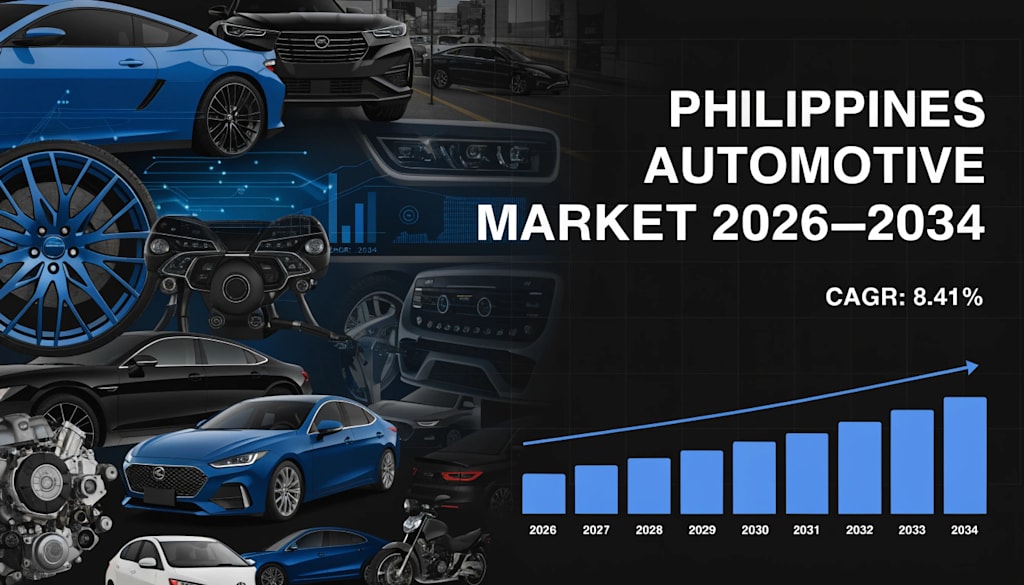
According to IMARC Group, the Philippines automotive market size reached 515.4 Thousand Units in 2025 and is projected to reach 1,089.2 Thousand Units by 2034, exhibiting a compound annual growth rate (CAGR) of 8.41% during 2026–2034.
The market is experiencing strong growth, driven by rising disposable incomes, increasing demand for personal mobility and ongoing infrastructure development. Expanding financing options and the introduction of new vehicle models are further supporting market expansion.
Key Market Drivers
Rising Middle-Class Population and Urbanization
The growing middle class and increasing urban migration are driving demand for personal vehicles, particularly in major cities where mobility and convenience are essential.
Improved Access to Vehicle Financing
Flexible auto loan options, lower interest rates and digital lending platforms are making car ownership more accessible to a wider population.
Expansion of Infrastructure Development
Government initiatives to improve road networks, highways and connectivity are making vehicle ownership more practical and attractive across regions.
Growth of Commercial Vehicle Demand
Increasing logistics, e-commerce and business activities are driving demand for commercial vehicles, including trucks and vans.
Introduction of New Models and Technological Advancements
Automakers are launching new models with advanced features, improved fuel efficiency and enhanced safety systems, attracting consumers and boosting sales.
Request a Sample Report with the Latest 2026 Data & Forecasts
What the Opportunities Are
The Philippines automotive market presents strong growth opportunities as mobility needs and technology adoption continue to evolve.
Expansion of Electric Vehicle (EV) Segment
Government incentives, environmental awareness and rising fuel costs are supporting the gradual adoption of electric vehicles, creating new market opportunities.
Growth of Used Car Market
Demand for affordable mobility solutions is boosting the used car segment, supported by online marketplaces and certified pre-owned programs.
Development of Digital Automotive Retail
Online platforms, virtual showrooms and digital financing solutions are transforming how consumers research and purchase vehicles.
Increasing Demand in Provincial Areas
Improved infrastructure is opening up new markets beyond major cities, driving vehicle demand in emerging regions.
Integration of Smart and Connected Vehicle Technologies
Advancements in connectivity, AI and telematics are enhancing user experience and creating opportunities for innovation in the automotive sector.
Recent News and Developments
April 2026: The Philippines automotive market is witnessing strong electrification momentum, with the launch of new hybrid SUVs such as the Jaecoo J5 in April 2026, starting at around ₱999,000, reflecting growing affordability and adoption of hybrid vehicles in the country.
March 2026: The Philippines automotive industry recorded 492,558 total vehicle sales in 2025, up from 475,094 units in 2024, indicating steady growth in demand driven by economic recovery and rising consumer purchasing power.
February 2026: The market continues to be highly concentrated, with Toyota holding 46.21% market share (227,595 units sold in 2025), followed by Mitsubishi at 17.62%, highlighting strong brand dominance in the Philippine automotive sector.
January 2026: Electrification trends are strengthening with hybrid and EV model launches such as the Toyota Vios hybrid variant introduced in late 2025, reflecting increasing integration of fuel-efficient and low-emission vehicles in the market.
December 2025: The Philippines automotive market reached a value of USD 17.2 billion in 2025, supported by rising vehicle ownership, urbanization, and expanding middle-class income levels.
November 2025: SUVs and multipurpose vehicles (MPVs) continue to dominate demand, accounting for a significant share of total vehicle sales, driven by consumer preference for larger, versatile vehicles suited to local road conditions.
October 2025: The Philippines automotive market remains heavily import-dependent, with a large portion of vehicles sourced from Thailand, Indonesia, and China, reflecting limited domestic manufacturing capacity and strong regional trade integration.
September 2025: Government policies supporting cleaner mobility remain in place, including zero tariffs on electric vehicles and components, reducing costs by 5%–30% previously, and accelerating EV adoption across the country.
Why You Should Know About the Philippines Automotive Market?
The Philippines automotive market plays a crucial role in enabling mobility, supporting economic activity and driving industrial growth.
With projected growth from 515.4 Thousand Units in 2025 to 1,089.2 Thousand Units by 2034, the market demonstrates strong expansion potential driven by urbanization, rising incomes and technological advancements.
As consumer demand for mobility continues to rise and the industry evolves toward electrification and digitalization, the Philippines automotive market is expected to remain a key contributor to the country’s economic development and transportation ecosystem.
About the Creator
Enjoyed the story? Support the Creator.
Subscribe for free to receive all their stories in your feed.
Comments
There are no comments for this story
Be the first to respond and start the conversation.