
Philippines ATM Market 2026: Banking Expansion, Cash Accessibility & Smart ATM Technologies Driving Growth
How financial inclusion initiatives, digital banking transformation, and self-service banking solutions are shaping the Philippines ATM industry

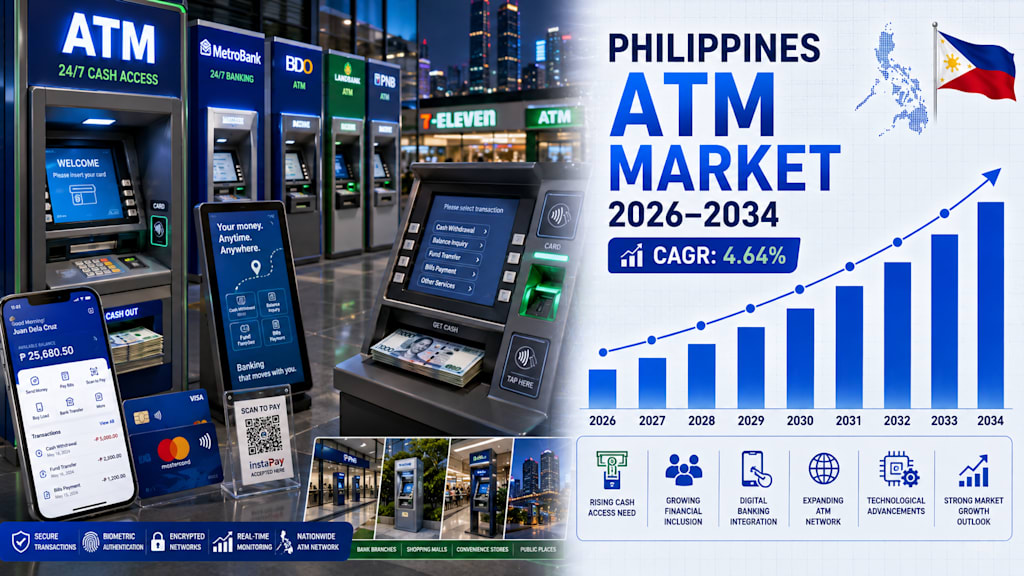
Philippines ATM Market Overview
The Philippines ATM market is an important component of the country’s banking and financial services infrastructure, involving automated teller machines (ATMs) used for cash withdrawals, fund transfers, bill payments, balance inquiries, and other self-service banking transactions.
According to IMARC Group, the Philippines ATM market size reached USD 115.1 Million in 2025 and is projected to reach USD 176.8 Million by 2034, exhibiting a compound annual growth rate (CAGR) of 4.64% during 2026–2034.
The market is experiencing steady growth driven by increasing banking penetration, rising demand for convenient cash access, expansion of financial services in rural areas, and the adoption of smart ATM technologies.
Key Market Drivers
Expansion of Banking and Financial Inclusion
Government and banking sector initiatives aimed at improving financial inclusion are encouraging ATM deployment across underserved and rural regions in the Philippines.
Rising Demand for Convenient Banking Services
Consumers continue to rely on ATMs for fast and accessible banking transactions, particularly for cash withdrawals and account management services.
Growth of Digital and Self-Service Banking
Banks are increasingly adopting self-service technologies to improve customer convenience, reduce branch congestion, and optimize operational efficiency.
Increasing Urbanization and Consumer Spending
Growing urban populations and higher transaction volumes are contributing to increased ATM usage across commercial and residential areas.
Adoption of Smart ATM Technologies
Advanced ATMs with features such as cardless withdrawals, biometric authentication, contactless transactions, and cash recycling are gaining popularity.
Request a Sample Report with the Latest 2026 Data & Forecasts
What the Opportunities Are
Expansion into Rural and Remote Areas
Financial institutions are increasingly deploying ATMs in underserved communities to improve banking accessibility and support financial inclusion goals.
Growth of Biometric and Contactless ATM Solutions
Biometric verification and NFC-enabled transactions are creating opportunities for more secure and convenient banking experiences.
Integration with Digital Payment Ecosystems
ATMs are evolving to support digital banking functions such as QR-based transactions, e-wallet top-ups, and account onboarding services.
Increasing Demand for Cash Recycling Machines
Banks are adopting cash recycling ATMs to reduce cash handling costs and improve operational efficiency.
Development of Multi-Function Smart ATMs
Modern ATMs offering services such as loan applications, bill payments, and digital account services are enhancing customer engagement.
Recent News and Developments
April 2026: The Philippines ATM market is undergoing modernization as banks increasingly adopt digital and self-service banking technologies. Financial institutions are deploying advanced ATMs with cardless withdrawal, biometric authentication, and QR-based transaction capabilities to improve customer convenience and reduce branch congestion. The shift reflects rising digital banking adoption and growing demand for 24/7 financial services access.
March 2026: The Philippines banking sector continues expanding ATM accessibility, particularly in underserved and rural regions. According to central bank data, the country had more than 23,000 ATMs installed nationwide in 2025, supported by ongoing financial inclusion initiatives and expansion of digital banking infrastructure.
February 2026: ATM usage patterns are evolving as cashless transactions increase across the country. While digital payments continue to grow rapidly, cash withdrawals remain significant for retail purchases and remittances, particularly outside major urban centers. This is encouraging banks to maintain and upgrade ATM networks despite rising digital payment adoption.
December 2025: Security and fraud prevention are becoming major priorities in the ATM ecosystem. Banks are increasingly investing in anti-skimming technologies, encrypted transactions, and AI-based fraud monitoring systems as cybercrime and digital banking threats continue to evolve across Southeast Asia.
2025–2026 (market trend): The Philippines ATM market is being shaped by financial inclusion initiatives, digital transformation in banking, and increasing integration of contactless and mobile banking technologies. At the same time, rising maintenance costs, cybersecurity concerns, and growing consumer preference for digital wallets and cashless payments continue to influence ATM deployment strategies and transaction volumes.
Why You Should Know About the Philippines ATM Market?
The Philippines ATM market continues to play a crucial role in the country’s banking infrastructure and financial inclusion strategy.
With projected growth from USD 115.1 Million in 2025 to USD 176.8 Million by 2034, the market demonstrates stable expansion driven by rising banking accessibility, technological innovation, and growing demand for self-service financial solutions.
As banks continue modernizing their ATM networks with smart technologies and digital integration, ATMs are expected to remain an essential channel for convenient and secure financial services across the Philippines.
About the Creator
Enjoyed the story? Support the Creator.
Subscribe for free to receive all their stories in your feed.
Comments
There are no comments for this story
Be the first to respond and start the conversation.