
Philippines Animal Vaccines Market 2026: ASF Battle, Poultry Defense & Pet Care Integration
How ₱151 million government vaccine R&D, a ₱200 billion livestock modernization law, and a 90% ASF efficacy rate are reshaping Philippine animal health

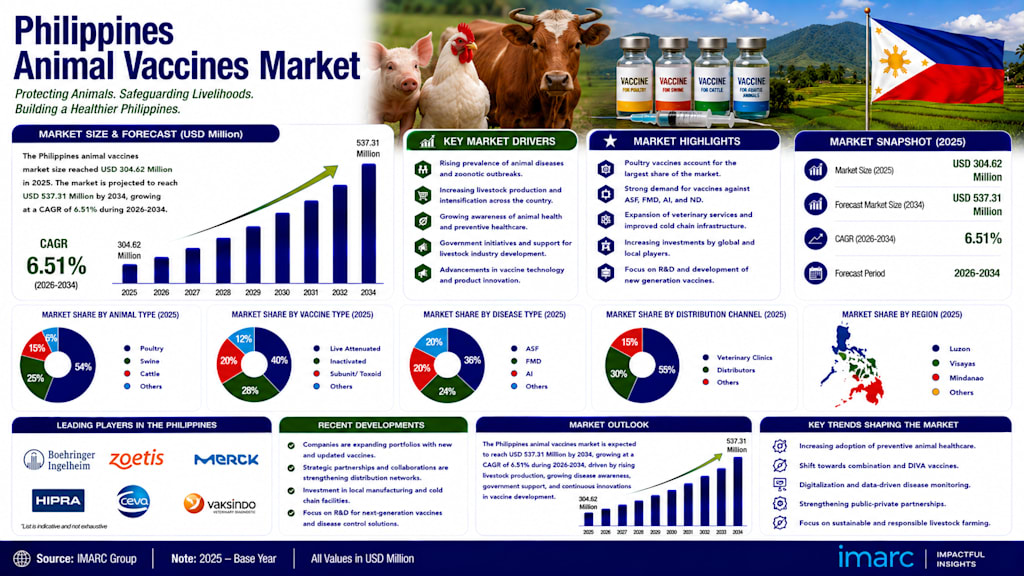
The Philippines animal vaccines market is at the epicentre of the nation's fight for food security, as the government wages an aggressive, multi front war against devastating livestock diseases that have crippled the swine and poultry industries. Animal vaccines — including attenuated, inactivated, subunit, toxoid, recombinant and DNA formulations — are deployed across commercial poultry and swine farms, backyard livestock operations and urban veterinary clinics to protect against African swine fever (ASF), highly pathogenic avian influenza (HPAI), foot and mouth disease (FMD), Newcastle disease, rabies and an expanding range of companion animal conditions | 8†L21-L24. According to IMARC Group, the market size reached USD 304.62 Million in 2025 and is projected to reach USD 537.31 Million by 2034, exhibiting a compound annual growth rate (CAGR) of 6.51% during 2026 2034 | 0†L10-L13. As the DA fast tracks vaccine approvals, the Philippine swine population remains at only 60% of its pre ASF levels, and the poultry sector battles a virus that has caused the culling of over 10 million chickens — animal vaccines have become the most critical tool for rebuilding national protein security | 17†L22-L27.
What's Driving Market Growth?
Government Led War on ASF and Avian Influenza. The single most powerful catalyst for vaccine demand is the government's determined campaign against ASF. Since the first ASF outbreak in 2019, the Philippine swine industry has suffered billions in losses, with the current swine population only 60 percent of nearly 13 million heads before the outbreak | 17†L22-L25. The DA BAI has been using the AVAC live ASF vaccine from Vietnam, and the government supervised vaccination programme has recorded an efficacy rate of 90 percent among healthy, ASF negative hogs | 15†L10-L12. Nearly 500,000 pigs have been vaccinated across 12 semi commercial farms, nine smallholder farms and one government run farm | 15†L14-L16. ASF affected barangays have declined by 92 percent from 98 in late December 2025 to just 8 by mid January 2026 | 10†L34-L36. For poultry, the FDA approved the country's first HPAI vaccine (Volvac B.E.S.T. AI plus ND) in August 2025, which also protects against velogenic Newcastle disease | 14†L9-L12. Ceva Animal Health launched its Vectormune HVT AIV vaccine in November 2025, making the Philippines the 52nd country to register this vector vaccine technology | 3†L44-L48.
Landmark Infrastructure and Legislative Investment. The government is building long term self sufficiency. In April 2025, the Department of Agriculture inaugurated a vaccine unit at the Center for Transboundary Animal Diseases (CenTrAD) in Nueva Ecija, a state of the art facility with PHP 151 million allocated for a three year vaccine development programme | 17†L11-L16. The new PHP 200 billion (US$3.43 billion) livestock, poultry and dairy law passed in October 2025 specifically mandates building local capacity for producing vaccines against ASF, Newcastle disease and avian influenza, reducing reliance on imports and improving national biosecurity | 5†L27-L29, 5†L39-L42. The DA has allocated PHP 151 million for a three year programme, including the country's first Biosafety Level 3 Laboratory (BSL 3), which enables research on highly lethal microbes through inhalation | 17†L12-L15.
Expansion of Commercial Livestock and Commercial Farming. The growth of large scale poultry and swine farming operations demands comprehensive, vaccination based biosecurity protocols. The Philippine poultry sector, including eggs, generated a production value of PHP 362 billion in 2024, and the DA is targeting pork production to increase at an average of 1.77 percent (from 1.768 million MT to 1.933 million MT) and chicken production at 1.96 percent (from 1.904 million MT to 2.102 million MT) under the 2023 2028 Philippine Development Plan | 14†L20-L21, 11†L25-L28. Backyard and semi commercial farms are also formalising vaccination schedules as biosecurity becomes a mainstream practice. Rising domestic demand for animal protein from a growing population is compelling farmers to invest in preventive healthcare measures that minimise disease related production losses | 19†L147-L149.
Pet Humanisation and Urban Companion Animal Adoption. The fastest growing segment of the market is companion animal vaccines. Rising disposable incomes in urban Filipino households, combined with government led rabies education campaigns, have made routine vaccinations for dogs and cats a standard part of pet ownership. Government education campaigns and media coverage highlighting rabies prevention are raising public awareness about the critical importance of mandatory vaccination protocols | 19†L158-L160. The modernisation of veterinary healthcare infrastructure, including the expansion of private veterinary clinics and diagnostic laboratories across metropolitan areas, is improving access to vaccination services | 19†L160-L163. The companion animal vaccines segment is registering the fastest growth trajectory, with comprehensive preventive care programmes now covering rabies, parvovirus, distemper and feline respiratory diseases | 10†L51-L55.
Market Segmentation & Key Insights
By Product Type, the market includes attenuated vaccines, inactivated vaccines, subunit vaccines, toxoid vaccines, conjugate vaccines, recombinant vaccines and DNA vaccines. Attenuated vaccines command the largest share due to their strong immune response and suitability for mass poultry and swine vaccination programmes | 10†L39-L42. By Animal Type, livestock animals (cattle, pigs, sheep) dominate, driven by the scale of commercial farming, but companion animals (dogs, cats) are the fastest growing segment | 10†L43-L46, 10†L51-L55. By Route of Administration, intramuscular leads, offering reliable vaccine delivery across diverse species, while subcutaneous and intranasal routes are gaining traction for companion animal applications | 8†L23-L24. By Region, the market covers Luzon, Visayas and Mindanao, with Luzon hosting the majority of commercial farms and the new CenTrAD facility | 8†L25-L26.
What the Opportunities Are?
Domestic Vaccine Manufacturing Through CenTrAD and Public Private Partnerships. The Philippine government is actively seeking partners to develop, manufacture and distribute vaccines based on indigenous disease strains, which are more effective against local virus variants than imported products. The DA has already stated that locally developed vaccines tend to be more effective in preventing outbreaks | 17†L17-L19. With the new BSL 3 laboratory and the PHP 151 million three year programme aiming to deliver vaccine prototypes by 2028, the government is open to private sector collaboration. These companies have also established cold chain distribution networks and technical support systems serving both commercial and government procurement channels.
Next Generation Recombinant and DNA Vaccines. While the Philippine market has been dominated by conventional attenuated and inactivated vaccines, recombinant and DNA vaccines are gaining significant attention for their improved safety profiles and the ability to differentiate vaccinated animals from infected ones | 10†L56-L58. Zoetis launched Vanguard Recombishield in November 2025 for companion animals, and Ceva's Vectormune HVT AIV uses innovative vector vaccine technology. Multivalent vaccines that combine multiple diseases into a single dose reduce injection stress and simplify logistics — a major advantage for smallholder farms with limited handling capacity.
Cold Chain Infrastructure and Last Mile Distribution. The Philippine archipelago makes vaccine distribution extremely challenging. Maintaining the cold chain from central depots to remote island farms requires significant investment in portable refrigeration, temperature controlled transport and real time monitoring technology. Modernisation of cold chain infrastructure is improving vaccine distribution, with investments in temperature controlled storage and transportation ensuring vaccine potency reaches remote communities | 19†L120-L124. Companies offering specialised cold chain logistics, portable vaccine carriers and temperature data loggers can secure contracts with both the government and private distributors.
Exports of Philippine Developed Vaccines. Once CenTrAD successfully develops ASF, AI and FMD vaccines, the Philippines could become a regional supplier of vaccines using indigenous strains that are effective against Southeast Asian virus variants. The ASEAN animal health market is large and growing, presenting a significant export opportunity for locally manufactured biologics.
Regulatory Accelerator and Approval Consultancy. The DA and FDA have agreed to a cohesive process to assist vaccine developers in navigating clinical trials and product registration. With the USDA having identified overlapping regulatory functions that have caused confusion for exporters, there is a clear need for consulting services that help international and local companies navigate the dual approval pathway through the Bureau of Animal Industry and the Food and Drug Administration | 12†L40-L43.
Recent News and Developments in Philippines Animal Vaccines Market
May 2026: The DA and FDA announced a strengthened partnership to expedite the rollout of ASF and avian influenza vaccines. The BAI will now refer vaccine applicants directly to the FDA, which will provide feedback and guidance through the approval process | 12†L15-L18. Officials expressed cautious optimism regarding commercial rollout expected before the end of 2026 | 12†L16-L18.
January 2026: The Bureau of Animal Industry reported a 92 percent decline in ASF affected barangays, dropping from 98 in late December 2025 to just 8 by mid January 2026 | 10†L35-L36.
December 2025: Malacañang announced a 90 percent efficacy rate for the government's ASF vaccination campaign. Nearly 500,000 hogs were vaccinated across six provinces | 15†L4-L16.
October 2025: A PHP 200 billion (US$3.43 billion) livestock and dairy law was passed, mandating the building of local capacity for vaccine production against ASF, Newcastle disease and avian influenza | 5†L27-L29, 5†L39-L42.
August 2025: The FDA approved the country's first avian influenza vaccine, Volvac B.E.S.T. AI plus ND. The vaccine provides immunity against H5N1 and velogenic Newcastle disease, both fatal to poultry | 14†L9-L12.
April 2025: The DA inaugurated a vaccine unit at the Center for Transboundary Animal Diseases in Nueva Ecija, allocating PHP 151 million for a three year vaccine development programme. The facility includes the country's first Biosafety Level 3 Laboratory | 17†L4-L16.
Why Should You Know About Philippines Animal Vaccines Market?
You should know about this market because it captures how national food security, public private partnerships and cutting edge biotechnology converge to rebuild an agricultural sector decimated by transboundary diseases. Animal vaccines are no longer just farm inputs — they are strategic national assets that protect the livelihoods of millions of smallholder farmers, secure the country's protein supply and reduce the risk of zoonotic spillover into human populations.
For investors, the animal vaccines market offers exposure to a high growth agricultural technology category anchored in enforceable government spending (PHP 151 million for CenTrAD, PHP 200 billion for livestock modernisation), aggressive disease eradication targets and the structural shift from reactive culling to preventive immunisation. The projected CAGR of 6.51% reflects strong confidence in regulatory momentum, while higher growth sub segments — including recombinant DNA vaccines, companion animal biologics and ASF specific products — offer differentiated upside.
For veterinary pharmaceutical executives, international development partners, contract manufacturers and livestock producers, understanding the segmentation between livestock and companion animals, the newly streamlined regulatory approval pathway, and the emerging domestic production landscape helps shape intelligent investment decisions, technology transfer agreements and procurement strategies that deliver measurable disease suppression, economic recovery and food security outcomes.
In essence, the Philippines animal vaccines market captures how biosecurity, public investment and scientific innovation converge — making it a compelling area for investors, vaccine manufacturers and development partners seeking smarter approaches to livestock disease control, agricultural resilience and national health security in one of Southeast Asia's most dynamic and rapidly recovering agricultural economies.
About the Creator
Thomas
Market Research Analyst | Industry Trends & Forecasting | Turning market data into clear, actionable business insights across global sectors.
Enjoyed the story? Support the Creator.
Subscribe for free to receive all their stories in your feed.
Comments
There are no comments for this story
Be the first to respond and start the conversation.