
Philippines Anesthesia Devices & Drugs Market 2026: Surgical Surge, ASC Expansion & Technology Adoption
How healthcare infrastructure modernization, rising surgical volumes and artificial intelligence are transforming perioperative care across the Philippines

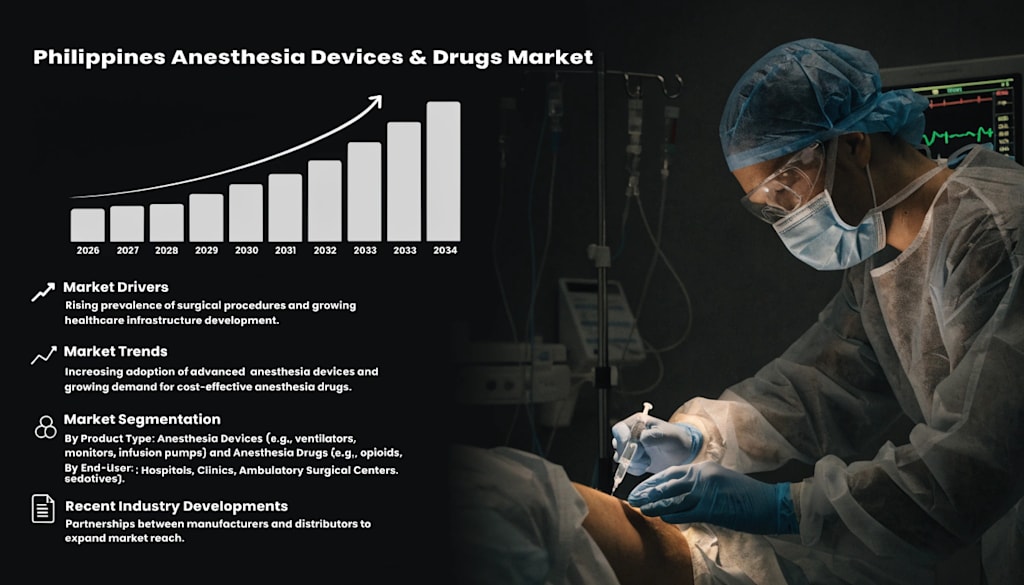
The Philippines anesthesia devices and drugs market is undergoing robust transformation as hospitals, ambulatory surgical centers and clinics increasingly invest in advanced equipment and pharmaceutical agents to support rising surgical volumes and improve patient safety. Anesthesia devices — including workstations, delivery machines, monitors, vaporizers, ventilators and disposables — are deployed across general, cardiac, orthopedic, neurosurgical, ophthalmic and dental procedures, while anesthesia drugs (general and local anesthetics) enable precise sedation, pain management and rapid recovery. According to IMARC Group, the market size reached USD 911.25 Million in 2025 and is projected to reach USD 1,884.72 Million by 2034, exhibiting a strong compound annual growth rate (CAGR) of 8.41% during 2026–2034. As the government modernizes public hospitals, private networks expand ambulatory footprints and artificial intelligence begins to reshape clinical decision-making, anesthesia solutions have become a cornerstone of the country's surgical care ecosystem.
What's Driving Market Growth?
Healthcare Infrastructure Modernization and Public Investment. A primary driver for the anesthesia market is the significant and ongoing investment in modernizing the Philippines' healthcare infrastructure. The government's Health Facility Enhancement Program (HFEP) is central to this effort, focusing on upgrading public hospitals from primary to tertiary care levels. This involves the construction of new facilities and the critical procurement of modern medical equipment, including state-of-the-art anesthesia workstations, monitors and ventilators. The Philippine Department of Health allocated substantial funding in 2024 for procuring modern medical equipment, including anesthesia workstations and monitors, for regional hospitals to enhance surgical capacity and care quality.
In Cebu, the Capitol rolled out newly purchased medical equipment across all 16 provincial and district hospitals, with the next batch of purchases set to cover larger machines, such as anesthesiology units and defibrillators, intended to fill deficiencies listed under the DOH's Regional Local Health Enhancement and Development (RLED). The DAVAO REGIONAL MEDICAL CENTER also announced a tender for the supply, delivery, installation and commissioning of an anesthesia machine with patient monitor, reflecting sustained procurement activity across the country.
Rising Surgical Volumes and Specialized Procedures. The market is experiencing sustained growth due to an increasing volume and complexity of surgical procedures performed across the country. Factors such as a growing and aging population, a rising prevalence of chronic diseases (e.g., cardiovascular conditions, cancers), and improving access to healthcare insurance are contributing to higher demand for surgeries. Notably, there is a marked increase in specialized procedures in fields like cardiology, orthopedics and neurology, which require sophisticated anesthesia management. The Philippine Heart Center, for example, reported an increase in complex cardiac surgeries in its 2024 performance report, directly driving demand for advanced anesthesia monitoring devices and a consistent supply of specialized anesthetic drugs. The anesthesia devices market in the Philippines was estimated to be worth USD 82 million in 2025, with the increasing number of surgeries coupled with rising awareness about advanced medical technology among the primary factors driving growth.
Strategic Focus on Ambulatory Surgical Centers (ASCs). A significant shift in care delivery models is fueling market expansion, characterized by the strategic growth of Ambulatory Surgical Centers (ASCs). Both public policy and private investment are encouraging the migration of suitable procedures from traditional inpatient hospital settings to ASCs, which offer cost-efficiency, convenience and reduced patient wait times. This transition creates a distinct demand for anesthesia solutions tailored for outpatient care, including compact and user-friendly anesthesia delivery machines, short-acting anesthetic drugs that facilitate rapid patient recovery, and efficient disposables. Leading private healthcare networks are actively expanding their ambulatory footprints. In 2024, The Medical City announced the expansion of its ambulatory care services, including the opening of new ASCs, a strategic move that increases demand for compact anesthesia devices and short-acting drugs.
Market Segmentation & Key Insights
By Product Type, the market is divided into anesthesia devices (anesthesia workstations, anesthesia delivery machines, anesthesia monitors, vaporizers, ventilators, and disposables) and anesthesia drugs (general anesthetics, local anesthetics, and others).
By Application, the market includes general surgery, orthopedic surgery, cardiac surgery, neurosurgery, ophthalmic surgery, dental surgery, and others.
By End User, the market is segmented into hospitals, ambulatory surgical centers (ASCs), clinics, and others. Hospitals currently dominate, but ASCs represent the fastest-growing segment as outpatient care expands.
By Region, major markets include Luzon, Visayas, and Mindanao. Luzon accounts for the largest share due to the concentration of tertiary hospitals, private healthcare networks and government medical centers in Metro Manila and surrounding provinces.
What the Opportunities Are?
AI-Powered Monitoring and Drug Delivery Systems. Artificial intelligence is beginning to impact the anesthesia market in the Philippines through advanced monitoring and decision-support systems. AI-integrated anesthesia monitors can analyze patient vitals in real-time to predict hypoxemia or other adverse events, allowing for proactive intervention. Furthermore, AI-powered drug delivery systems are being developed to provide target-controlled infusion (TCI) for more precise dosing of intravenous anesthetics. While adoption is in early stages, these technologies promise to enhance patient safety and optimize drug utilization in both public and private hospitals, representing a significant forward-looking trend in the market. Healthcare facilities are increasingly adopting smart anesthesia delivery systems, real-time monitoring tools, and AI-enabled drug management platforms that enhance precision and safety during surgical procedures. Intelligent algorithms now interpret real-time patient data streams to dynamically adjust dosing parameters with millisecond precision.
Ambulatory Surgical Center (ASC) Expansion and Compact Solutions. The strategic growth of ASCs creates distinct demand for anesthesia solutions tailored for outpatient care. Manufacturers and suppliers offering compact, user-friendly anesthesia delivery machines, short-acting anesthetic drugs that facilitate rapid patient recovery, and efficient disposables will capture significant market share as private healthcare networks continue expanding their ambulatory footprints. The requirement for rapid patient turnover and minimal side effects favors next-generation anesthetic agents and portable monitoring systems.
Public-Private Partnerships and Equipment Financing. While government budgets for health are increasing, they often remain insufficient to meet the comprehensive modernization needs of all public health facilities simultaneously. This creates opportunities for public-private partnerships, equipment leasing arrangements, and innovative financing models that enable regional and rural hospitals to acquire modern anesthesia workstations without prohibitive upfront capital expenditure. Suppliers that demonstrate long-term cost-benefit and offer flexible procurement options will succeed in this price-sensitive environment.
Generic Drug Manufacturing and Local Supply Chains. The market's reliance on imports for a majority of high-end devices and many patented drugs makes it vulnerable to global supply chain disruptions. Preference towards generic drugs instead of branded ones, mainly due to economic considerations, may hamper profitability but also presents opportunities for local manufacturers and distributors of generic anesthetic agents. Phil Pharmawealth, Inc., the largest Filipino importer of parenteral products, includes anesthetic agents among its wide range of formulations, demonstrating the potential for local supply chain development.
Clinical Training and Workforce Development Programs. The Philippines faces a challenge in the maldistribution and, in some areas, a shortage of anesthesiologists and anesthesia nurses, particularly in rural and remote regions. This shortage can limit the operational capacity of newly equipped operating theaters and slow down the adoption of complex devices that require specialized training. Companies that invest in comprehensive training programs, continuous professional development initiatives and partnerships with academic medical centers will build long-term customer loyalty and differentiate themselves in a competitive market. The brain drain of healthcare professionals seeking opportunities abroad further exacerbates this issue, creating sustained demand for training that maximizes the utility of available personnel.
Recent News and Developments in Philippines Anesthesia Devices & Drugs Market
September 2025: GE HealthCare entered a strategic partnership with a major Philippine hospital group to supply and install a new fleet of AI-enhanced anesthesia workstations and patient monitors. The deal includes training for clinical staff on the new systems.
September 2025: Cebu's provincial government announced that the next batch of purchases for its 16 district hospitals will cover larger machines, including anesthesiology units and defibrillators, intended to fill deficiencies listed under the DOH's Regional Local Health Enhancement and Development (RLED).
November 2025: A tender was issued for the supply, delivery, installation and commissioning of an anesthesia machine with patient monitor at the DAVAO REGIONAL MEDICAL CENTER, reflecting sustained procurement activity across the country.
2025: The Philippines anesthesia import market saw significant growth, with top exporters being the USA, Japan, Vietnam, China and Singapore. The low concentration of the Herfindahl-Hirschman Index (HHI) indicates a diverse market landscape, with an impressive CAGR of 10.31% from 2020 to 2024 highlighting steady expansion.
Why Should You Know About Philippines Anesthesia Devices & Drugs Market?
You should know about this market because it captures how public health investment, surgical specialization and digital transformation intersect to create strong growth opportunities in a mission-critical segment of the Philippines' healthcare landscape. Anesthesia devices and drugs are no longer just surgical enablers — they are precision tools that help hospitals improve patient safety, enable minimally invasive procedures, support rapid recovery in ambulatory settings, and expand surgical access across Luzon, Visayas and Mindanao.
For investors, the anesthesia devices and drugs market offers exposure to a high-growth MedTech category anchored in the government's Health Facility Enhancement Program, the expansion of private ambulatory surgical networks, and the early adoption of AI-powered monitoring systems. The projected CAGR of 8.41% reflects strong confidence in adoption trends, technological differentiation and recurring demand tied to disposables, drug consumption and equipment maintenance cycles. The anesthesia devices import market registered a remarkable growth rate of 59.27% from 2023 to 2024, signaling a surge in demand and presenting lucrative opportunities for both domestic and international suppliers.
For healthcare administrators, medical device distributors, pharmaceutical suppliers and technology partners, understanding anesthesia segmentation, ASC requirements, AI integration pathways and the dynamics of public procurement helps shape intelligent investment decisions, product development roadmaps and strategic partnerships that deliver measurable patient safety, operational efficiency and clinical excellence outcomes.
In essence, the Philippines anesthesia devices and drugs market captures how surgical access, clinical innovation and patient-centered care converge — making it a compelling area for innovators, investors and healthcare organizations seeking smarter approaches to perioperative medicine, healthcare capacity expansion and quality improvement across the Philippines' rapidly modernizing health system.
About the Creator
Thomas
Market Research Analyst | Industry Trends & Forecasting | Turning market data into clear, actionable business insights across global sectors.
Enjoyed the story? Support the Creator.
Subscribe for free to receive all their stories in your feed.
Comments
There are no comments for this story
Be the first to respond and start the conversation.