
Philippines Aluminum Foil Packaging Market 2026: E Commerce Boom, Pharmaceutical Demand & Green Transition
How online retail expansion, healthcare industry growth and sustainability mandates are reshaping the Philippine packaging sector

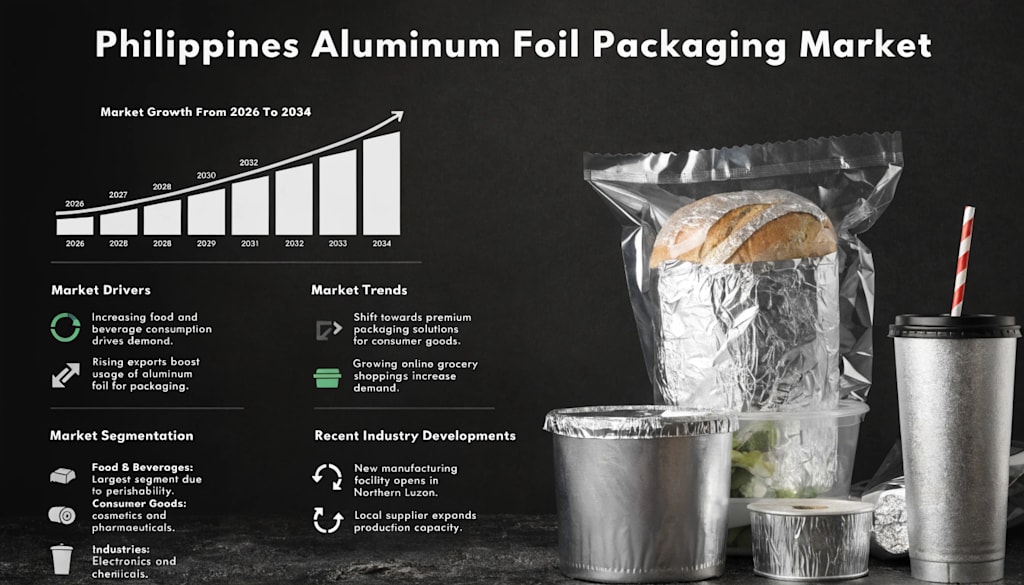
The Philippines aluminum foil packaging market is expanding at a moderate but steady pace as food and beverage companies, pharmaceutical manufacturers, and e commerce logistics providers increasingly demand lightweight, high barrier and sustainable packaging solutions. Aluminum foil packaging – encompassing foil wraps, pouches, blister packs, containers, and semi rigid formats – delivers exceptional protection against moisture, oxygen, light, and contaminants, making it indispensable across multiple industrial sectors. According to IMARC Group, the market size reached USD 789.60 Million in 2025 and is projected to reach USD 1,062.22 Million by 2034, exhibiting a compound annual growth rate (CAGR) of 3.35% during 2026–2034.
This expansion reflects a convergence of powerful forces: the digital transformation of retail, a sharp increase in healthcare infrastructure investment, and a systematic shift toward environmentally responsible packaging. The Philippines packaging industry as a whole stood at 78.5 billion units in 2024 and is expected to reach 91.8 billion units by 2029, with flexible packaging – a category heavily reliant on aluminum foil – dominating the sector at 38.4 billion units in 2024.
What's Driving Market Growth?
E Commerce and Food Delivery Service Expansion. The explosive growth of digital commerce platforms and online food delivery services across Metro Manila, Cebu, Davao, and other urban centers is fundamentally reshaping packaging requirements in the Philippines. App based food ordering and grocery delivery platforms demand packaging that maintains product integrity during last mile transit, and aluminum foil’s superior barrier properties against oxygen, moisture and external contaminants make it ideal for takeaway containers, ready to eat meal packs, and insulated delivery wraps. The demand for aluminum foil containers alone has surged at an average annual rate of around 7%, driven by convenience oriented lifestyles and increased consumption of packaged foods. Simultaneously, the contract packaging and fulfillment services market – integral to e commerce logistics – is witnessing strong growth as brands partner with third party providers for streamlined operations and faster delivery.
Food and Beverage Industry Modernization. The Philippine food processing sector is a cornerstone of the economy, with total value added contributions reaching P1 trillion in 2025. Urban lifestyles and hectic routines are fueling demand for packaged snacks, convenience meals, and ready to eat products, all of which rely on aluminum foil packaging for prolonged durability, contamination protection, and enhanced food safety. Processed meat and seafood packaging volumes are projected to grow at a 4% CAGR to reach 3.9 billion units, while processed fruit and vegetable packaging volumes are forecast to increase at a 5% CAGR, illustrating the considerable scale of food packaging consumption in which aluminum foil plays a critical role. Furthermore, rising health awareness has led to increased demand for low calorie snacks and ready to eat meals, with local companies creating unique flavors catering specifically to Filipino taste buds.
Pharmaceutical Sector and Healthcare Infrastructure Investment. The pharmaceutical industry is a significant and fast growing driver for aluminum foil packaging, particularly in the form of blister packs and other medical packaging solutions that require verified compliance with strict regulatory standards. Aluminum foil is the material of choice for primary pharmaceutical packaging because it offers unmatched protection against moisture, light, and contamination – essential for maintaining drug stability and efficacy. The Philippines pharmaceutical packaging market was valued at approximately USD 176.52 Million in 2025 and is projected to grow at a CAGR of 4.48–4.90% through 2030–2035. Government initiatives supporting pharmaceutical manufacturing and healthcare infrastructure development are creating expanded opportunities for specialized medical packaging, and the interaction of these factors continues to expand the role of aluminum foil in the healthcare supply chain.
Sustainability Mandates and Corporate Commitments. Increasing environmental awareness among Filipino consumers and growing corporate sustainability commitments aligned with global environmental standards are compelling manufacturers and brand owners to transition toward fully recyclable packaging materials. Consumers and businesses are increasingly adopting recyclable and eco friendly packaging to reduce environmental impact, and aluminum – which can be recycled infinitely without quality loss – is emerging as a strategic alternative to plastics, which typically can be recycled only two to three times. Environmental regulations and corporate sustainability commitments are further accelerating the adoption of aluminum based packaging solutions. The government has also promoted a circular economy through policies encouraging the use of recycled materials, including offering tax incentives for businesses that meet sustainability standards.
Market Segmentation & Key Insights
By Product Type, the market includes foil wraps, pouches, blister packs, containers, and others. Blister packs are widely used in pharmaceuticals, while foil wraps and containers dominate food service and takeaway applications.
By Packaging Type, the market is segmented into rigid packaging, flexible packaging, and semi rigid packaging. Flexible packaging dominates due to its lightweight nature, cost efficiency, and versatility, with converted flexible packaging demand growing strongly from the food, beverage, personal care, and pharmaceutical industries.
By Foil Type, aluminum foil packaging is available in printed and unprinted formats. Printed foil is gaining traction for branding and product differentiation.
By Thickness, foil thickness varies based on application: 0.007 mm – 0.09 mm, 0.09 mm – 0.2 mm, and 0.2 mm – 0.4 mm.
By End Use Industry, the market serves food and beverage, tobacco, pharmaceuticals, cosmetics, and others. Food and beverage and pharmaceutical sectors together account for the majority of consumption.
By Region, the market is divided into Luzon, Visayas, and Mindanao. Luzon – particularly Metro Manila and surrounding industrial zones – dominates due to its concentration of manufacturing activities and population density.
The Philippine laminated aluminum foil market – a key sub segment – is also growing robustly, with imports increasing at an impressive 22.19% CAGR from 2020 to 2024, top exporting countries including Malaysia, South Korea, China, India, and the USA, and a concentrated competitive landscape.
What the Opportunities Are?
AI Powered Smart Packaging and Supply Chain Optimization. Artificial intelligence is transforming the aluminum foil packaging sector. AI powered analytics enable packaging companies to decode complex consumer preferences, anticipate market trends, and optimize sustainability strategies. Smart packaging technologies incorporating QR codes, RFID, and NFC tags embedded within aluminum materials facilitate real time monitoring of temperature, freshness, and product authenticity – a particularly critical capability for pharmaceutical and premium food applications. Furthermore, AI driven supply chain optimization improves quality control processes, reduces waste generation, and enables predictive maintenance systems, strengthening the competitive positioning of aluminum foil packaging manufacturers in an increasingly technology driven marketplace.
Recycled Content and Closed Loop Packaging Systems. The drive toward sustainable packaging is creating significant opportunities for post consumer recycled (PCR) aluminum content. PCR aluminum with up to 70% recycled content is becoming commercially viable, while closed loop recycling systems can deliver 95% energy savings compared to virgin material production. Fully metallic designs that eliminate multi material layers can achieve >95% recycling rates, opening new product development pathways for environmentally conscious brand owners. The recycled packaging materials market in the Philippines, including aluminum, is seeing increasing adoption due to cost benefits and environmental appeal, supported by collaborations between recyclers, converters, and brand owners aiming to reduce carbon footprints and landfill dependency.
Pharmaceutical Blister Packaging and Cold Formed Aluminum Sheets. The Philippine pharmaceutical packaging market is projected to grow at a steady 4.5–4.9% CAGR, and within it, premium applications such as cold formed aluminum sheets (20–40 µm) for sensitive drug products offer higher margins than standard flexible packaging. Suppliers using vacuum metallized PET (VMPET) or cold formed aluminum sheets are better suited for premium or sensitive applications requiring extended protection and superior barrier performance. Smaller enterprises entering the Philippine market can benefit from suppliers offering low minimum order quantities and agile production.
Food Service and Consumer Packaging Innovation. For businesses and consumers in the Philippines, foil pouches offer a compelling combination of shelf life protection, cost effective shipping, convenience, and scalability. Manufacturers who invest in ultra thin foil development, new protective nano coatings (which can extend food shelf life by 20–35% compared to untreated foil), and recyclable mono material laminates will capture growing consumer demand for high performance, low environmental impact packaging solutions.
Recent News and Developments in Philippines Aluminum Foil Packaging Market
September 2025: The Philippines processed fruit and vegetable packaging retail volumes were forecast to increase at a 5% CAGR, reaching 355 million units in 2029, while sauces, dips and condiments packaging volumes were projected to reach 3.1 billion units at a 2% CAGR.
August 2025: Philippine taro powder (ube powder) packaging bags made a stunning appearance at WOFEX, utilizing a multi layer aluminum foil composite material (PET/AL/PE) that offers superior moisture proof, light proof, and antioxidant properties, significantly extending the product’s shelf life.
May 2025: Strategic sourcing guidance for the Philippine market emphasized that suppliers using vacuum metallized PET (VMPET) or cold formed aluminum sheets (20–40 µm) are better suited for premium or sensitive products, while smaller enterprises benefit from low MOQ and agile production suppliers.
February 2025: The Philippine food processing industry was estimated to contribute P1 trillion in total value added, with rising demand for convenience foods and ready to eat meals directly benefiting aluminum foil packaging demand.
2025: The Philippine Department of Trade and Industry, together with the Bureau of Customs, continued to streamline logistics policies, while tax incentives from PEZA (Philippine Economic Zone Authority) and BOI (Board of Investments) supported companies offering packaging and fulfillment services for both local and export markets. Concurrently, the Bureau of Customs and DTI worked to streamline last mile delivery processes, indirectly benefiting packaging providers.
Why Should You Know About Philippines Aluminum Foil Packaging Market?
You should know about this market because it illustrates how digital retail transformation, healthcare infrastructure modernization, and environmental sustainability intersect to create steady growth opportunities in a mission critical segment of the Philippine industrial sector. Aluminum foil packaging is no longer just a protective layer – it is a smart, sustainable, and technologically adaptive solution that helps food manufacturers extend product shelf life, enables pharmaceutical companies to safeguard drug efficacy, and supports e commerce logistics in delivering quality goods to Filipino consumers.
For investors, the aluminum foil packaging market offers exposure to a stable growth industrial category underpinned by the Philippines’ rapidly growing e commerce sector (contract packaging services), expanding pharmaceutical industry (blister packaging), and the national shift toward circular economy principles (recycled aluminum content). The projected CAGR of 3.35% reflects consistent baseline demand, while higher growth sub segments – including smart pharmaceutical blister packaging, PCR aluminum products, and AI enabled supply chain solutions – offer differentiated upside potential.
For packaging manufacturers, brand owners, logistics providers, and supply chain planners, understanding the segmentation of foil types, end use industries, thickness specifications, and regional distribution patterns helps shape intelligent investment decisions, sourcing strategies, and product development roadmaps that deliver measurable performance, compliance, and sustainability outcomes.
In essence, the Philippines aluminum foil packaging market captures how protection, innovation, and environmental responsibility converge – making it a compelling area for investors and organizations seeking smarter approaches to packaging, product integrity, and sustainable growth in one of the most dynamic economies in the Asia Pacific region.
About the Creator
Thomas
Market Research Analyst | Industry Trends & Forecasting | Turning market data into clear, actionable business insights across global sectors.
Enjoyed the story? Support the Creator.
Subscribe for free to receive all their stories in your feed.
Comments
There are no comments for this story
Be the first to respond and start the conversation.