
Philippines Aluminum Cans Market: Beverage Dominance, EPR Mandates & Premiumisation Push
How rising drink consumption, strict packaging recovery laws and craft beverage innovation are driving steady growth in the Philippine aluminum cans sector

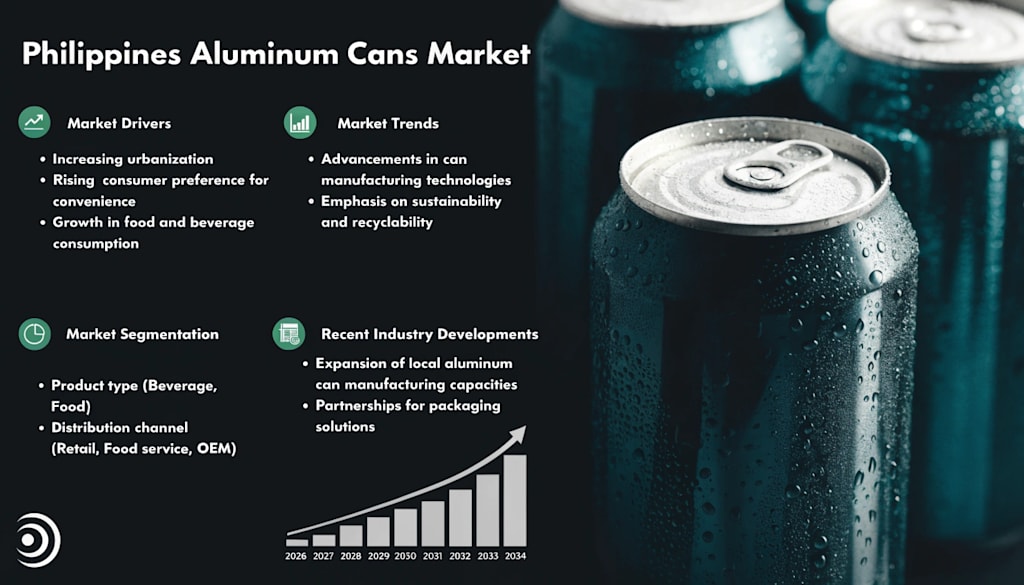
The Philippines aluminum cans market is expanding steadily as the nation's thriving beverage industry, tightening environmental regulations and shifting consumer preferences toward convenience and sustainability converge to reshape the packaging landscape. Aluminum cans — widely used for beverages, food packaging and ready-to-drink products — are gaining popularity due to their lightweight nature, durability, infinite recyclability and superior barrier properties that protect against light, air and moisture. According to IMARC Group, the market size reached USD 1,137.04 Million in 2025 and is projected to reach USD 1,435.14 Million by 2034, exhibiting a compound annual growth rate (CAGR) of 2.62% during 2026 2034. As urbanization accelerates, lifestyles become faster-paced and environmental consciousness grows, aluminum cans have emerged as the packaging format of choice for the country's expanding beverage economy.
What's Driving Market Growth?
Beverage Sector Dominance and Rising Consumption. The beverages segment commands the market with a dominant 72.6% share in 2025, driven by robust consumption of carbonated soft drinks, beer and energy drinks in canned formats. The Philippine alcoholic beverages market alone was valued at USD 7.6 Billion in 2025, underscoring the substantial consumption base that drives canned format adoption. Beer sales are projected to grow 10% annually to 3.8 billion liters by 2027, led by mid priced lagers at a CAGR of 10.8%. Expanding distribution networks and the tropical climate sustain year round demand for chilled canned beverages across urban and rural retail channels. The country's youthful demographic profile and rising disposable incomes further support increasing consumption of packaged beverages.
EPR Act and Sustainability-Driven Shift from Plastic. The Extended Producer Responsibility (EPR) Act of 2022 (Republic Act No. 11898), which makes the Philippines the first country in Southeast Asia to implement mandatory EPR for plastic packaging, is fundamentally reshaping packaging decisions. The law mandates that large enterprises with total assets exceeding PHP 100 Million implement packaging waste recovery programs, with escalating targets reaching 80% by 2028. The national diversion rate reached 55.98% in 2025, significantly exceeding the mandated 40% target, with recovery rates reaching 56.33% for flexible plastics and 55.60% for rigid plastics. Aluminum's infinite recyclability without quality loss makes it a preferred sustainable alternative to single-use plastic containers, and this regulatory push is accelerating the shift across the beverage and food industries. An industry survey found that 88.7% of respondents believe companies must adopt a proactive and transparent approach to addressing environmental challenges.
Expanding Modern Retail and E Commerce Channels. The growth of modern retail infrastructure and e commerce platforms is significantly supporting market expansion. Retail e commerce in the Philippines posted robust double digit growth in 2025, with value sales reaching PHP 1.19 trillion, up 13% from the previous year. This expansion outpaced both regional and global benchmarks, supported by improved household incomes, solid GDP growth of 5%, rising internet and smartphone penetration, and stronger logistics infrastructure. Platforms such as Lazada, Shopee and TikTok Shop have broadened their reach, increasing the availability and visibility of canned products to consumers nationwide. Supermarkets, convenience stores and online grocery channels are driving higher consumption by making canned beverages and food products more accessible than ever before.
Premiumisation and Craft Beverage Expansion. Young urban consumers in the Philippines are driving increasing demand for premium and craft beverages packaged in aluminum cans. The introduction of artisanal beers, flavored malt beverages and ready-to-drink cocktails in sleek can formats has created new market opportunities beyond traditional lager and soft drink categories. Social media influence together with nightlife culture drives consumers to adopt visually distinctive canned beverages, creating opportunities for manufacturers to produce specialized can sizes, finishes and designs that generate higher prices while establishing brand identity. The ready-to-drink segment, especially flavored and craft-style cocktails, is rapidly growing, reflecting evolving consumer preferences and expanding market depth.
Infrastructure Investment and Manufacturing Capacity. Ongoing infrastructure investments and modernized production lines are enhancing domestic supply chain resilience. The Packaging Group, part of San Miguel Corporation, operates the country's only aluminum beverage can plant, pioneering two piece can technology and serving major clients including Coca Cola Femsa, Pepsi-Cola Products Philippines, and Nestlé Philippines. The metal container plant has an annual capacity of 620 million body pieces, equivalent to approximately 7,500 tons per year, though aluminum coil raw material is imported from Korea and Australia. Competition among the few large packaging producers is shaped by long-term contracts, can size and printing capabilities, and supply reliability, with players differentiating through lightweighting, recycled-content offerings and proximity to high-volume bottling hubs.
Market Segmentation & Key Insights
By Application, beverages dominates the market with a share of 72.6% in 2025, owing to strong consumption of carbonated soft drinks, beer and energy drinks in canned formats. Expanding distribution networks and the tropical climate sustain year round demand for canned beverages across urban and rural retail channels. The food segment, including canned seafood and ready to eat products, represents a smaller but growing application area.
By Region, Luzon comprises the largest region with 64.8% share in 2025, driven by the concentration of major beverage and food manufacturing facilities in Metro Manila and surrounding industrial zones, along with the island's dense urban population base generating substantial packaged goods consumption.
By Production Landscape, the market is concentrated among a few large packaging producers supplying major beverage brands, with competition shaped by long-term contracts, can size and printing capabilities, and supply reliability.
What the Opportunities Are?
Recycled Content and Circular Economy Leadership. With EPR compliance requiring escalating plastic recovery targets up to 80% by 2028, there is strong opportunity for can manufacturers to differentiate through post-consumer recycled aluminum content. Aluminum's recycling rate in Metro Cebu reaches approximately 71.6%, one of the highest among recyclable materials, highlighting the viability of closed-loop systems. Companies that invest in recycled-content offerings and circular economy certifications can capture environmentally conscious brand owners seeking to meet their own EPR obligations.
AI Powered Quality Inspection and Production Automation. Artificial intelligence is transforming aluminum can production. AI-powered quality inspection systems using deep learning and computer vision are being deployed on production lines to detect micro-defects in real time, ensuring consistent quality standards while reducing waste and improving manufacturing throughput for Philippine can producers. The Philippines AI market is projected to reach USD 1.025 Billion in 2026 with a CAGR of nearly 28% through 2030, driving adoption of AI-driven automation and predictive analytics across manufacturing sectors. AI-based demand forecasting models are helping beverage companies and can manufacturers predict seasonal consumption patterns, optimize inventory management and align production schedules with real-time market demand signals from both traditional retail and e commerce channels.
Specialised Can Formats for Premium and Craft Beverages. The growth of craft beverages — including artisanal beers, ready-to-drink cocktails and functional energy drinks — requires can manufacturers to offer greater variety in can sizes, finishes and decorative printing. Sleek cans, limited-edition finishes and direct-to-can digital printing capabilities enable brand differentiation on crowded retail shelves. Social media influence together with nightlife culture drives consumers to adopt visually distinctive canned beverages, creating opportunities for manufacturers to produce specialized can designs that command premium pricing while establishing brand identity.
Lightweighting and Energy-Efficient Production. Innovations such as lightweight cans reduce material costs, lower carbon emissions from transport and support corporate sustainability targets. Machine learning algorithms optimizing aluminum can forming and coating processes analyze production variables in real time, reducing material waste, minimizing energy consumption and enabling faster changeovers between different can sizes and designs to meet growing demand for premium and craft beverage formats.
Smart Sorting Technologies for Recycling Infrastructure. Advanced AI sorting technologies such as TOMRA's GAINnext deep learning platform are transforming aluminum scrap recycling by enabling precise alloy-level sorting, improving the quality of recycled aluminum feedstock and supporting circular economy initiatives in the Philippine packaging industry. As EPR targets escalate, investment in sorting technologies that improve recovery rates will be critical.
Recent News and Developments in Philippines Aluminum Cans Market
January 2026: The DENR convened the 2026 Extended Producer Responsibility (EPR) Recognition Program, reporting that the national diversion rate reached 55.98% in 2025, significantly exceeding the mandated 40% target. A total of 1,017 entities were registered across 201 EPR programs.
January 2025: Alaminos City in Pangasinan launched the "Palit Basura" program, enabling residents to exchange recyclable waste — including aluminum cans — for grocery food items through a partnership with a local junk shop. Approximately 30,000 kg of non-biodegradable waste are being collected in the city daily.
2025: IMARC Group reported that the Philippines aluminum cans market reached USD 1,137.04 Million in 2025, with beverages accounting for 72.6% of market share. Luzon led regional consumption with 64.8% share.
2025: The Packaging Group, through its subsidiary Can Asia, Inc., continued to operate the country's only aluminum beverage can plant, with an annual body capacity of 620 million pieces, serving major multinational beverage brands including Coca-Cola Femsa, Pepsi-Cola Products Philippines and Nestlé Philippines.
Why Should You Know About Philippines Aluminum Cans Market?
You should know about this market because it captures how beverage consumption growth, regulatory enforcement and premiumisation trends intersect to create steady expansion in a foundational packaging sector. Aluminum cans are no longer just beverage containers — they are compliance instruments for EPR reporting, brand differentiation tools for craft beverage producers, and logistical enablers for e commerce fulfillment. As the Philippines pushes toward its 80% packaging recovery target by 2028 and expands modern retail across the archipelago, aluminum cans have become essential components of the country's circular economy infrastructure.
For investors, the aluminum cans market offers exposure to a stable growth packaging category anchored in the Philippines' USD 7.6 billion alcoholic beverage market, the enforceable EPR Act and the structural shift away from single-use plastics. The projected CAGR of 2.62% reflects consistent baseline demand, while higher-growth sub-segments — including premium craft can formats, AI powered production automation, recycled-content innovation and smart sorting technologies — offer differentiated upside potential.
For packaging manufacturers, beverage companies, sustainability investors and supply chain planners, understanding aluminum can segmentation, EPR compliance pathways, recycling infrastructure development and e commerce logistics requirements helps shape intelligent investment decisions, product development roadmaps and strategic partnerships that deliver measurable sustainability, supply chain resilience and consumer preference outcomes.
In essence, the Philippines aluminum cans market captures how industrial design, environmental regulation and consumer convenience converge — making it a compelling area for investors, manufacturers and brand owners seeking smarter approaches to sustainable packaging, circular economy participation and market differentiation in one of Southeast Asia's most dynamic consumer economies.
About the Creator
Thomas
Market Research Analyst | Industry Trends & Forecasting | Turning market data into clear, actionable business insights across global sectors.
Enjoyed the story? Support the Creator.
Subscribe for free to receive all their stories in your feed.
Comments
There are no comments for this story
Be the first to respond and start the conversation.