
Philippines Air Compressor Market: Industrialisation Surge, Infrastructure Push & Energy-Efficient Innovation
How manufacturing expansion, the Build Better More program and the semiconductor boom are driving steady growth in the Philippine compressed air sector

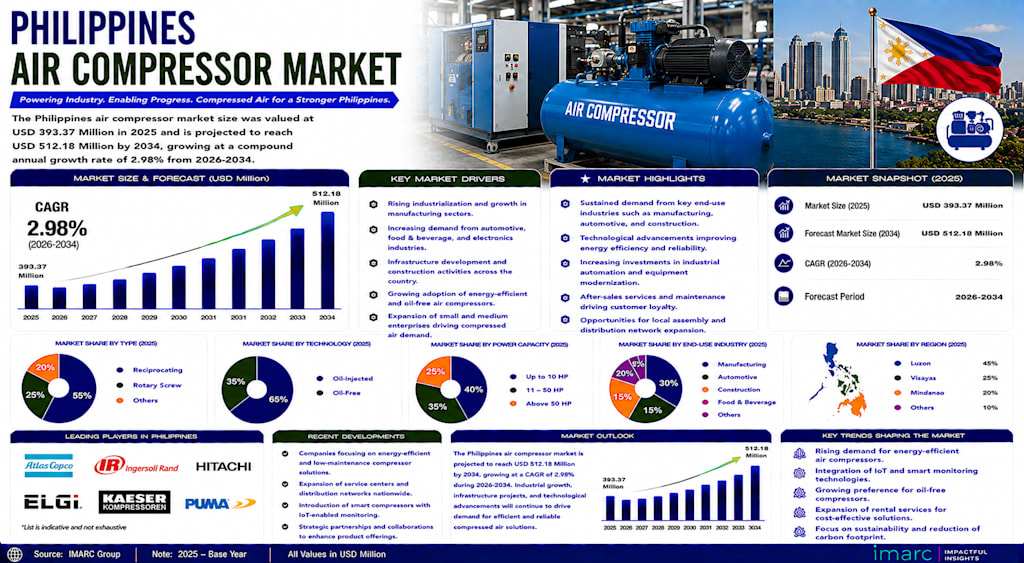
The Philippines air compressor market is expanding steadily as the country's accelerating industrialisation, large scale infrastructure development, and growing manufacturing sector drive sustained demand for reliable compressed air systems. Air compressors — encompassing stationary and portable units, rotary screw and reciprocating technologies, and oil filled and oil free variants — are deployed across manufacturing facilities, construction sites, mining operations, oil and gas installations, and power generation plants to power pneumatic tools, automate production lines, and support critical industrial processes. According to IMARC Group, the market size reached USD 393.37 Million in 2025 and is projected to reach USD 512.18 Million by 2034, exhibiting a compound annual growth rate (CAGR) of 2.98% during 2026–2034. As the government pushes forward with its Build Better More infrastructure programme, the semiconductor sector expands, and manufacturers invest in energy efficient technologies, air compressors have become essential workhorses powering the Philippine industrial engine.
What's Driving Market Growth?
Manufacturing Sector Expansion and Record Factory Activity. The single most powerful driver of air compressor demand is the sustained growth of the Philippine manufacturing sector. The country's Manufacturing Purchasing Managers' Index (PMI) reached 54.3 in December 2024, marking the joint strongest reading since November 2017 and signalling sustained expansion in factory activity. Compressed air is essential across factory operations, assembly lines, and material handling applications, making it a critical utility for industrial production. The manufacturing sector remains the primary demand driver, with rising factory output in electronics, automotive components, food processing, and general consumer goods manufacturing collectively generating higher demand for reliable compressed air solutions. Increased investment in special economic zones and modernisation of food processing and pharmaceutical manufacturing are further bolstering demand.
Government Infrastructure Programs and Build Better More. The Philippine government's ambitious infrastructure agenda, anchored by the Build Better More programme, is a significant catalyst for air compressor adoption. Government led infrastructure modernisation efforts are strengthening the foundation for sustained growth, creating favorable conditions for compressor demand across construction, mining, and industrial sectors. Infrastructure projects ranging from road and bridge construction to airport expansions and railway developments require portable air compressors for on site operations, pneumatic tools, and material handling. The construction sector's reliance on mobile and stationary compressors for concrete spraying, drilling, and demolition work sustains consistent demand across project lifecycles. Rising investments in the construction sector, with a forecast market value of USD 43.44 billion in 2025 expected to climb to USD 63.77 billion by 2031, underscores the long term demand pipeline.
Semiconductor and Electronics Industry Expansion. The Philippines is positioning itself as a regional semiconductor and electronics manufacturing hub, creating specialised demand for high purity, oil free compressed air. Semiconductor fabrication requires ultra clean compressed air systems that eliminate the risk of oil contamination, driving adoption of oil free compressor technologies. The electronics sector's precision manufacturing processes demand consistent, high quality compressed air for assembly, testing, and packaging operations. As the government targets USD 70 billion in semiconductor exports and USD 40 billion in electronics exports annually by 2030, the industrial base for compressed air demand will expand significantly, particularly for oil free and energy efficient compressor systems.
Market Segmentation & Key Insights
By Type, stationary air compressors dominate the market with a share of 61.2% in 2025, owing to their widespread deployment across manufacturing facilities, industrial parks, and fixed location operations requiring continuous and reliable compressed air supply. Portable compressors serve construction, mining, and on site industrial applications where mobility is essential.
By Technology, rotary or screw compressors lead the market with a share of 46.8% in 2025, driven by superior energy efficiency, continuous duty capability, and reduced maintenance requirements that align with the operational demands of large scale industrial facilities. Reciprocating compressors serve smaller scale and intermittent applications, while centrifugal compressors are deployed in high volume industrial processes.
By Lubrication Method, oil filled compressors exhibit clear dominance with a 58.9% share in 2025, reflecting strong industrial preference for durable, cost effective systems that deliver reliable performance under demanding operating conditions. Oil free compressors are the fastest growing segment, driven by semiconductor, pharmaceutical, and food processing applications requiring contamination free air.
By Power Rating, the 101 to 300 kW segment represents the largest market with a 34.6% share in 2025, owing to its suitability for medium to large scale industrial operations that require consistent, high volume compressed air output.
By End User, manufacturing comprises the biggest segment with a 39.7% share in 2025, driven by the country's expanding industrial base and rising factory output. Other key end users include construction, oil and gas, power generation, and petrochemical industries.
By Region, Luzon accounts for the most prominent region with 66.1% share in 2025, driven by the concentration of industrial parks, special economic zones, and manufacturing clusters in Metro Manila, Central Luzon, and CALABARZON.
What the Opportunities Are?
Energy Efficient and Oil Free Compressor Technologies. With the Department of Energy overseeing energy efficiency policies for industrial compressors and tax incentives available for energy efficient systems, there is strong opportunity for suppliers offering advanced, high efficiency compressor technologies. Oil free compressors are gaining traction in semiconductor, pharmaceutical, and food processing applications where air purity is critical. Manufacturers that invest in variable speed drive technology, which matches compressor output to actual demand, can capture the growing segment of energy conscious industrial buyers seeking lower operational costs and reduced carbon footprints.
Equipment Rental and Fleet Management Services. The high capital cost of industrial compressors creates substantial opportunity for equipment rental companies serving contractors and small to medium manufacturers who cannot justify outright purchase. Rental models offering flexible terms, maintenance packages, and modern, fuel efficient fleets capture the growing segment of project specific requirements. The mobile air compressor segment is growing due to its applications in construction, mining, and industrial sectors, with portability and energy efficiency as key market drivers.
Aftermarket Parts and Predictive Maintenance Services. The growing installed base of compressors across manufacturing, construction, and mining creates sustained demand for aftermarket parts, servicing, and maintenance contracts. Providers offering genuine parts, rapid turnaround, and IoT enabled predictive maintenance solutions — which monitor compressor performance, detect anomalies, and schedule service before failures occur — can build durable customer relationships and generate recurring revenue.
Semiconductor Grade Oil Free Compressor Supply. As the Philippines expands its semiconductor manufacturing capacity, there is growing demand for oil free compressors capable of delivering Class 0 air purity required for cleanroom environments. Suppliers offering validated, contamination free compressed air systems with real time purity monitoring will capture premium contracts as semiconductor fabrication facilities come online.
Government Infrastructure and Public Private Partnership Procurement. With the Build Better More programme driving multi billion dollar infrastructure investments, there is substantial opportunity for suppliers to secure government and PPP contracts for compressor supply across construction, transportation and power generation projects. Manufacturers offering comprehensive service packages and local support capabilities will gain advantage in public procurement.
Recent News and Developments in Philippines Air Compressor Market
2025: The Philippines air compressor market was valued at USD 393.37 Million in 2025, with IMARC Group projecting growth to USD 512.18 Million by 2034 at a 2.98% CAGR. Stationary compressors led with 61.2% market share, followed by rotary screw technology at 46.8%.
2025: The manufacturing sector remained the primary demand driver, with the PMI reaching 54.3 in December 2024 — the joint strongest reading since November 2017. Rising electronics production, food processing modernisation, and pharmaceutical manufacturing expansion collectively generated higher demand for compressed air solutions.
2025: Luzon accounted for 66.1% of the market, driven by the concentration of industrial parks, special economic zones, and manufacturing clusters in Metro Manila, Central Luzon, and CALABARZON.
2025: Key players in the Philippine industrial air compressor market included Atlas Copco, Ingersoll Rand, Kaeser Kompressoren, Gardner Denver, and Sullair, competing through energy efficient models, after sales support, and spare part availability.
2025: The Philippine compressors market growth rate was projected to ascend from 5.18% in 2025 to 15.18% in 2029, reflecting accelerating demand across industrial sectors.
Why Should You Know About Philippines Air Compressor Market?
You should know about this market because it captures how industrialisation, infrastructure investment, and technological modernisation intersect to create steady growth in a foundational industrial equipment category. Air compressors are no longer just utility equipment — they are critical production enablers that power manufacturing assembly lines, drive construction equipment, support semiconductor fabrication, and ensure pharmaceutical production integrity.
For investors, the air compressor market offers exposure to a stable growth industrial equipment category anchored in the Philippines' expanding manufacturing base, the multi billion dollar Build Better More infrastructure programme, and the accelerating shift toward energy efficient and oil free technologies. The projected CAGR of 2.98% reflects consistent baseline demand, while higher growth sub segments — including oil free compressors for semiconductor applications, energy efficient variable speed drive systems, and equipment rental services — offer differentiated upside potential.
For industrial engineers, plant managers, equipment distributors and infrastructure investors, understanding segmentation across type, technology and power rating, the emerging role of energy efficiency regulations and the expanding semiconductor manufacturing footprint helps shape intelligent procurement decisions, fleet management strategies and capital allocation that deliver measurable productivity, reliability and operational cost outcomes.
In essence, the Philippines air compressor market captures how compressed air technology, industrial expansion and sustainable manufacturing converge — making it a compelling area for investors, equipment manufacturers and industrial operators seeking smarter approaches to production efficiency, energy optimisation and reliable industrial power across one of Southeast Asia's most dynamic manufacturing economies.
About the Creator
Thomas
Market Research Analyst | Industry Trends & Forecasting | Turning market data into clear, actionable business insights across global sectors.
Enjoyed the story? Support the Creator.
Subscribe for free to receive all their stories in your feed.
Comments
There are no comments for this story
Be the first to respond and start the conversation.