
Philippines AI in Healthcare Market: Early Detection Revolution, Drug Discovery Acceleration & Universal Health Integration
How a ₱2.6bn government AI investment, a 12M person TB screening goal and ₱7bn AstraZeneca commitment are driving a 24.90% CAGR toward a $1.44bn market by 2034

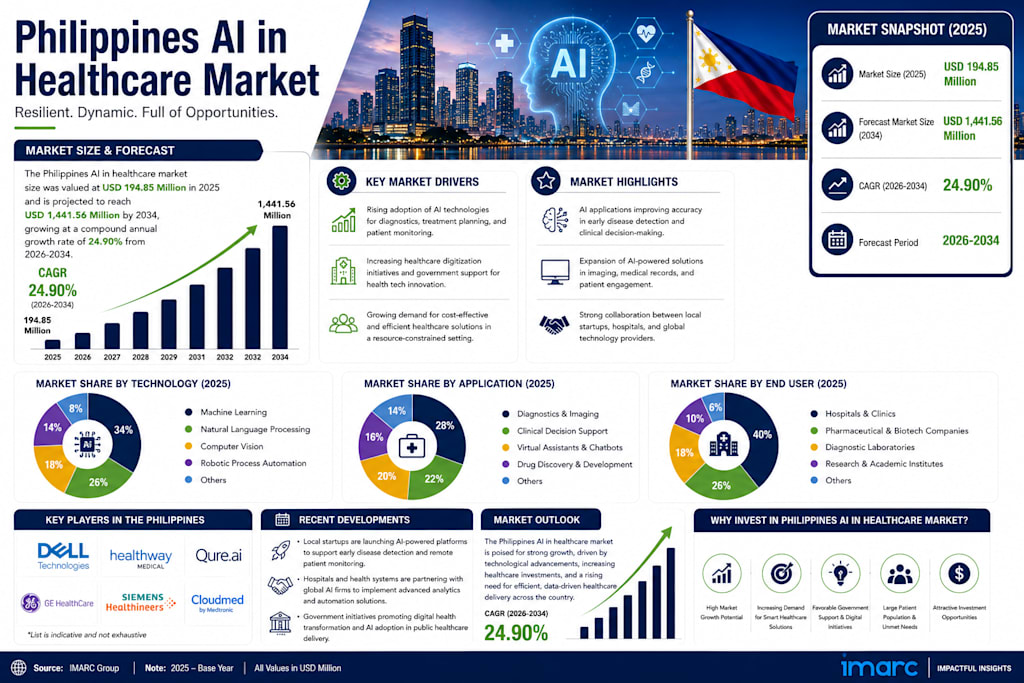
The Philippines AI in healthcare market is experiencing explosive growth as the national government, international pharmaceutical giants and a new generation of healthtech startups unite behind a single vision: using artificial intelligence to solve the country’s most persistent healthcare challenges. AI in healthcare — encompassing computer aided detection systems for medical imaging, AI powered telemedicine platforms, predictive analytics for hospital operations, drug discovery algorithms and personalized treatment recommendation engines — is deployed across tuberculosis screening programmes, cancer detection initiatives, electronic health record systems and rural primary care networks to bridge gaps in access, accuracy and efficiency. According to IMARC Group, the Philippines AI in healthcare market size reached USD 194.85 Million in 2025 and is projected to reach USD 1,441.56 Million by 2034, exhibiting a stellar compound annual growth rate (CAGR) of 24.90% during 2026–2034. Bolstered by the Department of Science and Technology's (DOST) landmark ₱2.6 billion AI investment, the Department of Health's (DOH) AI powered push to screen 12 million Filipinos for tuberculosis, and a ₱7 billion AstraZeneca commitment to a Health Innovation Hub, the country is rapidly emerging as ASEAN's most compelling AI enabled healthcare laboratory.
What's Driving Market Growth?
Massive Government Investment in AI Infrastructure and R&D. The most powerful catalyst for AI adoption is the unprecedented scale of public investment. The DOST is earmarking more than PHP 2.6 billion (approximately USD 45 million) for AI projects spanning healthcare, education, mobility, environment and disaster risk reduction. This investment supports the country’s AI roadmap, which rests on four pillars: national infrastructure, talent and skills development, research and data, and policy engagement. The Philippines has already invested PHP 1.4 billion in AI R&D from 2018 to 2024, supporting initiatives such as the Computing and Archiving Research Environment (COARE) high performance computing facility. The National AI Center for Research and Innovation (NAICRI) has been established to coordinate these efforts, and the DOST is developing an AI Virtual Hub as a national centre for emerging AI research, startup support and expert training. The country’s AI readiness ranking has improved from 65th in 2023 to 56th in 2024, reflecting growing capability to deploy AI for public service transformation.
DOH Led AI Deployment in Tuberculosis Elimination. The Department of Health has embedded AI directly into its flagship TB elimination programme. Under the Philippine Strategic TB Elimination Plan Phase 2 (PhilSTEP2) 2025 2030, the DOH aims to screen twelve million Filipinos nationwide by 2026. The DOH National Expenditure Program for 2026 proposes a budget of ₱4.2 billion for TB services — nearly twice the ₱2.6 billion budget in 2025. In the Cordillera Administrative Region, health workers now bring AI powered ultra portable X ray units closer to communities, enabling early detection and treatment. “In the Philippines, we are already using ultra portable AI powered chest X rays and WHO recommended Nucleic Acid Amplification Tests (NAAT) to quickly screen and diagnose TB cases,” said Secretary of Health Teodoro Herbosa. The DOH has confirmed that AI is now part of its digital health strategies, with priority provinces including Aklan, Batangas, Benguet, Laguna and Sarangani being prepared for local health information exchanges that will underpin AI deployment.
Medical Imaging and Early Cancer Detection at Scale. AI enabled imaging has moved from pilot projects to nationwide deployment. In March 2026, the Philippine Charity Sweepstakes Office (PCSO) deployed a NASA tested, ultra portable AI X ray system (REMEX KA6) to Batanes, one of the country’s most remote provinces. The battery operated device weighs only 3.5 kilograms and can instantly screen for tuberculosis and six other chest related diseases — pneumonia, nodules, masses, pneumothorax, pleural effusion and increased lung opacity — as well as bone fractures. Makati City has invested over P16 billion in healthcare expenditures since 2017, including the Philippines’ first AI powered PET/CT scanner capable of detecting cancer in as little as eight minutes at the Makati Life Medical Center. The AI enabled X ray imaging solutions market is expanding due to increasing demand for faster and more accurate medical imaging diagnostics. Computer aided detection (AI CAD) powered by deep learning has been introduced in chest X ray screening across communities, health facilities and workplaces.
Multi Billion Peso Private Investment and International Collaboration. Global pharmaceutical and technology leaders are making substantial commitments. AstraZeneca Philippines is playing a leading role in driving more than P7 billion (USD 120 million) in projected investments into the country’s healthcare ecosystem from 2026 to 2028 through the establishment of the country’s first multi stakeholder Health Innovation Hub in partnership with the Philippine Economic Zone Authority (PEZA). The investment pipeline covers AI powered diagnostics, early screening for non communicable diseases, digital health solutions and community health programmes. In March 2026, the US ASEAN Business Council and ASEAN BAC Philippines advanced the AI for Health Agenda under the Philippines’ ASEAN chairship, aligning private sector innovation with government priorities to accelerate digital health adoption, strengthen regulatory readiness and ensure that AI delivers measurable outcomes for patients. The Philippines AI Life Science Analytics Market, a specialized sub segment, is valued at USD 15 million, driven by increasing adoption of AI in healthcare, rising demand for personalized medicine and expanding investments in biotechnology and clinical trials.
AI Driven Startups Serving the Underserved “Last Mile”. A wave of Filipino healthtech startups is demonstrating that AI can operate reliably in low resource, remote settings — and reach patients at scale. 1Life, Inc. has served over one million patients across all 81 provinces and 1,335 cities and municipalities. The company’s integrated system brings portable diagnostic devices, cloud based patient records and AI assisted workflows together in a single community visit, turning a typical four day primary care journey into about one hour. Innovations include the 1Life Digital Community Healthcare System, portable diagnostic devices, DocMate AI (trained on hundreds of thousands of Filipino patient records), and the 1Life Health App. The company is an accredited partner of DOH, PhilHealth, LGUs and the DepEd YAKAP programme. Meanwhile, InstaMed Corp. has soft launched InstaMedico, an AI driven telehealth and pharmaceutical logistics platform that brings together teleconsultation, e prescriptions, AI powered follow ups, automated refill reminders, digital health records, online medicine ordering and nationwide pharmaceutical logistics with real time delivery tracking. VSee Health launched Project MAMA (Mom's AI for Maternity Aid), an AI powered telehealth initiative to reduce high maternal mortality rates in remote communities of Zamboanga Sibugay, featuring AI chatbots responding in local languages, portable diagnostic devices and electronic health records.
Predictive Analytics for Hospital Operations and Mortality Reduction. Real time AI is transforming hospital administration and patient safety. HealthServ Los Baños Medical Center won the Gold Award in the Most Advanced Healthcare Technology category at the 2025 Hospital Management Asia Awards for its “Smart Alerts for Smarter Audits” project. The system uses AI generated mortality predictions drawn from more than 30,000 anonymized patient records, automatically flagging specific cases for review. The AI model employs natural language processing (NLP) to interpret clinical notes and a random forest algorithm to identify patterns contributing to higher mortality risks, cutting chart review time by nearly half while increasing data accuracy. At the 46th National Convention of the Private Hospitals Association of the Philippines Inc. (PHAPi), Vantiq and Radenta Technologies demonstrated how real time, context aware AI can update electronic health records, streamline internal processes and support faster clinical decisions. The Vantiq Bio Surveillance Philippines system operates as a privacy preserving, real time disease intelligence network that connects participating hospitals without exposing patient data, enabling decision makers to monitor live disease trends alongside operational data including bed availability, ICU capacity and equipment stock.
Market Segmentation & Key Insights
By Technology Type, key segments include machine learning and deep learning, natural language processing (NLP) , computer vision, context aware computing and predictive analytics. Machine learning is the dominant segment, driven by its application in disease prediction, treatment optimisation and clinical decision support. NLP is gaining traction for mining unstructured clinical notes and supporting mortality prediction models.
By Application, the market covers medical imaging and diagnostics (AI enabled X ray, CT, MRI), drug discovery and development, hospital workflow automation, patient monitoring and predictive analytics, telemedicine and virtual care, personalized medicine, and administrative and financial applications. Medical imaging currently commands the largest share due to TB screening programmes and cancer detection initiatives, while drug discovery is the fastest growing segment, supported by AstraZeneca’s Innovation Hub and AI driven liver cancer detection projects.
By End User, major segments include hospitals and clinics, diagnostic imaging centres, pharmaceutical and biotechnology companies, health insurance providers, telehealth platforms and government health agencies.
By Region, the market is concentrated in Luzon (Metro Manila, CALABARZON and Central Luzon) , which hosts the majority of tertiary hospitals, technology firms and government AI initiatives. Visayas (Cebu) and Mindanao (Davao) are emerging markets, driven by smart hospital initiatives and remote telehealth deployments.
What the Opportunities Are?
AI Powered Tuberculosis and Chest Disease Screening at Scale. With the DOH targeting 12 million screenings by 2026 and employing AI enabled X ray units across priority provinces, there is substantial opportunity for providers of portable AI imaging solutions, teleradiology platforms and computer aided detection algorithms. The DOH’s focus on establishing local health information exchanges in Aklan, Batangas, Benguet, Laguna and Sarangani creates a pipeline for AI enabled diagnostic integration. Vendors offering interoperability with government led health data infrastructure will capture long term procurement contracts.
Drug Discovery and Clinical Trial Acceleration. AstraZeneca’s ₱7 billion Health Innovation Hub, coupled with the Philippines’ growing participation in biotechnology and clinical trials, creates strong demand for AI driven drug discovery platforms. The DOST funded P150 million AI driven liver cancer detection project by DARC Labs specifically targets early diagnosis among chronic hepatitis B cases — a disease disproportionately affecting Filipino populations. AI platforms that can model drug target interactions, predict clinical trial outcomes and identify patient recruitment cohorts will find receptive partners in the Philippines’ expanding pharmaceutical ecosystem.
Remote and Rural Telehealth Integration. With AI powered telehealth platforms proving their viability in Zamboanga Sibugay (Project MAMA) and nationwide through InstaMedico and 1Life, the opportunity now is to scale. The 1Life model — delivering diagnostics, consultations and medicines in a single community visit using portable devices and AI workflows — has already served over 1 million patients across 81 provinces. Vendors offering AI powered triage, local language chatbots and offline capable diagnostic support will capture the “last mile” segment that traditional healthcare cannot reach.
Smart Hospital Automation and Real Time Operations. The Philippines Smart Hospitals Market, valued at USD 160 million, is growing as hospitals adopt AI and IoT sensors to improve patient care and operational efficiency. The Universal Health Care Act (Republic Act No. 11223) mandates an integrated healthcare system, encouraging hospitals to adopt smart technologies for service delivery. Real time AI platforms that automate electronic health record updates, streamline discharges, manage bed turnover and provide predictive alerts for patient surges address critical pain points. The Vantiq Bio Surveillance system, which enables live disease trend monitoring alongside operational data, offers a model for scalable hospital level AI deployment.
AI Integrated Electronic Health Records and Health Data Repositories. PhilHealth is laying digital foundations for AI through electronic medical records (EMRs), the Health Care Institution (HCI) Portal, the Integrated PhilHealth Accreditation System (iPASS) and the National Health Data Repository. The Philippines Hospital Electronic Health Records Market includes AI integrated, cloud based and mobile EHR platforms. The Philippine Mental Health Act mandates electronic health record systems with analytics capabilities. Vendors offering AI enabled clinical decision support embedded within EHRs, automated coding and billing, and real time population health dashboards will find institutional buyers across both public and private hospital networks.
AI Powered Personalized Medicine and Chronic Disease Management. Over 16 million Filipinos live with chronic diseases, and healthcare expenditure is approximately PHP 1.5 trillion, with the personalized medicine market projected to reach PHP 60 billion. The Philippines AI in Precision Medicine Market is being driven by the increasing adoption of AI technology in healthcare and rising prevalence of chronic diseases. AI platforms that integrate genomics, lifestyle data and clinical history to deliver personalized treatment plans — particularly for diabetes, hypertension and cardiovascular disease — address both clinical demand and the government’s universal health coverage goals.
National AI Workforce Training and Capacity Building. The DOST has trained over 49,000 Filipinos in AI and data science through the SPARTA programme and the AI Pinas Summer School. The DOST ASTI’s NAIRA project seeks to train over 600 individuals in AI fundamentals from 2025 to 2026. However, the demand for AI trained healthcare professionals — data scientists, clinical informaticians and AI implementation specialists — far exceeds current supply. Providers offering certification programmes, hands on training for hospital IT staff and clinical AI competency courses will find ready customers among both public institutions and private healthcare networks.
Recent News and Developments in Philippines AI in Healthcare Market
March 2026: The PCSO deployed a NASA tested, ultra portable AI X ray system (REMEX KA6) to Batanes province. The 3.5 kg battery operated device can instantly screen for TB, pneumonia, nodules, pneumothorax, pleural effusion and bone fractures, enabling immediate on spot diagnosis for remote island communities.
March 2026: The US ASEAN Business Council and ASEAN BAC Philippines advanced the AI for Health Agenda under the Philippines’ 2026 ASEAN chairship, focusing on accelerating digital health adoption, strengthening regulatory readiness and ensuring measurable patient outcomes.
February 2026: 1Life Inc. president Niño Namoco received the Mansmith Innovation Award for deploying AI to expand access to early detection and preventive care nationwide. The company has served over 1 million patients across all 81 provinces in two years.
January 2026: The Philippines Smart Hospitals Market was valued at USD 160 million, driven by adoption of AI and IoT sensors. Fully automated hospitals are gaining traction due to their ability to streamline operations and enhance patient care.
December 2025: InstaMed Corp. soft launched InstaMedico, an AI driven telehealth and pharmaceutical logistics platform integrating teleconsultation, e prescriptions, AI powered follow ups, digital health records and nationwide medicine delivery with real time tracking.
Why Should You Know About Philippines AI in Healthcare Market?
You should know about this market because it captures how government led disease elimination programmes, aggressive public R&D funding and multi billion peso private investment intersect to create one of Southeast Asia’s fastest growing and most mission critical AI markets. AI in healthcare in the Philippines is not a futuristic concept — it is already deployed on the frontlines of the world’s largest tuberculosis screening initiatives, already reducing maternal mortality in remote Zamboanga villages, already cutting chart review time by half in community hospitals and already delivering million patient scale through tech enabled primary care.
For investors, the Philippines AI in healthcare market offers exposure to a high growth technology category anchored in enforceable government spending (₱2.6 billion DOST AI budget), demographic tailwinds (over 16 million Filipinos with chronic diseases) and structural shifts toward universal healthcare that cannot be achieved without AI powered efficiency gains. The projected CAGR of 24.90% — transforming a USD 195 million market into a USD 1.44 billion market in under a decade — reflects strong confidence in adoption trends, technology differentiation and recurring revenue opportunities tied to AI as a service platforms, predictive analytics subscriptions and AI integrated electronic health records.
For healthcare administrators, technology vendors, pharmaceutical executives and impact investors, understanding segmentation between medical imaging, drug discovery and hospital automation, the emerging role of PhilHealth’s digital data infrastructure, and the success of last mile deployment models such as 1Life and Project MAMA helps shape intelligent investment decisions, product roadmaps and strategic partnerships that deliver measurable patient access, diagnostic accuracy and operational efficiency outcomes.
In essence, the Philippines AI in healthcare market captures how public health ambition, artificial intelligence and inclusive design converge — making it a compelling area for investors, technology partners and development organisations seeking smarter approaches to tuberculosis elimination, cancer detection, drug discovery and universal health coverage in one of the world’s most digitally dynamic and demographically young nations.
About the Creator
Thomas
Market Research Analyst | Industry Trends & Forecasting | Turning market data into clear, actionable business insights across global sectors.
Enjoyed the story? Support the Creator.
Subscribe for free to receive all their stories in your feed.
Comments
There are no comments for this story
Be the first to respond and start the conversation.