
Philippines Additive Manufacturing Materials Market: Industry 4.0 Catalyst, Medical Innovation & Supply Chain Revolution
How the DOST's 19 AMCen hubs, a 20.27% CAGR, and the shift to functional part production are transforming the Philippine manufacturing landscape

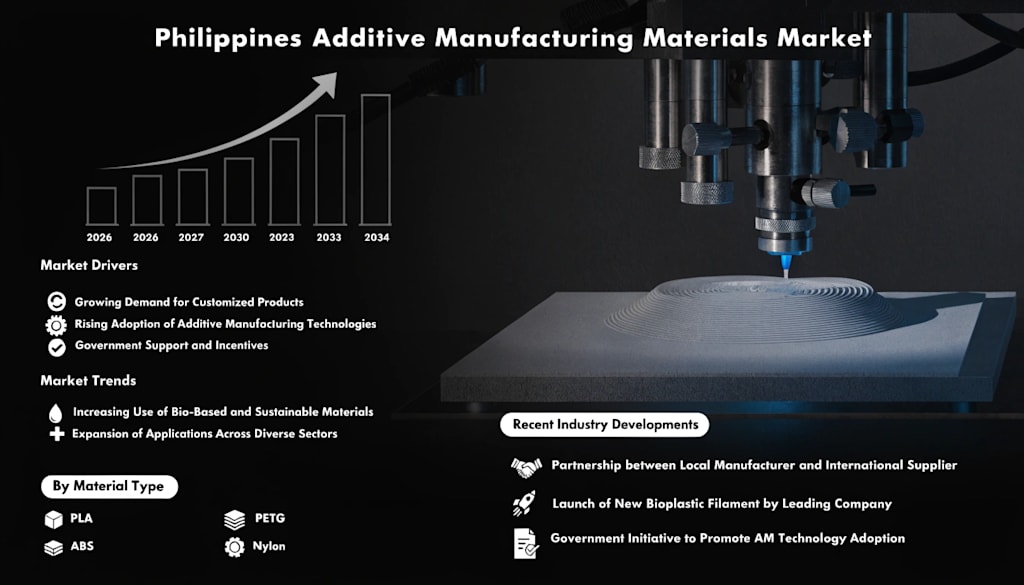
The Philippines additive manufacturing materials market is experiencing explosive growth, driven by the government's strategic push toward Industry 4.0 and the increasing integration of 3D printing into industrial production lines across the archipelago. Additive manufacturing materials — encompassing polymers, metals, ceramics, composites, and specialized filaments — are deployed across prototyping, tooling, functional parts manufacturing, and research and development to serve industries ranging from aerospace and healthcare to automotive, construction, and electronics. According to IMARC Group, the market size reached USD 938.07 Million in 2025 and is projected to reach USD 4,937.52 Million by 2034, exhibiting a stellar compound annual growth rate (CAGR) of 20.27% during 2026–2034.
The market is propelled by strategic government policies promoting advanced manufacturing technologies, the expansion of additive manufacturing beyond prototyping into the production of functional parts across high-value industries, and the advancement of local service bureaus improving the availability of specialized materials. As the Department of Science and Technology rolls out 19 regional Advanced Manufacturing Centers across Luzon, Visayas, and Mindanao, additive manufacturing materials have become the foundational inputs for the country's industrial modernisation.
What's Driving Market Growth?
Strategic Industrial Policy and Government-Led Adoption. The single most powerful driver is the Philippine government's active promotion of advanced manufacturing as a cornerstone of its industrial strategy. Agencies like the Department of Trade and Industry (DTI) and the Board of Investments (BOI) are fostering ecosystem development through incentives, public-private partnerships, and the establishment of technology demonstration centers. The DOST has opened 19 AMCen Regional Laboratories serving as innovation hubs across Luzon, Visayas, and Mindanao, linking researchers, MSMEs, universities, and industries. In Northern Mindanao, the Advanced Manufacturing Center is positioned to become the additive manufacturing hub, providing services including 3D printing, rapid prototyping, reverse engineering, and materials research. The AMCen in Zamboanga, equipped with cutting-edge 3D printing technology, supports rapid prototyping with future expansion into metal-based applications. Initiatives under the "Make It Happen in the Philippines" campaign in 2024 highlighted partnerships with international AM companies to facilitate technology transfer and establish local training hubs, creating a fertile environment for the entire AM value chain.
Expansion into Functional Part Production Across Key Industries. A pivotal trend driving the materials market is the strategic shift from using AM primarily for prototyping to its application in manufacturing functional, end-use parts. This transition is most evident in high-value industries such as aerospace, healthcare, and automotive, where the benefits of design freedom, part consolidation, and mass customization are most impactful. In aerospace, this means producing lightweight, non-critical components; in healthcare, it involves creating patient-specific surgical guides and implants; and in automotive, it enables the production of custom jigs, fixtures, and performance parts. Companies like Cebu Pacific have explored the use of 3D printed, non-critical cabin interior components to reduce weight and lead times, creating sustained demand for high-performance, certified materials. This evolution demands a different class of materials — those that are certified, high-performance, and capable of withstanding operational stresses, fundamentally expanding the total addressable market.
Advancements in Local Service Bureaus and Material Supply Chains. The maturation of the local additive manufacturing ecosystem, particularly the growth and technological upgrading of service bureaus, is a critical driver for materials consumption. These bureaus act as accessible entry points for small and medium-sized enterprises to utilize AM without large capital investments. As service providers invest in advanced printing technologies like Selective Laser Sintering (SLS), Direct Metal Laser Sintering (DMLS), and MultiJet Fusion, they concurrently need a reliable and diverse supply of corresponding materials — from nylon powders to metal alloys. Local service bureau 3D MetalCraft announced in 2025 the installation of a new DMLS machine capable of processing titanium and nickel superalloys, coupled with the establishment of a dedicated material handling facility, directly stimulating and stabilizing demand for advanced materials.
Government-Led Healthcare and Medical Innovation. The healthcare sector is a significant growth driver for additive manufacturing materials. ADMAM3D, the first advanced manufacturing facility of its kind in the Philippines, is translating science into impactful healthcare solutions through 3D printing for medical implants. The DOST's AMCen provides comprehensive services on product prototyping, manufacturing, materials development, and other 3D-printing solutions. Biocompatible 3D printing materials are at the forefront of medical and dental innovation, crucial for creating custom implants, prosthetics, and dental devices. Manila Central University partnered with TESCO Dental to integrate cutting-edge technologies — including CBCT imaging, CAD-CAM systems, 3D printing, and digital impression tools — into its academic and clinical curriculum.
AI Integration Revolutionising Additive Manufacturing. Artificial intelligence is increasingly integrated into the additive manufacturing workflow in the Philippines, primarily optimizing material usage and part quality. AI-powered software is used for generative design to create lightweight, material-efficient structures and for simulating the printing process to predict and prevent failures. In post-processing, AI-driven vision systems are being adopted for automated quality control and defect detection in functional parts. This integration enhances the reliability and economic viability of using advanced materials for critical applications, reducing waste and ensuring consistent output for industrial applications.
Market Segmentation & Key Insights
By Material Type, the market includes polymers, metals, ceramics, composites, and others. Polymers currently dominate, driven by the widespread adoption of FDM and SLA technologies across prototyping and consumer goods applications. Metals are the fastest-growing segment, propelled by aerospace, automotive, and medical applications requiring high-performance alloys.
By Form, the market is segmented into powder, filament, and liquid/resin. Filament dominates the polymer segment for FDM applications, while powder is the preferred form for metal additive manufacturing (DMLS, EBM, Binder Jetting) and advanced polymer sintering (SLS).
By Technology, the market covers Fused Deposition Modeling (FDM), Selective Laser Sintering (SLS), Stereolithography (SLA), Direct Metal Laser Sintering (DMLS), Electron Beam Melting (EBM), Binder Jetting, Material Jetting, and others. FDM remains the most widely adopted technology due to its accessibility and cost-effectiveness, while DMLS and SLS are the fastest-growing segments driven by industrial applications.
By Application, the market is divided into prototyping, tooling, functional parts manufacturing, and research and development. Prototyping still accounts for the largest share, but functional parts manufacturing is the fastest-growing segment as industries shift toward end-use production.
By End-Use Industry, key sectors include aerospace and defense, automotive, healthcare, consumer goods, electronics, construction, industrial machinery, and others. Healthcare and aerospace represent the highest-growth segments, driven by custom implants, surgical guides, and lightweight components.
By Region, the market covers Luzon, Visayas, and Mindanao. Luzon dominates, driven by the concentration of industrial parks, technology hubs, and AMCen facilities in Metro Manila and surrounding provinces.
What the Opportunities Are?
Domestic Material Production and Supply Chain Development. With global material suppliers like BASF Forward AM, Stratasys, and Höganäs expanding their local distribution networks, there is significant opportunity for domestic material producers and distributors to capture market share. The local availability of sustainable materials like BASF's Ultrafuse® rPET filament, made from recycled PET bottles, targets the consumer goods and prototyping sectors, emphasizing sustainability and catering to growing demand for eco-friendly material options.
Healthcare and Biocompatible Materials Innovation. The medical and dental sectors have shown growing interest in 3D printing and biocompatible materials. With the expansion of AMCen facilities and partnerships like MCU-TESCO Dental, there is strong opportunity for suppliers of biocompatible polymers, titanium alloys, and ceramic materials for custom implants, prosthetics, and surgical guides.
Aerospace-Grade Materials and Certification Services. As local aerospace companies like Cebu Pacific explore 3D printed cabin components, there is growing demand for certified, high-performance materials capable of withstanding operational stresses. Material certification and standardization represent both a challenge and an opportunity for suppliers who can navigate international standards and provide comprehensive technical documentation.
Metal Additive Manufacturing Expansion. With the installation of new DMLS machines capable of processing titanium and nickel superalloys, and Höganäs expanding its distribution of stainless steel and tool steel powders, there is significant opportunity for metal powder suppliers. The metal additive manufacturing market is gaining traction in aerospace, automotive, and healthcare applications.
SME Enablement and Service Bureau Partnerships. The high initial investment and total cost of ownership present barriers for SMEs. Service bureaus that can provide accessible, cost-effective AM services, coupled with reliable material supply chains, can capture the growing SME segment. Strategic partnerships between material suppliers and service bureaus, such as the Stratasys Center of Excellence partnership with a leading technical university, will drive material adoption.
Sustainable and Eco-Friendly Materials. BASF's introduction of Ultrafuse® rPET filament in the Philippines signals growing demand for sustainable material options. Suppliers offering recycled, bio-based, or low-environmental-impact materials will capture the premium segment of environmentally conscious consumers and industries.
Recent News and Developments in Philippines Additive Manufacturing Materials Market
October 2025: Stratasys Ltd. partnered with a leading technical university in Luzon to establish a Center of Excellence for Additive Manufacturing, equipped with Stratasys FDM and PolyJet systems, focusing on developing applications with advanced engineering polymers and composites for local industries.
October 2025: The DOST opened 19 AMCen Regional Laboratories serving as innovation hubs across Luzon, Visayas, and Mindanao, linking researchers, MSMEs, universities, and industries under the Advanced Manufacturing Center network.
September 2025: The DOST opened its 7th advanced manufacturing center in Laguna, the Philippines' premier research facility in additive manufacturing, providing comprehensive services on product prototyping, manufacturing, materials development, training, consultancy, and other 3D-printing solutions.
August 2025: The DOST announced the launch of a 3D lab for Northern Mindanao innovators, positioning the AMCen as the additive manufacturing hub in the region, providing cutting-edge services including 3D printing, rapid prototyping, reverse engineering, and materials research.
July 2025: The Philippine Army inked a partnership with DOST-NCR to boost 3D printing capacity, capacitating personnel for in-house designing, prototyping, and fabricating essential components such as communication devices.
June 2025: Höganäs AB, a global metal powder leader, expanded its distribution network in the Philippines through a new partnership with a major industrial supplier, improving local availability of high-quality stainless steel and tool steel powders for the growing DMLS and Binder Jetting market.
March 2025: BASF Forward AM announced the local availability of its Ultrafuse® rPET filament in the Philippines, made from recycled PET bottles, targeting the consumer goods and prototyping sectors and emphasizing sustainability.
2025: Local service bureau 3D MetalCraft announced the installation of a new DMLS machine capable of processing titanium and nickel superalloys, coupled with the establishment of a dedicated material handling facility.
Why Should You Know About Philippines Additive Manufacturing Materials Market?
You should know about this market because it captures how government-led industrial policy, technological innovation, and supply chain development intersect to create one of the fastest-growing advanced manufacturing sectors in Southeast Asia. Additive manufacturing materials are no longer limited to hobbyist filaments — they are mission-critical inputs for producing custom medical implants that save lives, lightweight aerospace components that reduce fuel consumption, and functional automotive parts that enable mass customization.
For investors, the additive manufacturing materials market offers exposure to a high-growth advanced manufacturing category anchored in the DOST's 19 AMCen regional hubs, the government's Industry 4.0 push, and the accelerating shift from prototyping to functional part production across aerospace, healthcare, and automotive sectors. The projected CAGR of 20.27% — transforming a USD 938 million market into a USD 4.94 billion market by 2034 — reflects exceptional confidence in adoption trends, material innovation, and the growing ecosystem of local service bureaus and material suppliers.
For manufacturers, engineers, material suppliers, and technology investors, understanding segmentation across material types, forms, and technologies, the emerging opportunities in healthcare and aerospace applications, and the growing importance of sustainable and certified materials helps shape intelligent investment decisions, product development roadmaps, and strategic partnerships that deliver measurable innovation, productivity, and competitive advantage.
In essence, the Philippines additive manufacturing materials market captures how material science, digital manufacturing, and industrial policy converge — making it a compelling area for investors, innovators, and manufacturers seeking smarter approaches to prototyping, production, and sustainable growth across one of Southeast Asia's most rapidly industrialising economies.
About the Creator
Thomas
Market Research Analyst | Industry Trends & Forecasting | Turning market data into clear, actionable business insights across global sectors.
Enjoyed the story? Support the Creator.
Subscribe for free to receive all their stories in your feed.
Comments
There are no comments for this story
Be the first to respond and start the conversation.