
Pharmaceutical Packaging Market Set to Reach US$ 299.42 Billion by 2033 as Innovation, Safety, and Sustainability Reshape Healthcare
Growing Demand for Medicines, Biologics, Smart Packaging Technologies, and Sustainable Materials Drives a New Era for Global Pharmaceutical Packaging

Pharmaceutical Packaging Emerges as a Critical Pillar of Modern Healthcare
The pharmaceutical industry has undergone remarkable transformation over the last decade. While drug discovery and advanced therapeutics often dominate headlines, one crucial component quietly supports the entire healthcare ecosystem—pharmaceutical packaging.
Packaging is no longer just a protective shell surrounding medicines. Today, it serves as a sophisticated solution that safeguards drug efficacy, ensures patient safety, prevents counterfeiting, enhances compliance, and supports sustainability goals. From blister packs and pre-filled syringes to intelligent packaging systems embedded with tracking technologies, pharmaceutical packaging has become a vital part of healthcare delivery worldwide.
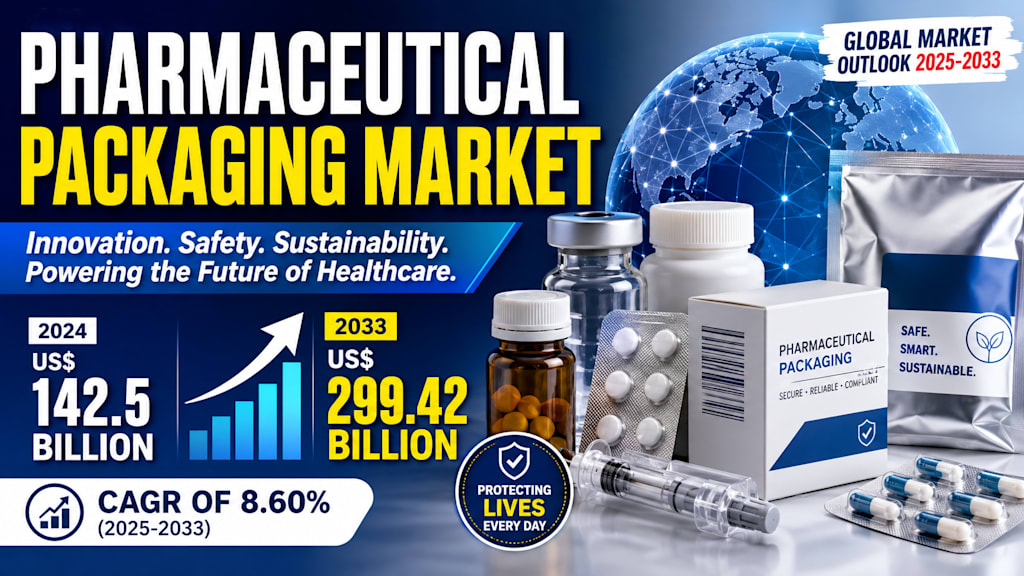
According to Renub Research, the Global Pharmaceutical Packaging Market is projected to grow from US$ 142.5 billion in 2024 to US$ 299.42 billion by 2033, expanding at a CAGR of 8.60% during 2025–2033. This impressive growth highlights the increasing importance of advanced packaging solutions in a rapidly evolving pharmaceutical landscape.
Why Pharmaceutical Packaging Matters More Than Ever
Every pharmaceutical product requires protection from contamination, moisture, light exposure, temperature fluctuations, and tampering. Effective packaging ensures medicines remain safe and effective throughout transportation, storage, and patient use.
The modern pharmaceutical supply chain has become increasingly globalized. Medicines may be manufactured in one country, packaged in another, and distributed across multiple continents before reaching patients. This complexity has elevated packaging from a supporting function to a strategic necessity.
Packaging solutions now address numerous challenges, including:
Product stability and shelf-life extension
Counterfeit prevention
Regulatory compliance
Patient adherence to medication schedules
Safe transportation of sensitive biologics
Sustainability and waste reduction
As healthcare systems become more advanced and patient-centric, packaging innovations are expected to play an even larger role in ensuring positive treatment outcomes.
Rising Global Drug Consumption Fuels Packaging Demand
One of the most significant growth drivers for the pharmaceutical packaging industry is the continuous rise in global medicine consumption.
Expanding healthcare access, population growth, increased awareness of preventive healthcare, and improved treatment availability have significantly increased pharmaceutical demand worldwide. Emerging economies are experiencing particularly strong growth as healthcare infrastructure expands and access to medications improves.
As pharmaceutical manufacturers produce larger volumes of medicines, the need for reliable packaging solutions grows simultaneously. Drug companies require packaging that protects products from environmental damage while maintaining quality throughout increasingly complex distribution networks.
Recent innovations have focused on extending drug shelf life and enhancing product protection. Advanced blister packaging technologies, for example, provide superior barriers against moisture, oxygen, and ultraviolet light, helping preserve medication effectiveness for longer periods.
These developments are becoming essential as pharmaceutical companies seek to meet growing global healthcare needs.
Aging Populations Create New Opportunities
Demographic changes represent another major factor driving market expansion.
Worldwide populations are aging rapidly. People are living longer than ever before due to advances in healthcare, nutrition, and disease management. As a result, chronic conditions such as diabetes, cardiovascular disease, arthritis, and neurological disorders are becoming increasingly common.
Older adults typically consume more prescription medications and over-the-counter treatments than younger populations. This increased medication usage directly boosts demand for pharmaceutical packaging solutions.
However, aging populations also introduce new packaging requirements.
Manufacturers must develop:
Easy-to-open packaging
Clearly labeled medication containers
Dose-tracking systems
Child-resistant yet senior-friendly closures
User-friendly dispensing mechanisms
Packaging innovation is increasingly focused on balancing safety and convenience while supporting medication adherence among elderly patients.
The Rise of Biologics Changes Packaging Requirements
The pharmaceutical industry is witnessing rapid growth in biologics, specialty drugs, and personalized medicines.
Unlike traditional small-molecule drugs, biologics are highly sensitive to environmental conditions. Exposure to temperature fluctuations, light, humidity, or contamination can compromise product effectiveness.
As biologics become more prevalent, pharmaceutical packaging must evolve accordingly.
Manufacturers are investing heavily in:
Sterile packaging systems
Cold-chain compatible containers
Advanced glass vials
Pre-filled syringes
Auto-injectors
Specialized barrier materials
These sophisticated packaging solutions help preserve product integrity while ensuring safe administration to patients.
The growing popularity of biologics is expected to remain one of the strongest drivers of packaging innovation over the next decade.
Smart Packaging Technologies Revolutionize the Industry
Technology is transforming pharmaceutical packaging at an unprecedented pace.
Smart packaging solutions now incorporate digital technologies that improve product security, traceability, and patient engagement.
Examples include:
RFID Tracking
Radio Frequency Identification (RFID) systems allow real-time monitoring throughout the supply chain, reducing theft and counterfeiting risks.
QR Codes
Consumers can scan codes to access product information, verify authenticity, and receive medication instructions.
Connected Packaging
Sensors and connected devices monitor environmental conditions such as temperature and humidity during transportation and storage.
Patient Adherence Solutions
Digital packaging can remind patients when to take medications and track compliance patterns.
These innovations improve healthcare outcomes while helping manufacturers comply with increasingly stringent regulatory requirements.
Sustainability Becomes a Competitive Advantage
Environmental responsibility is rapidly becoming a central focus across the pharmaceutical industry.
Traditional pharmaceutical packaging often relies heavily on plastics and multi-material structures that can be difficult to recycle. Growing environmental awareness and regulatory pressure are encouraging companies to explore sustainable alternatives.
Manufacturers are increasingly adopting:
Recyclable materials
Reduced-plastic packaging
Paper-based solutions
Lightweight packaging designs
Circular economy initiatives
Innovative packaging structures designed for improved recyclability are helping companies reduce their environmental footprints while maintaining product protection standards.
As sustainability becomes a key purchasing consideration for healthcare organizations and consumers alike, eco-friendly packaging solutions are expected to gain significant market share.
Regulatory Compliance Remains a Major Challenge
While growth opportunities abound, pharmaceutical packaging companies face substantial regulatory challenges.
Packaging must comply with strict requirements governing:
Product labeling
Tamper evidence
Child resistance
Serialization
Traceability
Material safety
Drug compatibility
Regulatory agencies across different regions frequently update requirements, forcing manufacturers to continually adapt packaging designs and production processes.
Failure to comply can result in:
Product recalls
Financial penalties
Supply chain disruptions
Reputational damage
As global pharmaceutical distribution becomes more interconnected, maintaining compliance across multiple jurisdictions remains a complex and costly undertaking.
Regional Market Trends Shape Industry Growth
United States
The United States remains one of the largest pharmaceutical packaging markets globally.
Factors driving growth include:
Expanding pharmaceutical production
Strong regulatory standards
Increased adoption of smart packaging
Rising focus on patient safety
The country's healthcare sector continues investing heavily in advanced packaging technologies that improve traceability, security, and medication adherence.
Germany
Germany's pharmaceutical packaging market is strongly influenced by sustainability initiatives and technological innovation.
Manufacturers are focusing on environmentally responsible packaging solutions while maintaining the high quality standards expected throughout Europe.
Growing investments in recyclable materials and circular packaging systems are helping Germany maintain its leadership position in sustainable packaging development.
India
India has emerged as one of the world's most important pharmaceutical manufacturing hubs.
The country's packaging market benefits from:
Expanding pharmaceutical exports
Growing domestic healthcare demand
Cost-effective manufacturing capabilities
Increased investment in advanced packaging technologies
As India strengthens its role in global pharmaceutical supply chains, demand for high-quality packaging solutions continues to rise.
Saudi Arabia
Healthcare modernization efforts are driving pharmaceutical packaging growth across Saudi Arabia.
The country is investing in healthcare infrastructure while encouraging innovation in pharmaceutical manufacturing and packaging.
Growing emphasis on sustainable healthcare practices is also supporting demand for environmentally responsible packaging solutions.
Product Categories Leading Market Expansion
Several packaging formats are expected to experience particularly strong growth throughout the forecast period.
Pre-Filled Syringes
Pre-filled syringes offer improved dosing accuracy, convenience, and patient safety, making them increasingly popular for biologics and injectable therapies.
Blister Packs
Blister packaging remains a preferred solution for oral medications due to its ability to protect individual doses and support patient adherence.
Vials and Ampoules
These formats continue to play a critical role in injectable medicines and specialty pharmaceuticals.
Bottles and Closures
Traditional packaging solutions remain essential for many prescription and over-the-counter medications, with ongoing innovation improving safety and usability.
Competitive Landscape Intensifies
Leading pharmaceutical packaging companies continue investing in innovation, sustainability, and capacity expansion to strengthen their market positions.
Major industry participants include:
Amcor PLC
3M Company
Schott AG
WestRock Company
Berry Global Group Inc.
McKesson Corporation
AptarGroup Inc.
Klockner Pentaplast Group
CCL Industries Inc.
FlexiTuff International Ltd
10 Recent Industry Developments
Südpack introduced PharmaGuard polypropylene blister packaging technology with enhanced barrier protection.
Constantia Flexibles launched REGULA CIRC, improving pharmaceutical packaging recyclability.
Crown Packaging Corp. announced expansion plans through a new Chicago branch.
Amcor collaborated on fully polyethylene pouch technology supporting sustainable packaging.
Increased adoption of RFID-enabled smart pharmaceutical packaging across global supply chains.
Growing commercialization of QR-code authentication systems to combat counterfeit medicines.
Expansion of cold-chain packaging solutions for biologics and specialty drugs.
Greater investment in senior-friendly pharmaceutical packaging designs.
TPG acquired a strategic stake in SCHOTT Poonawalla to strengthen pharmaceutical packaging capabilities.
Organon expanded regional pharmaceutical distribution partnerships supporting advanced packaging adoption.
Final Thoughts
The pharmaceutical packaging industry is entering a transformative decade marked by innovation, sustainability, and increasing healthcare demands.
As global medicine consumption rises, populations age, biologics gain prominence, and regulations become more stringent, packaging will play an even more essential role in ensuring patient safety and therapeutic effectiveness.
Renub Research's forecast of US$ 299.42 billion by 2033 underscores the enormous opportunities ahead. Companies capable of delivering smart, sustainable, compliant, and patient-centric packaging solutions will be best positioned to capitalize on this growth.
In a healthcare environment where every dose matters, pharmaceutical packaging is no longer simply a container—it is a critical enabler of modern medicine and a key driver of future healthcare innovation.
About the Creator
Enjoyed the story? Support the Creator.
Subscribe for free to receive all their stories in your feed.
Comments
There are no comments for this story
Be the first to respond and start the conversation.