
Pediatric Interventional Cardiology Market Poised for Strong Growth as Minimally Invasive Heart Treatments Transform Children's Healthcare
Advances in medical technology, early diagnosis of congenital heart disease, and growing demand for minimally invasive procedures are driving the future of pediatric cardiac care worldwide.

Heart disease is often associated with adults, but congenital and acquired cardiac conditions remain among the most serious health challenges affecting children worldwide. Advances in medicine have dramatically improved survival rates for infants and children born with heart defects, creating a growing need for specialized treatment options that are safer, more effective, and less invasive.
One of the most promising areas of pediatric healthcare is interventional cardiology, a specialized field focused on diagnosing and treating heart conditions through catheter-based procedures rather than traditional open-heart surgery. These minimally invasive approaches have transformed the treatment landscape by reducing recovery times, lowering procedural risks, and improving long-term outcomes for young patients.
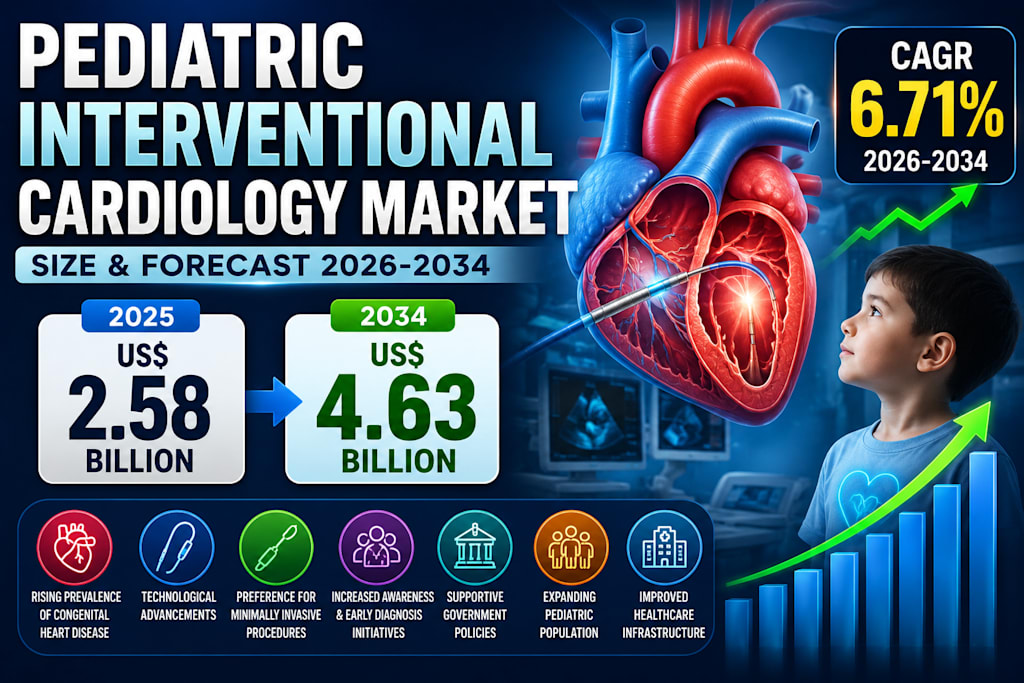
According to Renub Research, the Pediatric Interventional Cardiology Market is expected to grow from US$2.58 billion in 2025 to US$4.63 billion by 2034, expanding at a CAGR of 6.71% between 2026 and 2034. Growing awareness of congenital heart disease, technological innovation, increasing healthcare investments, and rising demand for minimally invasive procedures are expected to support this steady market expansion.

Understanding Pediatric Interventional Cardiology
Pediatric interventional cardiology is a highly specialized branch of medicine focused on treating heart abnormalities in infants, children, and adolescents using catheter-based techniques.
Unlike traditional cardiac surgery, these procedures are performed through small incisions using specialized devices that travel through blood vessels to reach the heart. This approach minimizes trauma, shortens hospital stays, and often eliminates the need for extensive surgical recovery.
The field addresses a wide range of conditions, including congenital heart defects, valve abnormalities, vascular obstructions, and structural heart diseases. Procedures commonly involve the use of balloons, catheters, stents, closure devices, and implantable valves designed specifically for pediatric patients.
As healthcare providers continue to prioritize less invasive treatment options, pediatric interventional cardiology is becoming an increasingly important component of modern cardiac care.
The Growing Burden of Congenital Heart Disease
One of the most significant factors driving market growth is the increasing recognition and diagnosis of congenital heart disease (CHD).
Congenital heart defects are among the most common birth abnormalities worldwide. These conditions occur when the heart develops improperly before birth, leading to structural abnormalities that can affect blood flow and cardiac function.
Fortunately, advances in prenatal care and neonatal screening have dramatically improved detection rates. Technologies such as fetal echocardiography allow physicians to identify many heart defects before birth, enabling early planning and intervention.
Early diagnosis is critical because timely treatment often leads to significantly better outcomes. As healthcare systems continue investing in screening programs and awareness campaigns, more children are receiving life-saving interventions at earlier stages.
This growing patient population remains one of the strongest drivers of demand for pediatric interventional cardiology procedures and devices.
Why Minimally Invasive Procedures Are Gaining Popularity
Parents and healthcare providers increasingly prefer minimally invasive procedures whenever possible.
Traditional open-heart surgery, while effective, involves significant recovery time, surgical risks, and emotional stress for both patients and families. In contrast, catheter-based interventions offer several important advantages.
These procedures typically require smaller incisions, shorter hospital stays, faster recovery periods, reduced risk of infection, and less physical trauma. Many patients are able to return to normal activities much sooner than they would after major surgery.
The ability to achieve excellent clinical outcomes while minimizing procedural risks has made interventional cardiology an attractive treatment option for many congenital and acquired heart conditions.
As technology continues to improve, physicians are performing increasingly complex procedures through minimally invasive approaches, further expanding the market's potential.
Technological Innovation Is Transforming Pediatric Cardiac Care
Technology has become the foundation of progress within pediatric interventional cardiology.
Manufacturers are developing increasingly sophisticated devices designed specifically for the unique needs of children. Unlike adult cardiac devices, pediatric products must account for smaller anatomies and future patient growth.
Modern devices include specialized balloons, occluders, guidewires, catheters, stents, and implantable valves engineered to provide durability, flexibility, and long-term safety.
Innovations in materials science and biomedical engineering have enabled the creation of devices that deliver improved performance while reducing complications.
As these technologies continue to evolve, physicians gain access to more treatment options, allowing them to address a broader range of cardiac conditions with greater precision and confidence.
Advanced Imaging Improves Precision and Safety
Successful pediatric cardiac interventions depend heavily on imaging technology.
Modern catheter-based procedures rely on advanced visualization tools that allow physicians to navigate complex cardiac structures with exceptional accuracy.
Technologies such as fluoroscopy, echocardiography, three-dimensional imaging, and hybrid imaging systems provide real-time guidance during procedures. These systems enable physicians to identify abnormalities, position devices accurately, and monitor treatment outcomes immediately.
Three-dimensional imaging technologies have become particularly valuable because they provide detailed anatomical views that improve procedural planning and decision-making.
Enhanced imaging capabilities reduce procedural risks, improve patient safety, and increase the likelihood of successful outcomes, making them essential drivers of market growth.
Specialized Pediatric Cardiac Centers Are Expanding Access
The expansion of specialized pediatric cardiac centers is helping increase access to advanced treatment options worldwide.
Hospitals and healthcare institutions are investing heavily in dedicated pediatric cardiology units equipped with state-of-the-art catheterization laboratories and advanced imaging technologies.
These specialized centers bring together multidisciplinary teams that include interventional cardiologists, surgeons, nurses, anesthesiasts, imaging specialists, and rehabilitation experts.
Such collaborative care models ensure that children receive comprehensive treatment tailored to their specific medical needs.
As more healthcare organizations establish specialized pediatric cardiac programs, access to minimally invasive procedures continues to improve, supporting overall market growth.
Growing Expertise Supports Better Outcomes
Highly trained medical professionals play a crucial role in the success of pediatric interventional cardiology.
Because children's cardiovascular systems differ significantly from adults, procedures require specialized expertise and extensive training.
Medical schools, fellowship programs, and continuing education initiatives are helping develop the next generation of pediatric interventional cardiologists.
The increasing availability of skilled specialists improves procedural success rates, enhances patient safety, and encourages broader adoption of advanced interventions.
As expertise continues to expand globally, more healthcare facilities will be capable of offering sophisticated pediatric cardiac procedures.
The United States Leads Global Innovation
The United States remains one of the most advanced markets for pediatric interventional cardiology.
Strong healthcare infrastructure, leading research institutions, advanced medical technologies, and specialized pediatric hospitals have positioned the country as a global leader in this field.
American healthcare providers benefit from access to cutting-edge devices, advanced imaging technologies, and highly trained specialists. The country's emphasis on innovation has accelerated the adoption of minimally invasive procedures and contributed to consistently improving patient outcomes.
Increasing awareness of congenital heart disease and growing survival rates among children with complex cardiac conditions continue to drive demand across the United States market.
Germany Maintains a Strong Position in Europe
Germany represents one of Europe's most established pediatric interventional cardiology markets.
The country's healthcare system emphasizes early diagnosis, advanced medical technology, and high-quality specialized care. Widespread neonatal screening programs and sophisticated imaging technologies contribute to timely identification of congenital heart defects.
German healthcare providers are also known for adopting innovative treatment techniques and conducting extensive clinical research. These strengths continue to support steady growth within the country's pediatric cardiac care sector.
India Emerges as a Rapidly Growing Market
India is becoming an increasingly important market for pediatric interventional cardiology.
Rising awareness of congenital heart disease, improving healthcare infrastructure, and growing investments in specialized cardiac centers are driving demand throughout the country.
Major cities such as Delhi, Mumbai, Bengaluru, and Chennai now host advanced pediatric cardiac facilities capable of performing complex interventional procedures.
Government healthcare initiatives, expanding insurance coverage, and increasing disposable incomes are further supporting market development.
Although challenges remain regarding affordability and access in rural areas, India is expected to experience significant growth in the coming years.
The UAE Continues to Invest in Advanced Pediatric Care
The United Arab Emirates has emerged as a promising market for pediatric interventional cardiology.
Investments in healthcare infrastructure, specialized medical centers, and advanced diagnostic technologies have strengthened the country's ability to provide high-quality pediatric cardiac care.
Cities such as Dubai and Abu Dhabi offer modern catheterization laboratories and access to innovative treatment options. Additionally, the UAE's growing medical tourism sector contributes to increasing demand for specialized cardiovascular services.
These developments position the country for continued market expansion.
Challenges Remain Despite Strong Growth
While the future outlook is positive, several challenges continue to affect the pediatric interventional cardiology market.
One major issue is the limited availability of pediatric-specific devices. Developing products for children is considerably more complex than designing devices for adults due to anatomical differences and growth considerations.
Manufacturers must invest heavily in research, testing, and regulatory compliance while serving a relatively small patient population. These factors increase development costs and can slow innovation.
Regulatory approval processes also present challenges. Pediatric medical devices often require extensive clinical evidence and safety testing before receiving approval, extending development timelines and increasing expenses.
Reimbursement issues create additional obstacles. Variations in insurance coverage and healthcare funding can affect patient access to advanced procedures and technologies.
Despite these hurdles, ongoing collaboration between manufacturers, healthcare providers, and research institutions continues to drive progress.
Recent Industry Developments Highlight Momentum
Recent developments demonstrate continued innovation within the market.
In April 2025, Abbott received FDA approval for its Tendyne transcatheter mitral valve replacement technology, expanding treatment options for patients with severe cardiac conditions.
Boston Scientific strengthened its cardiovascular portfolio through the acquisition of Bolt Medical in January 2025, enhancing capabilities in treating complex vascular diseases.
Meanwhile, Johnson & Johnson received FDA clearance in late 2024 to expand pediatric applications for its Impella heart pump technology, representing an important advancement in pediatric mechanical circulatory support.
These developments illustrate the industry's commitment to innovation and improving outcomes for young cardiac patients.
Final Thoughts
The pediatric interventional cardiology market stands at the intersection of medical innovation, technological advancement, and patient-centered care.
As healthcare providers increasingly embrace minimally invasive procedures, children with congenital and acquired heart conditions are gaining access to safer, more effective treatment options than ever before.
With the market projected to grow from US$2.58 billion in 2025 to US$4.63 billion by 2034, the future appears highly promising. Continued advancements in medical devices, imaging technologies, physician expertise, and healthcare infrastructure will likely expand treatment possibilities and improve quality of life for millions of young patients worldwide.
For families, physicians, and healthcare systems alike, pediatric interventional cardiology represents one of the most important and rapidly evolving areas of modern medicine.
About the Creator
Enjoyed the story? Support the Creator.
Subscribe for free to receive all their stories in your feed.
Comments
There are no comments for this story
Be the first to respond and start the conversation.