
Parallel Spotlights: When Royal Tradition Meets Modern Media Strategy
A closer look at timing, perception, and the evolving relationship between public duty and personal branding

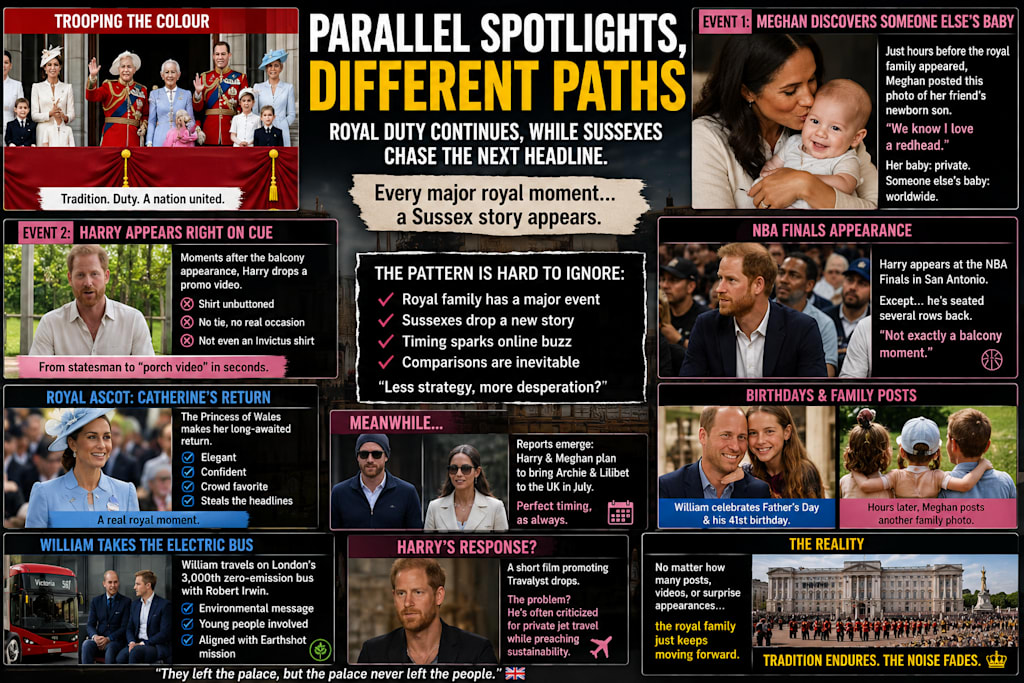
Each year, the grand ceremony of Trooping the Colour captures attention across the United Kingdom and beyond. With its rich tradition, military precision, and royal symbolism, the event marks more than just a celebration—it reinforces continuity, stability, and history. Crowds gather, cameras roll, and the world watches as members of the royal family appear on the Buckingham Palace balcony, representing an institution that has endured for generations. Yet in today’s digital era, tradition rarely exists in isolation. Alongside these historic moments, a different kind of visibility unfolds—one shaped not by ceremony, but by timing, media presence, and personal platforms. Increasingly, observers have noticed a pattern: whenever a major royal event dominates headlines, parallel stories begin to surface elsewhere, often involving the Duke and Duchess of Sussex. From social media posts to public appearances, these moments create what many describe as “competing narratives.” While the royal family carries out formal duties tied to national identity, the Sussexes operate in a more flexible, modern media space. This difference in approach has sparked ongoing discussion about intention, relevance, and the power of timing. For example, during one recent Trooping the Colour, attention quickly expanded beyond the balcony. Around the same time, a social media post featuring a personal moment involving a close friend’s newborn gained widespread circulation. While some viewers saw it as a simple expression of affection, others questioned the contrast between this openness and the couple’s previously stated desire to protect their own children’s privacy. Moments like these highlight a recurring tension: how public figures manage personal boundaries while maintaining a public presence. In an age where every image can be shared instantly with millions, even small decisions can become widely interpreted. What one person views as harmless, another may see as inconsistent. At nearly the same time, a video appearance by Prince Harry promoting an upcoming international sporting initiative added another layer to the conversation. Supporters appreciated his continued commitment to charitable work, particularly efforts that support veterans and global communities. However, critics noted the timing, suggesting it drew attention away from the royal event unfolding in London. Whether intentional or coincidental, these overlaps contribute to a growing perception that two parallel narratives are unfolding. On one side stands the royal institution—structured, ceremonial, and rooted in tradition. On the other is a more modern approach—personal, media-driven, and responsive to global audiences. Public reaction often depends on perspective. Some admire the Sussexes for building an independent identity and continuing their work outside royal constraints. Others feel that the timing of their appearances creates unnecessary comparisons. In reality, both interpretations reflect the complexity of modern public life, where image and intention are constantly analyzed. Additional appearances—whether at sporting events, public engagements, or media productions—further shape this narrative. Attending widely viewed events like major sports finals can increase visibility, but it also invites comparison. When placed alongside the scale and symbolism of royal ceremonies, these appearances may feel different in tone, even if not in importance. Meanwhile, members of the royal family continue to focus on long-term initiatives. Environmental campaigns, charitable programs, and public engagements remain central to their roles. These efforts are often carefully aligned with broader goals, such as sustainability and community impact, reinforcing a consistent message over time. This contrast in communication styles is perhaps the most significant difference. The royal family typically follows a structured calendar, with messaging that emphasizes continuity. In contrast, the Sussexes operate with more flexibility, using media opportunities to share updates, promote causes, and maintain relevance in a fast-changing digital landscape. The challenge arises when these two approaches intersect. Timing becomes a powerful factor. Even when actions are unrelated, overlapping moments can create the impression of competition. In reality, it may simply be the result of two different systems operating simultaneously—one traditional, one modern. Another important aspect is public perception. In today’s connected world, audiences do not just consume information—they interpret it, discuss it, and reshape it. Social media plays a major role in amplifying certain narratives, often focusing on contrast and comparison. This can make separate events feel interconnected, even when they are not intended to be. Ultimately, what emerges is not a simple story of rivalry, but a reflection of changing times. The royal institution continues to represent history and national identity, while newer public figures explore alternative ways of engaging with global audiences. Both approaches come with advantages and challenges. As these parallel narratives continue, one thing remains clear: visibility is no longer controlled by a single platform or moment. Instead, it is shaped by a combination of tradition, media strategy, and public interpretation. In this environment, timing is everything—and perception can often matter just as much as reality. In the end, the story is not just about individuals or events. It is about how public life itself is evolving. The intersection of heritage and modern media has created a space where multiple narratives can exist at once, each influencing how the other is seen. And as long as both worlds continue to operate side by side, these moments of overlap will likely remain a defining feature of the public conversation.
About the Creator
Behind the Curtain
"Exploring the untold stories and hidden truths. From royal rumors to cultural deep dives, Behind the Curtain brings you bold, insightful narratives that spark curiosity and conversation."
Enjoyed the story? Support the Creator.
Subscribe for free to receive all their stories in your feed.
Comments
There are no comments for this story
Be the first to respond and start the conversation.