
Orthodontics Market Outlook 2026–2034: The Rise of Digital Dentistry and the Future of Smile Correction
Growing demand for aesthetic dental treatments, clear aligner technology, and AI-powered orthodontic solutions is transforming the global orthodontics industry and creating new opportunities for healthcare providers worldwide.

The global orthodontics industry is entering a period of remarkable transformation. Once considered a specialized dental service primarily for children and teenagers, orthodontics has evolved into a rapidly expanding healthcare segment that serves patients of all ages. Advances in digital dentistry, increasing awareness of oral health, and growing demand for aesthetic treatments have significantly expanded the market's reach across developed and emerging economies.
Today, consumers are seeking more than just functional dental correction. They want comfortable, convenient, and visually appealing treatment options that fit seamlessly into their personal and professional lifestyles. This shift in consumer expectations has encouraged orthodontic providers and manufacturers to invest heavily in innovation, resulting in the widespread adoption of clear aligners, digital scanning systems, artificial intelligence, and 3D-printing technologies.
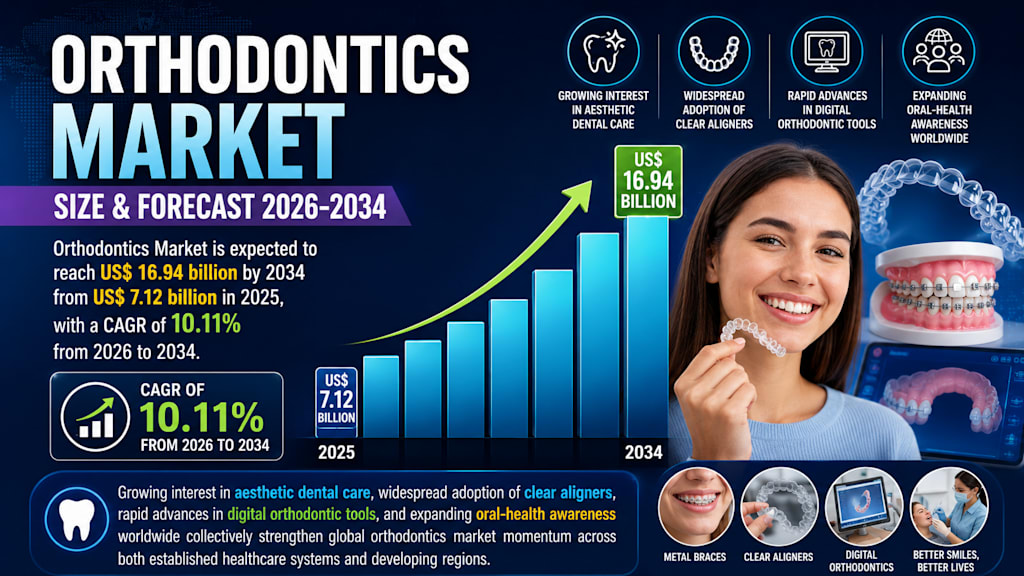
According to Renub Research, the global orthodontics market is projected to grow from approximately US$ 7.12 billion in 2025 to US$ 16.94 billion by 2034, registering an impressive compound annual growth rate (CAGR) of 10.11% from 2026 to 2034. This strong growth trajectory reflects the increasing importance of oral health, technological innovation, and rising demand for personalized orthodontic care worldwide.
As healthcare systems continue embracing digital transformation and patients become more proactive about dental wellness, the orthodontics market is expected to experience sustained growth throughout the forecast period.

Understanding the Role of Orthodontics in Modern Healthcare
Orthodontics is a specialized branch of dentistry focused on diagnosing, preventing, and correcting misaligned teeth and jaw irregularities. While many people associate orthodontic treatment primarily with improving appearance, its benefits extend far beyond aesthetics.
Proper dental alignment contributes significantly to overall oral health. Correctly positioned teeth are easier to clean, reducing the risk of gum disease and tooth decay. Orthodontic treatment can also improve chewing efficiency, speech function, jaw alignment, and long-term dental stability.
Modern orthodontic treatments include traditional braces, clear aligners, retainers, lingual braces, and various corrective appliances. These solutions are designed to gradually reposition teeth and improve bite function through carefully planned treatment programs.
Technological innovation has revolutionized the way orthodontic care is delivered. Digital imaging systems, AI-guided treatment planning, and 3D-printed appliances enable practitioners to create highly personalized treatment plans that improve comfort, efficiency, and outcomes for patients of all ages. As a result, orthodontics has become more accessible, predictable, and patient-friendly than ever before.
Digital Transformation Is Reshaping Orthodontic Care
One of the most powerful drivers of market growth is the rapid integration of digital technologies into orthodontic practice.
Traditional treatment methods often relied on manual impressions, physical models, and time-consuming adjustments. Today, digital workflows have streamlined nearly every stage of the treatment process.
Advanced technologies such as intraoral scanners, three-dimensional imaging systems, artificial intelligence, and computer-aided design tools allow orthodontists to diagnose conditions with greater accuracy and develop highly customized treatment plans.
AI-powered treatment planning systems can simulate tooth movement, predict treatment outcomes, and identify potential challenges before treatment begins. These capabilities improve efficiency while reducing the need for revisions and unnecessary appointments.
Three-dimensional printing technology has also become increasingly important within the industry. Custom aligners, retainers, brackets, and other orthodontic components can now be produced with exceptional precision, improving patient comfort and treatment effectiveness.
As digital-first orthodontics continues evolving, clinics around the world are investing heavily in advanced technologies that enhance both clinical performance and patient satisfaction.
The Growing Popularity of Clear Aligners
Perhaps the most visible trend within the orthodontics market is the widespread adoption of clear aligners.
Consumers increasingly prefer treatment options that offer discretion, comfort, and convenience. Unlike traditional metal braces, clear aligners are nearly invisible and can be removed during eating, brushing, and other daily activities.
This flexibility makes them especially appealing to adults and working professionals who want to improve their smiles without drawing attention to their treatment.
Advancements in digital treatment planning have significantly improved the effectiveness of clear aligners, enabling them to address increasingly complex orthodontic cases. Combined with AI-guided treatment simulations and customized manufacturing processes, modern aligners deliver predictable results while minimizing discomfort.
The growing acceptance of clear aligners among patients and providers has made this segment one of the fastest-growing categories within the orthodontics industry. Strategic collaborations between technology companies and aligner manufacturers continue accelerating innovation and expanding treatment possibilities.
Integrated Oral-Care Ecosystems Are Creating New Opportunities
Another important trend shaping the market is the emergence of integrated oral-care ecosystems.
Patients increasingly seek comprehensive dental solutions that combine orthodontic treatment with preventive care, cosmetic dentistry, and long-term oral-health management. In response, major dental technology companies are forming strategic partnerships designed to provide interconnected products and services.
These collaborations improve treatment efficiency, simplify patient experiences, and create opportunities for remote monitoring and digital communication between providers and patients.
Integrated care models also support tele-orthodontics, allowing practitioners to monitor treatment progress remotely and reduce the number of in-person visits required.
As healthcare becomes increasingly connected and technology-driven, integrated oral-care ecosystems are expected to play an increasingly important role in driving orthodontics market growth.
Rising Awareness of Oral Health Is Expanding Demand
Global awareness of oral health has improved significantly over the past decade.
Educational campaigns, school-based dental programs, preventive-care initiatives, and improved access to healthcare information have encouraged consumers to take a more proactive approach to dental wellness.
Many individuals now understand that orthodontic treatment provides important health benefits beyond cosmetic enhancement. Proper alignment contributes to improved oral hygiene, reduced dental complications, and better overall quality of life.
As awareness continues growing, more parents are seeking early orthodontic evaluations for their children. Early intervention often allows practitioners to address developmental issues before they become more severe, improving treatment outcomes and reducing future complications.
Rising disposable incomes in developing economies are also increasing access to premium orthodontic services, creating new opportunities for market expansion across emerging regions.
Challenges Facing the Orthodontics Industry
Despite its strong growth prospects, the orthodontics market faces several significant challenges.
One of the most important barriers is the high cost of treatment. Advanced technologies such as digital imaging systems, AI-powered software, and 3D-printing equipment require substantial investment. These costs often contribute to higher treatment fees for patients.
Insurance coverage for orthodontic procedures varies significantly between countries and is often limited for adult treatments. As a result, affordability remains a concern for many consumers, particularly in lower-income regions.
Another challenge involves the shortage of qualified orthodontic specialists. Orthodontics requires extensive education and specialized training beyond general dentistry. Many countries face shortages of trained professionals, resulting in uneven access to care and longer waiting times.
Rapid technological advancement also creates ongoing training requirements for practitioners. Clinics must continually invest in education and equipment upgrades to remain competitive in an increasingly digital healthcare environment.
Regional Market Insights
The United States remains one of the most advanced orthodontics markets globally. Strong demand for aesthetic dentistry, widespread adoption of clear aligners, and sophisticated healthcare infrastructure support continued market growth. American clinics are among the earliest adopters of technologies such as AI-assisted treatment planning, digital impressions, and 3D printing, helping establish the country as a global leader in orthodontic innovation.
Germany also plays a significant role within the global orthodontics landscape. The country's strong healthcare system, emphasis on preventive care, and commitment to technological excellence support widespread adoption of advanced orthodontic solutions. German patients increasingly choose discreet treatment options such as clear aligners and lingual braces, contributing to growing demand for innovative products and services.
China represents one of the fastest-growing orthodontics markets in the world. Rising incomes, rapid urbanization, and growing interest in aesthetic dentistry have fueled demand for modern orthodontic treatments. Local manufacturers are becoming increasingly competitive by producing cost-effective aligners and digital solutions tailored to domestic market needs. Meanwhile, major cities continue adopting advanced technologies such as AI-powered diagnostics and 3D printing at an accelerated pace.
Saudi Arabia is emerging as a key orthodontics market in the Middle East. Government investments in healthcare modernization, increasing awareness of oral health, and strong consumer interest in aesthetic treatments are driving market expansion. The growing presence of international manufacturers and advanced dental technologies further supports industry development throughout the region.
Recent Developments Shaping the Industry
The orthodontics industry continues to witness significant innovation and collaboration. In November 2024, the International Orthodontics Foundation partnered with the ADA Forsyth Institute to strengthen global orthodontic innovation through research, technology development, and professional education initiatives. In August 2024, Angelalign Technology entered a strategic collaboration with The Lubrizol Corporation to advance clear-aligner materials and improve treatment performance.
Earlier in January 2024, Henry Schein introduced the Carriere Motion Pro bite corrector, a device designed to address Class II and Class III malocclusions while reducing overall treatment duration. Meanwhile, BRACES ON DEMAND collaborated with EasyRx in December 2023 to improve workflow efficiency through integrated digital imaging and customized 3D-printed braces. These developments highlight the industry's ongoing commitment to innovation and patient-centered care.
Market Segmentation and Industry Structure
The orthodontics market encompasses a wide range of products, patient groups, and healthcare settings. Product categories primarily include instruments and supplies used throughout the treatment process. Instruments consist of diagnostic and treatment equipment, while supplies include aligners, braces, retainers, wires, and related materials essential for orthodontic care.
The market serves both adult and pediatric populations. While children continue representing a significant portion of orthodontic patients, adult orthodontics has emerged as one of the fastest-growing segments due to increasing awareness of aesthetic dental care and the popularity of clear aligners.
Dental clinics remain the dominant end-user segment because they provide specialized orthodontic services and increasingly invest in advanced treatment technologies. Hospitals and other healthcare facilities also contribute to market demand, particularly in regions where integrated healthcare systems support orthodontic treatment.
Competitive Landscape
Competition within the global orthodontics market remains intense as leading companies continue investing in innovation, research, and digital transformation. Major industry participants include 3M Corporation, Henry Schein, Inc., Dentsply Sirona, Align Technology, Inc., Straumann AG, Danaher Corporation, and Envista Holdings Corporation.
These organizations focus on developing advanced orthodontic products, improving treatment efficiency, expanding digital capabilities, and forming strategic partnerships that strengthen their market positions. Their ongoing investments in technology and product development are helping shape the future of orthodontic care worldwide.
Final Thoughts
The global orthodontics market is undergoing a profound transformation driven by digital innovation, growing aesthetic awareness, and expanding access to advanced dental care. Technologies such as artificial intelligence, 3D printing, digital imaging, and clear aligners are fundamentally changing how orthodontic treatment is delivered, creating better outcomes for both patients and providers.
As awareness of oral health continues to grow and consumers increasingly seek personalized treatment solutions, the orthodontics industry is expected to experience sustained expansion throughout the coming decade. With the market projected to reach US$ 16.94 billion by 2034, orthodontics is positioned to remain one of the most dynamic and rapidly evolving segments within modern healthcare.
About the Creator
Enjoyed the story? Support the Creator.
Subscribe for free to receive all their stories in your feed.
Comments
There are no comments for this story
Be the first to respond and start the conversation.