
Orthodontics Market Is Being Transformed by Digital Dentistry and Clear Aligners
Rising demand for aesthetic dental care, AI-powered treatment planning, and advanced orthodontic technologies is reshaping the future of global oral healthcare.

The global orthodontics industry is entering one of the most transformative periods in its history. What was once viewed primarily as corrective treatment for teenagers has evolved into a technology-driven healthcare segment focused on aesthetics, precision, comfort, and preventive oral care. Adults are increasingly seeking orthodontic solutions, clear aligners are replacing traditional braces in many cases, and digital dentistry is redefining how treatments are planned and delivered.
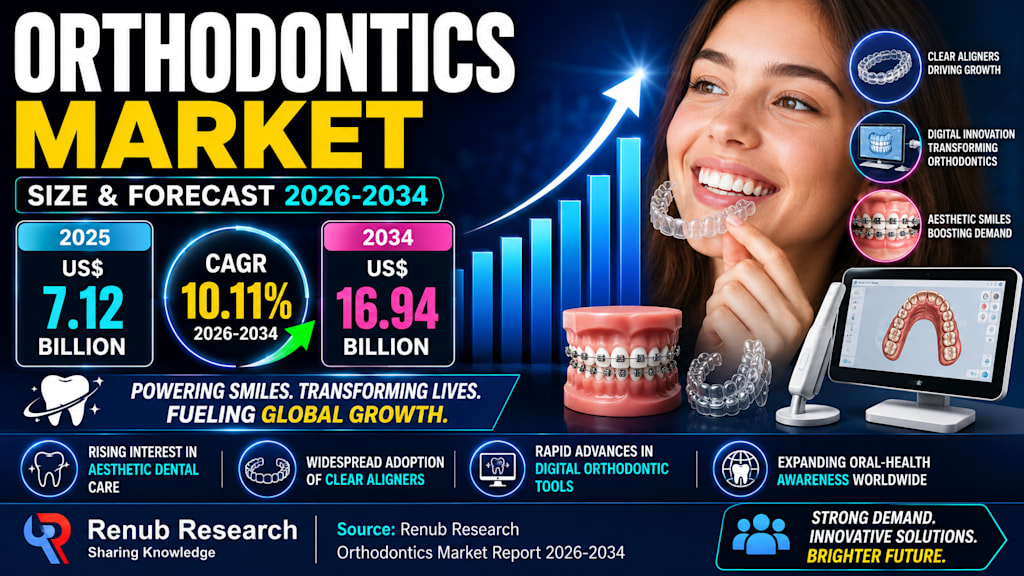
According to Renub Research, the Orthodontics Market is projected to grow from US$ 7.12 billion in 2025 to US$ 16.94 billion by 2034, expanding at a CAGR of 10.11% between 2026 and 2034. The market’s growth is being fueled by rising awareness of oral health, growing interest in aesthetic dental care, widespread adoption of clear aligners, and rapid advancements in digital orthodontic technologies.
Orthodontics is no longer just about straightening teeth. It is increasingly connected to long-term oral health, facial aesthetics, preventive care, and advanced digital healthcare systems.
Orthodontics is evolving into a technology-driven specialty
Orthodontics is a specialized branch of dentistry focused on diagnosing, preventing, and correcting misaligned teeth and jaw irregularities. Treatments typically involve braces, aligners, retainers, and other corrective devices that gradually reposition teeth to improve both function and appearance.
Proper alignment offers benefits that go beyond cosmetics. Correcting bite and jaw issues can reduce the risk of gum disease, tooth decay, jaw strain, and speech difficulties. As awareness of these long-term benefits grows, more patients are seeking orthodontic evaluation earlier in life.
Modern orthodontics has become highly dependent on digital innovation. AI-guided treatment planning, 3D imaging, digital impressions, and 3D-printed orthodontic components are improving precision while making treatments more comfortable and efficient.
These advancements allow orthodontists to create highly personalized treatment plans for children, teenagers, and adults alike. The result is a more patient-friendly experience that combines improved dental function with enhanced facial aesthetics.
Digital transformation is accelerating market growth
One of the strongest growth drivers in the orthodontics market is the rapid integration of digital technologies into clinical workflows. Orthodontic practices worldwide are increasingly adopting AI-assisted treatment planning, digital scanning systems, 3D imaging tools, and 3D-printed appliances.
Digital workflows significantly improve diagnostic accuracy and treatment precision. They also reduce appointment times, minimize treatment revisions, and create more predictable outcomes for patients.
Clear aligners have become one of the biggest beneficiaries of this transformation. Patients increasingly prefer discreet and comfortable orthodontic options that fit seamlessly into their daily routines. Unlike traditional metal braces, clear aligners are removable, less noticeable, and often perceived as more convenient.
The report highlights a strategic collaboration announced in November 2023 between Vivos Therapeutics and Ormco to integrate IVOS CARE technologies with Spark Clear Aligners. The partnership aims to improve treatment speed, comfort, and predictability, reflecting how digital-first orthodontic systems are becoming central to market growth.
As clinics continue investing in advanced digital infrastructure, the global demand for precision orthodontic systems is expected to rise steadily.
Integrated oral-care ecosystems are changing patient expectations
Another major trend shaping the orthodontics industry is the rise of integrated oral-care ecosystems. Patients increasingly prefer comprehensive dental solutions that combine orthodontics, cosmetic dentistry, preventive care, and digital monitoring within a single care experience.
This shift is encouraging collaborations between dental technology companies, healthcare providers, and oral-care brands. Strategic partnerships help improve workflow integration, patient monitoring, and treatment convenience while expanding access to modern orthodontic technologies.
The report highlights an important partnership announced in February 2023 between Koninklijke Philips N.V. and Candid Care Co. The collaboration aimed to create broader interconnected oral-care solutions, including orthodontic services and whitening technologies.
Integrated care ecosystems also support remote monitoring and tele-orthodontics, allowing providers to track patient progress digitally while reducing the need for frequent in-person visits.
Preventive oral healthcare is becoming a global priority
Growing awareness of preventive dental care is another major factor contributing to orthodontics market growth. Public health campaigns, school-based dental programs, and expanded insurance coverage are encouraging earlier orthodontic evaluations, especially among children and adolescents.
Parents increasingly recognize the importance of correcting alignment issues before they become more severe. At the same time, adults are becoming more conscious of how oral health affects overall wellness, confidence, and appearance.
Developing economies are also contributing significantly to market expansion. Rising disposable incomes and improving healthcare infrastructure are increasing access to premium orthodontic services such as clear aligners and advanced braces systems.
Clinics worldwide are adopting advanced technologies including self-adjusting wires, AI-assisted simulation platforms, digital impressions, and 3D-printed brackets. These innovations improve treatment efficiency while reducing discomfort and treatment duration.
Tele-orthodontics is also expanding access to care, especially in underserved and rural areas where specialist availability remains limited.
High treatment costs remain a major barrier
Despite strong growth prospects, affordability continues to be one of the biggest challenges in the orthodontics market. Advanced technologies such as clear aligners, digital imaging systems, AI-guided planning tools, and 3D printing significantly increase treatment costs.
Smaller clinics often struggle to invest in expensive digital equipment, limiting their ability to compete with larger dental chains and technologically advanced providers.
Insurance coverage remains another challenge. In many countries, orthodontic care — especially for adults — receives limited reimbursement support. As a result, many patients still view orthodontic treatment as a luxury rather than a standard healthcare service.
Premium pricing for aesthetic orthodontics can further widen accessibility gaps, particularly in low-income regions where affordability remains a critical issue.
Shortage of specialists is slowing market expansion
The global shortage of trained orthodontic specialists is another obstacle affecting industry growth. Orthodontics requires years of advanced training beyond general dentistry, and many regions lack sufficient educational programs to meet rising demand.
This shortage creates uneven access to orthodontic services, particularly in rural and underserved areas. Long waiting times and limited specialist availability continue to affect treatment accessibility in several countries.
Rapid technological change also requires ongoing professional training. Orthodontists must continually update their skills to work effectively with digital tools, AI-based systems, and advanced imaging technologies. This increases operational costs and creates skill gaps within the industry.
Regulatory differences between countries also complicate international expansion for orthodontic manufacturers and service providers.
The United States leads in digital orthodontics adoption
The United States remains one of the world’s most advanced orthodontics markets due to strong consumer demand for aesthetic dental care and highly developed dental infrastructure.
American clinics are rapidly adopting technologies such as AI-guided treatment planning, 3D printing, and digital impressions. Adult orthodontics is also growing rapidly as consumers increasingly prioritize appearance and long-term oral health.
The presence of major orthodontic manufacturers and innovators further strengthens the U.S. market by driving continuous product development and competitive pricing.
Flexible financing options and insurance support for children also improve treatment accessibility in the country.
Germany combines precision engineering with dental innovation
Germany’s orthodontics market benefits from high dental-care standards, strong preventive healthcare awareness, and widespread adoption of advanced digital technologies.
German patients increasingly prefer discreet orthodontic options such as clear aligners and lingual braces. The country’s strong engineering culture also supports adoption of technologies such as CAD/CAM systems, robotic wire bending, and advanced 3D imaging solutions.
Collaboration between universities, research institutions, and dental manufacturers continues driving innovation across the German orthodontics industry.
China is emerging as one of the fastest-growing markets
China’s orthodontics market is expanding rapidly due to rising disposable incomes, urbanization, and increasing interest in aesthetic dentistry.
Clear aligners are especially popular among younger consumers seeking convenient and discreet treatment options. Local manufacturers are also becoming increasingly competitive by producing cost-effective aligners and digital orthodontic systems tailored to domestic demand.
Major Chinese cities are rapidly adopting AI-powered diagnostics, remote monitoring applications, and 3D-printing technologies, helping modernize orthodontic treatment across the country.
Saudi Arabia is strengthening its orthodontic infrastructure
Saudi Arabia is emerging as a significant orthodontics market in the Middle East due to increasing healthcare investments, a youthful population, and strong cultural interest in appearance and cosmetic care.
Demand for advanced braces and clear aligners is rising among teenagers and working professionals. Expansion of private dental centers and modernization initiatives are improving treatment accessibility across the country.
International manufacturers are also increasing partnerships with local distributors to introduce digital orthodontic technologies such as AI-driven planning systems and intraoral scanners.
Recent innovations highlight the market’s rapid evolution
Recent developments within the orthodontics industry demonstrate how quickly innovation is reshaping the market.
In November 2024, the International Orthodontics Foundation partnered with the ADA Forsyth Institute to support global orthodontic innovation through research and professional training initiatives.
In August 2024, Angelalign Technology partnered with The Lubrizol Corporation to improve clear aligner materials and treatment performance.
Meanwhile, Henry Schein introduced the Carriere Motion Pro bite corrector in January 2024, designed to reduce orthodontic treatment duration for certain malocclusion cases.
These developments reflect the growing importance of technology, material science, and workflow optimization within modern orthodontics.
Major companies continue intensifying competition
The orthodontics market includes several major global players competing across aligners, braces systems, imaging tools, and digital treatment platforms. Companies highlighted in the report include 3M Corporation, Henry Schein, Dentsply Sirona, Align Technology, Straumann AG, Danaher Corporation, and Envista Holdings Corporation.
Competition is expected to intensify further as demand for digital-first orthodontic solutions continues rising globally.
Final thoughts
The orthodontics industry is rapidly evolving into a technology-driven healthcare market focused on precision, aesthetics, and patient convenience. According to Renub Research, the market’s projected growth from US$ 7.12 billion in 2025 to US$ 16.94 billion by 2034 highlights the increasing importance of advanced orthodontic solutions worldwide.
Clear aligners, AI-powered treatment planning, digital imaging, and integrated oral-care ecosystems are redefining how orthodontic treatment is delivered. At the same time, rising awareness of oral health and preventive care continues expanding the market across both developed and emerging economies.
About the Creator
Enjoyed the story? Support the Creator.
Subscribe for free to receive all their stories in your feed.
Comments
There are no comments for this story
Be the first to respond and start the conversation.