
Online Travel Market Heads Toward US$1.59 Trillion as Digital Booking Revolution Reshapes Global Tourism
Rising internet access, smartphone adoption, AI-powered personalization, and global tourism recovery are driving unprecedented growth in the online travel industry.

The way people travel has changed dramatically over the past two decades. What once required visits to travel agencies, printed brochures, and long phone calls can now be completed within minutes through a smartphone or laptop.
From booking flights and hotels to purchasing vacation packages and planning personalized itineraries, online travel platforms have transformed the global tourism experience. Consumers today expect convenience, flexibility, instant price comparisons, digital payments, and personalized recommendations—all delivered through seamless online interfaces.
As internet connectivity expands and digital technologies become more sophisticated, the online travel market is entering a new phase of accelerated growth. Artificial intelligence, mobile applications, digital wallets, and global tourism recovery are reshaping how travelers discover, book, and manage their journeys.
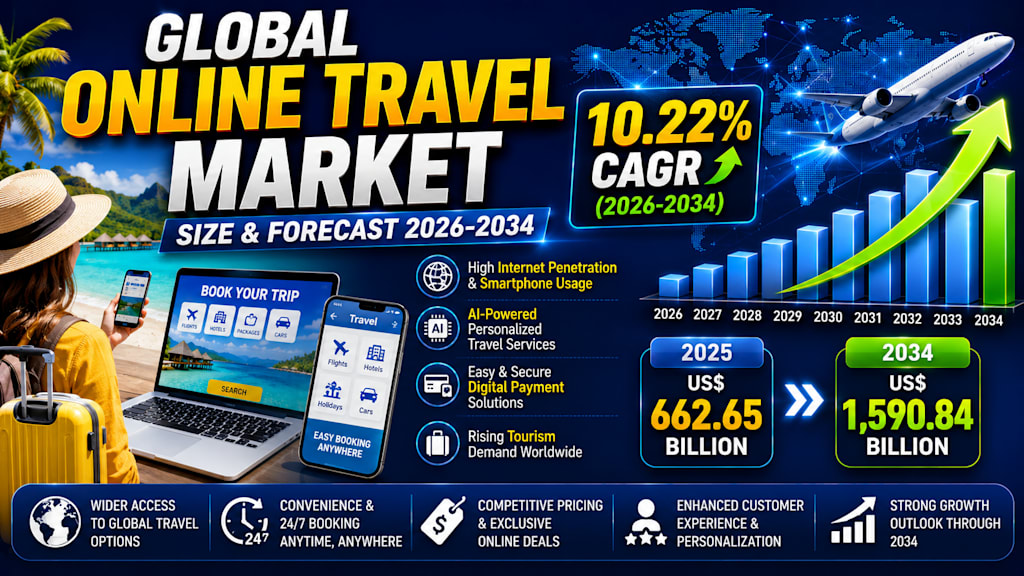
According to recent industry projections, the global online travel market is expected to grow from US$662.65 billion in 2025 to US$1,590.84 billion by 2034, registering a compound annual growth rate (CAGR) of 10.22% between 2026 and 2034. The market’s expansion is being fueled by high internet penetration, rising smartphone usage, growing tourism demand, and increasing preference for digital booking solutions.
Digital Platforms Have Redefined Travel Planning
Online travel refers to the use of websites, mobile applications, and digital platforms to book and manage travel-related services such as flights, accommodation, transportation, vacation packages, insurance, and activities.
These platforms allow consumers to compare prices, read reviews, explore destinations, and complete secure payments from virtually anywhere in the world. Major companies including Expedia, Booking Holdings, Airbnb, and MakeMyTrip Limited have transformed the industry by offering travelers unprecedented convenience and flexibility.
Consumers no longer rely solely on travel agents to organize trips. Instead, travelers can independently research destinations, customize itineraries, and secure reservations instantly.
The result is a travel ecosystem that is more transparent, competitive, and globally connected than ever before.
Internet Growth Continues to Fuel Market Expansion
One of the strongest drivers behind the online travel market is the rapid expansion of internet usage worldwide.
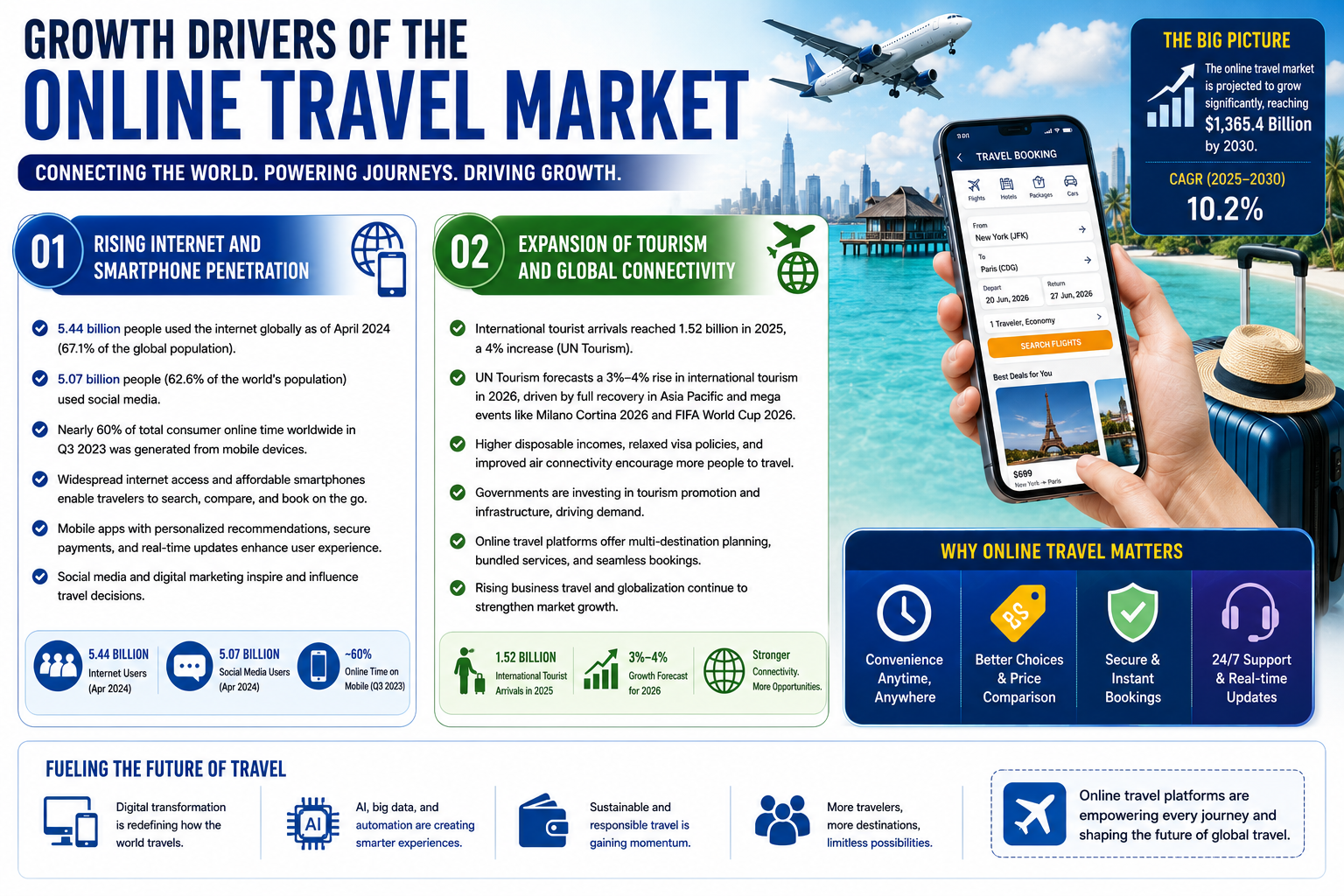
According to market data, there were approximately 5.52 billion internet users globally in 2024, representing 67.1% of the world’s population. Additionally, 95.9% of internet users accessed the web through smartphones, highlighting the critical role mobile technology now plays in digital consumer behavior.
Mobile connectivity has fundamentally changed how people engage with travel services.
Travelers can now search for destinations, compare hotel prices, purchase airline tickets, manage reservations, and receive real-time travel updates directly from their mobile devices. The convenience of mobile booking has significantly accelerated adoption of online travel platforms across both developed and emerging markets.
The continued rollout of affordable mobile internet and 4G/5G connectivity is further expanding access to online travel services, particularly in regions experiencing rapid digital transformation.
As internet penetration continues increasing in Asia-Pacific, Africa, and Latin America, millions of new users are expected to enter the digital travel ecosystem over the coming decade.
Smartphones Have Become Essential Travel Tools
The smartphone is no longer just a communication device—it has become the center of the modern travel experience.
Consumers increasingly use smartphones for every stage of travel planning, from researching destinations and reading reviews to booking transportation and sharing experiences on social media.
Travel applications now integrate features such as:
- AI-powered personalized recommendations
- Digital wallets and UPI payments
- Real-time flight alerts
- Mobile boarding passes
- Hotel check-in services
- Travel insurance purchases
- Currency conversion tools
- Local activity suggestions
These features simplify the customer journey while improving convenience and engagement.
Social media integration has also become highly influential. Travel influencers, destination marketing campaigns, and user-generated content encourage consumers to discover and book experiences online.
As smartphone adoption continues rising globally, mobile-first travel behavior is expected to remain a major growth engine for the market.
Global Tourism Recovery Strengthens Industry Momentum
The global tourism industry has experienced a strong recovery, creating favorable conditions for online travel companies.
According to data cited from UN Tourism, international tourist arrivals reached approximately 1.52 billion visits globally in 2025, representing a 4% increase compared to 2024.
Several regions demonstrated particularly strong performance:
- Europe recorded 793 million international tourists
- Africa experienced 8% growth
- Asia-Pacific arrivals increased by 6%
- North-East Asia led regional growth with a 13% increase
This resurgence in global travel demand is directly benefiting digital booking platforms.
Travelers increasingly prefer online services because they provide immediate access to international destinations, dynamic pricing, customer reviews, and customized travel packages.
The continued recovery of tourism across Asia-Pacific, combined with major international events such as the Milano Cortina 2026 Winter Olympics and the FIFA World Cup 2026, is expected to further stimulate online travel demand in the years ahead.
AI Is Transforming the Customer Experience
Artificial intelligence is rapidly becoming one of the most influential technologies within the online travel industry.
Travel companies are increasingly using AI to deliver personalized recommendations, dynamic pricing, customer support automation, and predictive analytics.
AI systems analyze user behavior, travel history, spending patterns, and preferences to recommend flights, accommodations, and vacation packages tailored to individual travelers.
This level of personalization improves customer satisfaction while increasing conversion rates for travel platforms.
AI-powered chatbots and virtual assistants are also enhancing customer service by providing instant responses to booking inquiries, itinerary updates, and travel support requests.
For example, in March 2025, MakeMyTrip Limited launched “Collections,” an AI-driven recommendation feature designed to provide personalized hotel and homestay suggestions across more than 30 global destinations.
As AI capabilities continue evolving, online travel experiences are expected to become increasingly personalized, automated, and efficient.
Vacation Packages Continue to Gain Popularity
The online travel package segment has become one of the fastest-growing areas within the market.
Travel packages combine services such as flights, accommodation, transportation, and activities into bundled offerings that simplify trip planning while often reducing overall costs.
Consumers increasingly prefer packages because they reduce stress and allow travelers to organize vacations more efficiently. Online platforms also provide customization options, enabling users to tailor packages according to destination, budget, travel style, and duration.
Vacation-focused packages are particularly popular among:
- Families
- Couples
- Solo travelers
- Luxury tourists
- Adventure travelers
Social media influence and post-pandemic demand for experiential travel are further boosting interest in curated travel experiences.
Seasonal promotions, destination discounts, and AI-driven recommendations continue to support strong growth within this segment.
Digital Payments Are Simplifying Online Bookings
Digital payment systems have become a major contributor to online travel adoption.
Consumers increasingly prefer cashless transactions because they offer speed, convenience, and security. Payment methods now include debit cards, credit cards, e-wallets, digital banking systems, and real-time payment platforms such as UPI.
UPI-based travel payments, in particular, have gained significant momentum in countries with advanced digital payment ecosystems.
Travelers can instantly book flights, hotels, and transportation services without needing to enter card details repeatedly. Cashback offers, promotional rewards, and mobile wallet integration further encourage digital payment adoption.
As fintech innovation continues expanding globally, payment convenience is expected to remain a major driver of online travel growth.
Online Travel Is Expanding Across Demographics
The online travel market is becoming increasingly diverse in terms of consumer behavior and demographics.
Male Travelers Drive Adventure and Corporate Travel
Male travelers frequently use online platforms for business trips, solo travel, and adventure tourism. Efficiency, quick booking processes, loyalty programs, and price comparisons are often key priorities within this segment.
Corporate travel also represents a significant contributor to online booking demand, particularly in regions with strong business sectors.
Desktop Platforms Remain Relevant
Although mobile bookings dominate growth trends, desktop platforms continue to play an important role.
Many users still prefer desktop interfaces for complex itineraries, business travel planning, and comparing multiple travel options simultaneously. Large-screen interfaces make it easier to review details, analyze pricing, and manage group bookings.
The United States Remains a Global Leader
The United States continues to represent one of the world’s most advanced online travel markets.
Strong purchasing power, widespread internet usage, high consumer confidence, and a culture of both domestic and international travel support robust digital booking activity. Major companies including Expedia, Booking Holdings, and Airbnb maintain significant influence within the market.
Corporate travel demand remains particularly important because of the country’s large business ecosystem.
In April 2025, the United States Tour Operators Association formed the Beyond Borders Tourism Coalition to strengthen cross-border tourism demand amid policy uncertainty.
The U.S. market continues to lead in AI integration, loyalty programs, mobile innovation, and personalized travel services.
The United Kingdom Strengthens Digital Travel Adoption
The United Kingdom’s online travel market remains highly developed due to strong digital literacy, extensive outbound tourism, and widespread use of online travel agencies.
British travelers frequently use digital platforms for flights, vacation packages, and European leisure travel. Price comparison tools and flexible booking options are especially popular among UK consumers.
In February 2026, Jet2 increased summer seat capacity at London Gatwick by 27%, highlighting continued travel demand and market expansion.
India Emerges as a Fast-Growing Market
India has become one of the world’s most dynamic online travel markets.
Rapid smartphone adoption, affordable internet access, rising middle-class incomes, and digital payment systems are fueling extraordinary growth in online travel bookings.
Platforms such as MakeMyTrip, Yatra, and IRCTC have transformed how Indian consumers book flights, trains, hotels, and vacation packages.
Government infrastructure initiatives and expanding tourism activity are expected to support continued long-term growth, particularly in Tier-2 and Tier-3 cities.
Saudi Arabia Accelerates Tourism Diversification
Saudi Arabia’s Vision 2030 strategy is significantly boosting the country’s online travel market.
Large-scale investments in tourism infrastructure, entertainment, hospitality, and religious travel are creating substantial demand for digital travel services.
Improved airline connectivity, digital payment systems, multilingual booking support, and luxury tourism initiatives are all contributing to market growth.
As the Kingdom continues diversifying its economy beyond oil, online travel platforms are expected to play an increasingly important role in supporting tourism development.
Challenges Still Exist
Despite strong growth prospects, the online travel market faces several challenges.
Data Privacy and Cybersecurity Risks
Online travel companies manage highly sensitive customer information, including personal identification details, passport data, and financial information.
As cyber threats continue evolving, companies must invest heavily in cybersecurity infrastructure, encryption technologies, and compliance with regulations such as GDPR.
Intense Competition and Price Sensitivity
The market is highly competitive, with numerous global and regional companies competing aggressively on price.
Consumers frequently compare deals across multiple platforms before booking, forcing companies to invest heavily in promotions, advertising, and loyalty programs.
Maintaining profitability while delivering competitive pricing remains a major challenge for industry participants.
Looking Ahead
The future of the online travel market appears exceptionally strong.
Rising internet access, smartphone penetration, AI-driven personalization, digital payment innovation, and global tourism recovery are creating powerful long-term growth opportunities. Travelers increasingly expect seamless, personalized, and mobile-first experiences, pushing travel companies to continue investing in technology and customer engagement.
With the market projected to grow from US$662.65 billion in 2025 to US$1.59 trillion by 2034, online travel is positioned to remain one of the most influential sectors within the global digital economy.
Final Thoughts
The online travel revolution has fundamentally transformed how people explore the world. What once required physical travel agencies and manual coordination can now be accomplished instantly through digital platforms powered by artificial intelligence, mobile technology, and global connectivity.
As travelers become increasingly digital-first, online travel companies will continue shaping the future of tourism through innovation, personalization, and convenience. The combination of technology and global mobility is creating a travel ecosystem that is more connected, accessible, and dynamic than ever before.
For businesses, investors, and travelers alike, the online travel market represents not just a rapidly growing industry but also a reflection of how digital transformation continues reshaping modern life across the globe.
About the Creator
Enjoyed the story? Support the Creator.
Subscribe for free to receive all their stories in your feed.
Comments
There are no comments for this story
Be the first to respond and start the conversation.