
Online Grocery Shopping Is Transforming Global Retail Through Speed, Convenience, and Digital Innovation
Rising Smartphone Usage, Rapid Delivery Networks, and E-Commerce Expansion Are Driving the Global Online Grocery Market

The way consumers purchase groceries is undergoing one of the most significant transformations in retail history. What was once a routine trip to a neighborhood supermarket is increasingly becoming a digital experience powered by smartphones, artificial intelligence, advanced logistics networks, and same-day delivery services. Online grocery shopping has evolved from a convenience-focused niche into a mainstream retail channel serving millions of consumers worldwide.
The shift toward digital grocery shopping has accelerated dramatically in recent years as consumers seek faster, more flexible, and more efficient ways to purchase everyday essentials. Retailers are responding with investments in automated warehouses, rapid delivery services, loyalty integrations, and personalized shopping experiences designed to meet evolving customer expectations.
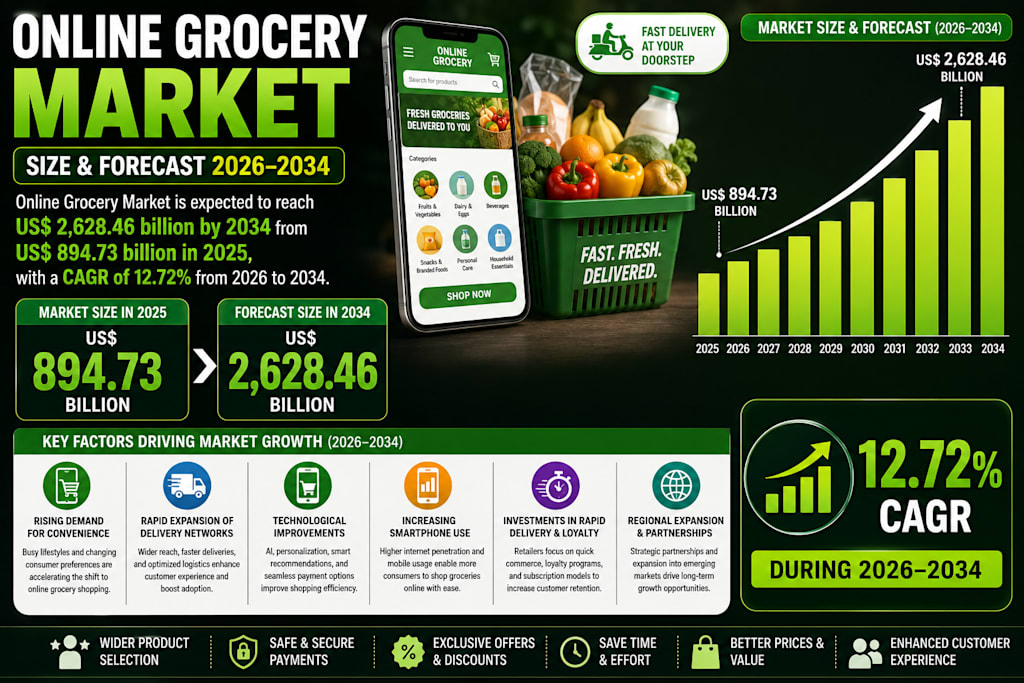
According to Renub Research, the Online Grocery Market is expected to grow from US$ 894.73 billion in 2025 to US$ 2,628.46 billion by 2034, registering a remarkable compound annual growth rate (CAGR) of 12.72% between 2026 and 2034. Rising demand for convenience, rapid expansion of delivery networks, technological advancements, and growing smartphone penetration are among the key factors fueling market growth worldwide.
As digital commerce continues reshaping consumer behavior, online grocery platforms are becoming an essential part of modern retail ecosystems.
The Evolution of Grocery Shopping in the Digital Age
Online grocery shopping refers to the purchase of food products, beverages, fresh produce, household essentials, and daily necessities through websites or mobile applications.
Consumers can browse product catalogs, compare prices, access promotions, select delivery times, and complete purchases without visiting physical stores.
Orders are fulfilled through home delivery services or click-and-collect programs where customers pick up purchases from designated locations.
The convenience offered by online grocery platforms has transformed shopping habits across both developed and emerging markets.
Technological innovations such as real-time inventory management, digital payments, route optimization, and personalized recommendations have significantly enhanced customer experiences.
What began as an alternative shopping channel has evolved into a core component of modern retail strategies.
As consumers increasingly embrace digital lifestyles, online grocery shopping is becoming a preferred purchasing method for everyday essentials.
Convenience Remains the Biggest Growth Driver
The primary reason consumers adopt online grocery services is convenience.
Modern lifestyles leave many individuals with limited time for traditional shopping trips. Busy work schedules, family responsibilities, commuting demands, and social commitments often make grocery shopping feel like a time-consuming task.
Online grocery platforms eliminate many of these challenges.
Consumers can place orders anytime, compare products quickly, and schedule deliveries according to their preferences.
The ability to shop from home reduces travel time while providing access to broader product selections than many physical stores can offer.
For elderly consumers, working professionals, parents, and individuals with mobility limitations, online grocery services offer particularly valuable benefits.
As convenience continues influencing purchasing decisions, demand for digital grocery solutions is expected to remain strong.
Same-Day Delivery Is Reshaping Consumer Expectations
One of the most important developments within the online grocery industry is the rapid expansion of same-day and ultra-fast delivery services.
Consumers increasingly expect groceries to arrive within hours rather than days.
Retailers are responding by investing heavily in logistics infrastructure designed to support rapid fulfillment.
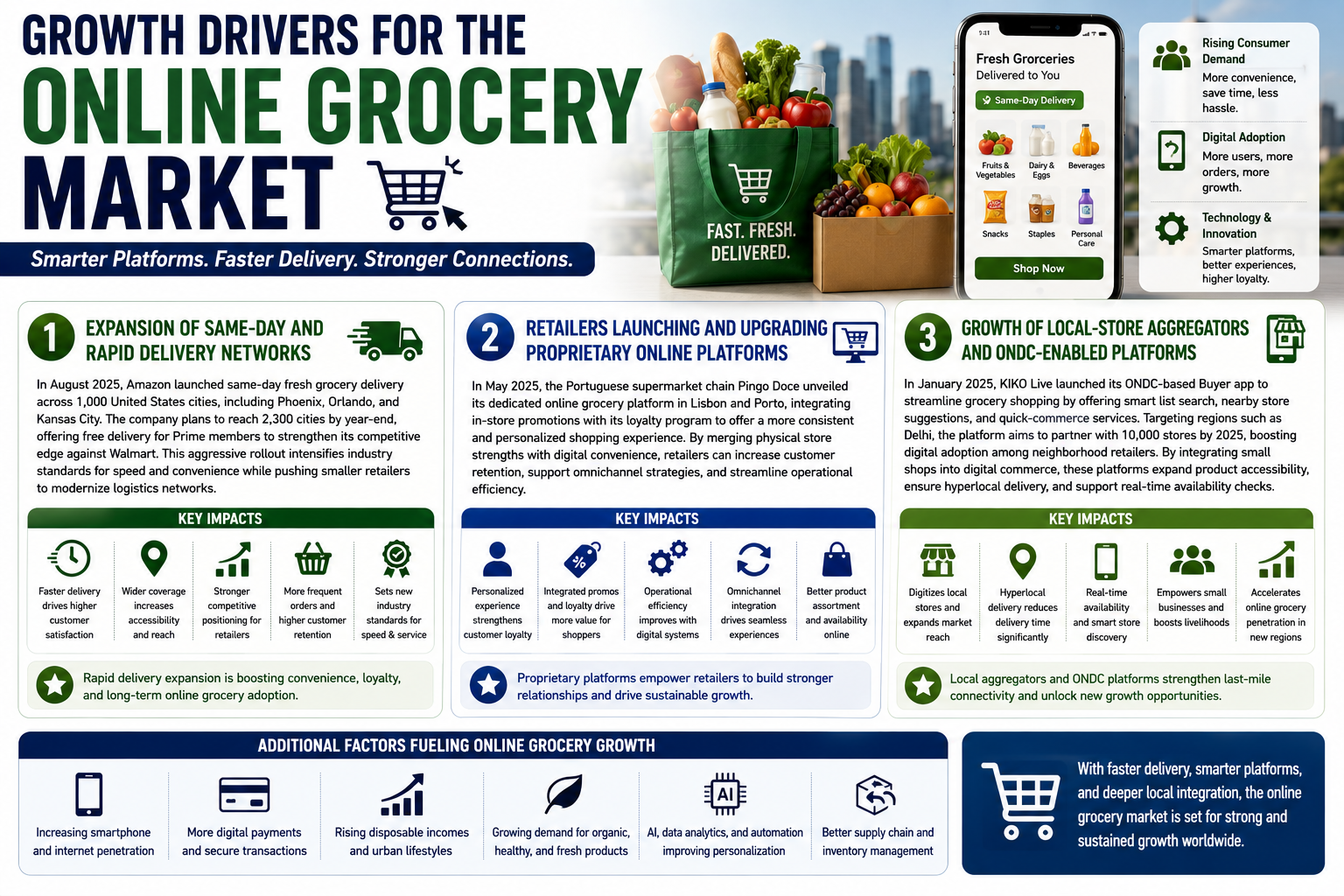
In August 2025, Amazon expanded same-day fresh grocery delivery across 1,000 cities in the United States, with plans to extend coverage to 2,300 cities by year-end. This initiative strengthens competition while raising industry standards for speed and convenience.
The growth of rapid delivery services is fundamentally changing consumer expectations.
Customers now prioritize speed, reliability, real-time tracking, and flexible delivery windows when choosing grocery platforms.
As delivery capabilities continue improving, same-day fulfillment is expected to become a standard feature across much of the industry.
Retailers Are Investing in Proprietary Platforms
Major grocery chains increasingly recognize the importance of controlling their digital ecosystems.
Rather than relying solely on third-party marketplaces, many retailers are launching proprietary online platforms that integrate seamlessly with existing loyalty programs, promotions, and inventory systems.
A notable example occurred in May 2025 when Portuguese supermarket chain Pingo Doce launched its dedicated online grocery platform in Lisbon and Porto. The platform combines in-store promotions with loyalty benefits to create a more personalized shopping experience.
Proprietary platforms allow retailers to strengthen customer relationships while gaining valuable insights into purchasing behavior.
They also support omnichannel strategies that connect physical stores with digital shopping experiences.
As competition intensifies, investments in proprietary technology platforms are expected to increase significantly.
Local Store Aggregators Are Expanding Market Access
Another major trend supporting market growth is the emergence of local-store aggregator platforms.
These services connect consumers with nearby retailers through centralized digital marketplaces, enabling smaller businesses to participate in e-commerce without developing independent platforms.
In January 2025, KIKO Live launched its ONDC-based grocery platform designed to connect consumers with neighborhood stores while supporting hyperlocal delivery services. The company aims to partner with 10,000 stores by 2025, helping accelerate digital adoption among independent retailers.
Aggregator models improve product accessibility, reduce delivery times, and support local businesses.
They are particularly valuable in emerging markets where independent retailers play a dominant role in grocery distribution.
As open commerce ecosystems expand, local-store aggregators are expected to contribute significantly to future market growth.
Artificial Intelligence Is Improving Retail Efficiency
Artificial intelligence is becoming increasingly important within the online grocery sector.
Retailers use AI-powered systems to optimize inventory management, forecast demand, personalize recommendations, and improve delivery efficiency.
Advanced algorithms analyze consumer behavior patterns to suggest relevant products and promotions.
These personalized experiences help increase customer satisfaction while encouraging repeat purchases.
AI also plays a critical role in supply chain management.
Retailers can predict purchasing trends more accurately, reducing stockouts and minimizing food waste.
As machine learning capabilities continue advancing, artificial intelligence is expected to become even more deeply integrated into online grocery operations.
Smartphone Adoption Is Accelerating Digital Commerce
The widespread use of smartphones is another major factor driving online grocery market expansion.
Consumers increasingly rely on mobile devices for shopping, payments, communication, and daily activities.
Mobile grocery applications provide intuitive interfaces, secure payment options, personalized offers, and real-time delivery tracking.
The convenience of ordering groceries through a smartphone has significantly increased adoption rates across multiple demographic groups.
Emerging markets are experiencing particularly strong growth due to rising internet penetration and affordable mobile technology.
As smartphone ownership continues expanding globally, mobile commerce will remain a key driver of online grocery adoption.
Fresh Produce Is Becoming a Major Online Category
Historically, consumers hesitated to purchase fresh produce online because they preferred selecting fruits and vegetables personally.
However, improvements in quality control, cold-chain logistics, and retailer reliability have changed consumer perceptions.
Many platforms now offer freshness guarantees, transparent sourcing information, and quality assurance programs.
Retailers increasingly use specialized packaging and temperature-controlled transportation to preserve product quality.
As trust continues improving, fresh produce is becoming one of the fastest-growing segments within the online grocery market.
The ability to deliver fresh food efficiently is helping online retailers compete more effectively with traditional supermarkets.
Subscription Programs Are Strengthening Customer Loyalty
Subscription models are becoming increasingly popular among online grocery retailers.
Programs that offer free delivery, exclusive discounts, personalized promotions, and loyalty rewards help encourage repeat purchases.
Consumers benefit from predictable savings and enhanced convenience, while retailers gain more stable revenue streams and stronger customer retention.
Subscription-based grocery services are particularly attractive to households that place frequent orders.
As competition increases, loyalty programs and membership offerings are expected to become increasingly important differentiators within the market.
Challenges Facing the Industry
Despite impressive growth, the online grocery market faces several challenges.
High Logistics and Fulfillment Costs
Managing grocery delivery operations is complex and expensive.
Retailers must maintain temperature-controlled storage, efficient inventory systems, and reliable last-mile delivery networks.
Rising fuel prices, labor costs, and urban congestion further increase operational expenses.
Maintaining profitability while meeting customer expectations for low-cost delivery remains a major challenge.
Freshness and Quality Concerns
Consumers continue expressing concerns regarding product freshness, order accuracy, and quality consistency.
Unlike traditional shopping, customers cannot personally inspect products before purchase.
Retailers must therefore invest heavily in quality control measures and transparent communication to maintain trust.
Addressing these concerns will remain essential for sustaining long-term growth.
Regional Markets Driving Growth
United States
The United States remains one of the world's largest online grocery markets, supported by advanced delivery infrastructure, widespread digital adoption, and aggressive investments from major retailers such as Amazon and Walmart.
Germany
Germany continues experiencing steady growth as consumers increasingly embrace home delivery, click-and-collect services, and subscription-based grocery programs.
China
China remains among the fastest-growing online grocery markets globally, driven by smartphone adoption, digital payments, AI-powered retail ecosystems, and highly developed delivery networks.
Saudi Arabia
Saudi Arabia's Vision 2030 initiatives, digital transformation programs, and expanding logistics infrastructure continue supporting rapid online grocery market development.
Final Thoughts
Online grocery shopping is no longer a convenience reserved for a small group of consumers—it has become a major force transforming the future of retail.
According to Renub Research, the Online Grocery Market is projected to grow from US$ 894.73 billion in 2025 to US$ 2,628.46 billion by 2034, reflecting extraordinary demand driven by convenience, technological innovation, and changing consumer lifestyles.
As retailers continue investing in artificial intelligence, rapid delivery networks, mobile commerce, and personalized shopping experiences, online grocery platforms will play an increasingly central role in everyday life.
The future of grocery shopping is no longer defined by store aisles alone—it is being shaped by digital innovation, real-time convenience, and a consumer experience designed to bring the supermarket directly to the customer's doorstep.
About the Creator
Enjoyed the story? Support the Creator.
Subscribe for free to receive all their stories in your feed.
Comments
There are no comments for this story
Be the first to respond and start the conversation.