
Oleochemicals Market Set to Reach US$ 44.51 Billion by 2034 Driven by Sustainability and Bio-Based Innovation
Rising Demand for Green Chemistry and Renewable Raw Materials Fuels Global Market Expansion

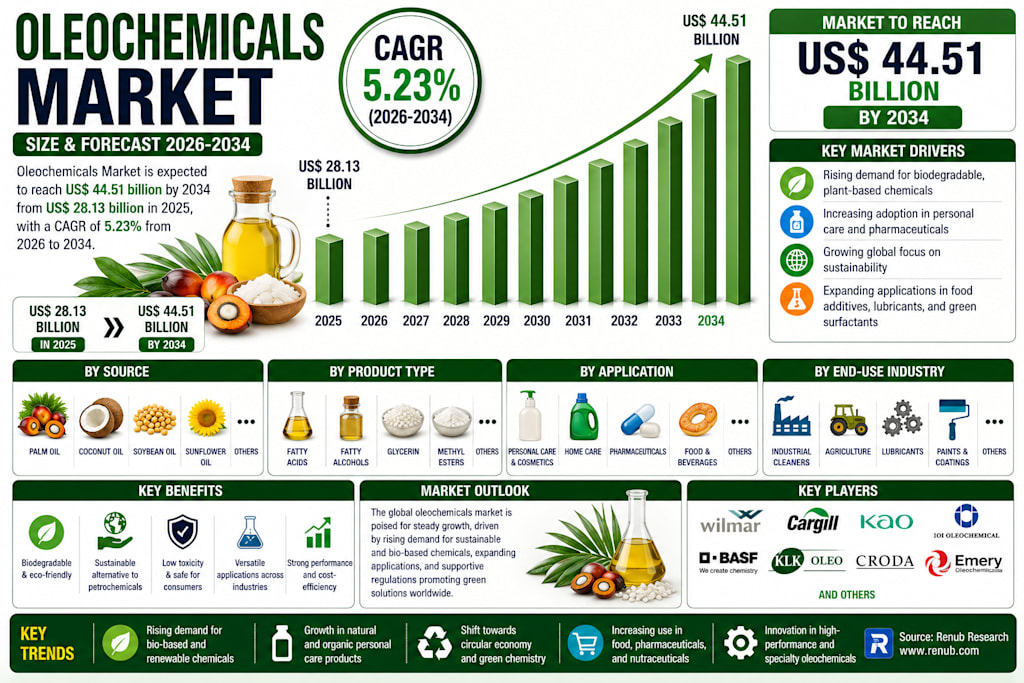
The global oleochemicals market is entering a transformative growth phase as industries shift toward sustainable, biodegradable, and renewable alternatives to petrochemical-based products. With increasing environmental awareness, stringent regulatory frameworks, and evolving consumer preferences, oleochemicals are gaining widespread acceptance across sectors such as personal care, pharmaceuticals, food processing, and industrial manufacturing.
According to Renub Research, the Oleochemicals Market is projected to grow from US$ 28.13 billion in 2025 to US$ 44.51 billion by 2034, expanding at a CAGR of 5.23% from 2026 to 2034. This growth trajectory underscores the critical role of bio-based chemicals in shaping the future of global industrial ecosystems.
Oleochemicals Industry Overview
Oleochemicals are chemical compounds derived from natural sources such as vegetable oils, animal fats, and increasingly, algae. These compounds include fatty acids, fatty alcohols, glycerol, esters, and soap noodles—each playing a vital role in a variety of industrial and consumer applications.
Unlike conventional petrochemicals, oleochemicals offer several advantages, including biodegradability, low toxicity, and reduced environmental impact. Their versatility allows them to be used in manufacturing everyday products such as soaps, detergents, cosmetics, lubricants, plastics, and even pharmaceutical formulations.
The growing emphasis on sustainability and circular economy principles has further accelerated their adoption. Industries are increasingly prioritizing renewable feedstocks, making oleochemicals a cornerstone of green chemistry initiatives worldwide.
Key Growth Drivers in the Oleochemicals Market
1. Surge in Demand for Natural Ingredients in Personal Care
The global personal care industry is undergoing a significant transformation, driven by consumer preference for clean-label, natural, and skin-friendly products. Oleochemicals, derived from plant-based oils, are widely used in skincare and cosmetic formulations due to their moisturizing, emulsifying, and stabilizing properties.
Ingredients such as glycerin and fatty acids enhance product texture and hydration, making them essential in creams, lotions, lipsticks, and serums. Companies are actively innovating to develop high-performance oleochemical derivatives that meet evolving consumer expectations.
The rising influence of social media, beauty trends, and wellness awareness has further fueled demand for organic and eco-friendly cosmetic products, directly boosting the oleochemicals market.
2. Technological Advancements in Production Processes
Advancements in biotechnology and chemical engineering are significantly improving the efficiency and scalability of oleochemical production. Modern processing techniques enable higher yields, reduced waste generation, and enhanced purity levels, making these products suitable for high-end applications in pharmaceuticals and food industries.
Innovations such as microbial fermentation and enzymatic processing are opening new avenues for producing specialty oleochemicals. Research institutions and industry players are collaborating to develop cost-effective and sustainable production technologies.
These advancements not only reduce operational costs but also improve competitiveness against petrochemical alternatives, thereby accelerating market growth.
3. Favorable Government Policies and Sustainability Initiatives
Governments worldwide are implementing stringent environmental regulations and promoting the use of renewable materials to reduce carbon emissions and environmental degradation. This has created a favorable policy environment for the oleochemicals industry.
Programs such as bio-based product incentives, green chemistry funding, and renewable energy targets are encouraging manufacturers to adopt sustainable practices. For instance:
The U.S. promotes bio-based products through federal initiatives.
The European Union supports green innovation via funding programs.
India is boosting oilseed production to support domestic feedstock availability.
These initiatives are not only driving demand but also fostering innovation and investment in the oleochemicals sector.
- Expanding Application Areas Strengthening Market Demand
- Oleochemicals are increasingly being used across a wide range of industries:
- Personal Care & Cosmetics: Moisturizers, emulsifiers, surfactants
- Food Processing: Additives, preservatives, flavor enhancers
Industrial Applications: Lubricants, coatings, surfactants
- Pharmaceuticals: Drug delivery systems, excipients
- Plastics & Polymers: Bio-based plasticizers and stabilizers
The versatility of oleochemicals makes them indispensable in modern manufacturing, particularly as industries transition toward sustainable materials.
Challenges in the Oleochemicals Market
1. Volatility in Raw Material Prices
One of the primary challenges facing the oleochemicals market is the fluctuating cost of raw materials such as palm oil, coconut oil, and animal fats. These feedstocks are highly sensitive to climatic conditions, geopolitical factors, and global trade dynamics.
Supply chain disruptions and sustainability concerns—particularly related to palm oil cultivation—can lead to price instability, affecting production costs and profit margins.
2. Competition from Petrochemical Alternatives
Despite their environmental advantages, oleochemicals face stiff competition from petrochemical-based products, which are often cheaper and benefit from established supply chains.
In certain applications, synthetic chemicals may offer superior performance or cost efficiency, making it difficult for oleochemicals to penetrate price-sensitive markets. Additionally, transitioning to bio-based materials often requires reformulation and certification, which can be resource-intensive.
Regional Insights: Key Markets Driving Growth
United States
The United States represents a mature and innovation-driven market for oleochemicals. Strong regulatory frameworks, combined with high consumer demand for natural products, are driving adoption across personal care, food, and industrial sectors.
The country’s emphasis on sustainability and clean-label products is further boosting demand for biodegradable surfactants and plant-based ingredients.
Germany
Germany stands at the forefront of Europe’s oleochemicals market, supported by advanced manufacturing capabilities and stringent environmental regulations. The country’s commitment to reducing carbon emissions is encouraging industries to shift toward renewable alternatives.
The robust personal care sector and growing demand for biodegradable industrial lubricants are key growth contributors.
China
China is one of the fastest-growing markets for oleochemicals, fueled by rapid industrialization and expanding consumer markets. Government support for green chemistry and environmental sustainability is accelerating the adoption of bio-based chemicals.
The rise of e-commerce and increasing demand for natural skincare products are further driving market growth.
Saudi Arabia
Saudi Arabia is diversifying its economy under Vision 2030, investing in sustainable industrial development. The growing demand for personal care, food processing, and specialty chemicals is boosting the oleochemicals market.
However, reliance on imported feedstocks remains a challenge for long-term growth.
Market Segmentation Overview
By Product
- Specialty Esters
- Fatty Acid Methyl Ester
- Glycerol Esters
- Fatty Amines
- Others
By Application
- Personal Care & Cosmetics
- Consumer Goods
- Food Processing
- Textiles
- Paints & Inks
- Industrial
- Healthcare & Pharmaceuticals
- Polymer & Plastic Additives
By Region
- North America
- Europe
- Asia-Pacific
- Latin America
- Middle East & Africa
Key Players Shaping the Competitive Landscape
Leading companies in the oleochemicals market are focusing on innovation, sustainability, and strategic partnerships to strengthen their market position. Key players include:
- Cargill Inc.
- Kuala Lumpur Kepong Berhad
- BASF SE
- Wilmar International Limited
- Kao Corporation
- Evonik Industries AG
- Procter & Gamble Company
- Corbion N.V.
These companies are investing heavily in R&D, expanding production capacities, and developing high-performance bio-based products to meet evolving market demands.
Recent Developments in Oleochemicals Market (Vocal Format)
- Corbion N.V. partnered with IMCD in May 2024 to expand distribution of food ingredient solutions in Thailand.
- Vantage Specialty Chemicals increased production capacity for METAUPON NMT in April 2024 to meet rising demand.
- India launched a national oilseed mission in March 2024 to boost domestic feedstock supply.
- The Solvent Extractors’ Association of India raised concerns over rising oleochemical imports in February 2024.
- Bursa Malaysia Derivatives collaborated with Dalian Commodity Exchange to introduce soybean oil futures pricing mechanisms.
- Godrej Industries announced a USD 71.8 million investment to expand oleochemical production capacity in January 2024.
- Companies are increasingly investing in bio-refinery technologies to improve yield and sustainability.
- Strategic collaborations between chemical manufacturers and research institutions are accelerating innovation.
- Expansion of green surfactant production is gaining momentum globally.
- Increased focus on biodegradable lubricants is opening new industrial opportunities.
Future Outlook: A Sustainable Chemical Revolution
The oleochemicals market is poised for sustained growth as industries continue to embrace sustainability and reduce dependence on fossil fuels. The convergence of regulatory support, technological innovation, and consumer awareness is creating a strong foundation for long-term expansion.
Emerging trends such as bio-refineries, circular economy models, and advanced biotechnology will further enhance the capabilities and applications of oleochemicals. As companies invest in greener solutions, the market is expected to witness increased collaboration, innovation, and global integration.
Final Thoughts
The oleochemicals market represents a critical shift in the global chemical industry—from reliance on finite fossil resources to renewable, eco-friendly alternatives. With strong growth projections, expanding applications, and increasing policy support, oleochemicals are set to become a cornerstone of sustainable industrial development.
While challenges such as raw material volatility and competition from petrochemicals persist, continuous innovation and strategic investments are expected to overcome these barriers. As sustainability becomes a central business priority, the oleochemicals market is not just growing—it is redefining the future of chemistry.
About the Creator
Enjoyed the story? Support the Creator.
Subscribe for free to receive all their stories in your feed.
Comments
There are no comments for this story
Be the first to respond and start the conversation.