
O-Ring Seals Market Grows on the Back of Automotive, Aerospace, and Energy Demand
Renub Research projects the market to rise from US$ 15.43 billion in 2025 to US$ 21.05 billion by 2034, supported by industrial expansion, material innovation, and rising demand for reliable sealing solutions.

The market story behind a small but essential component
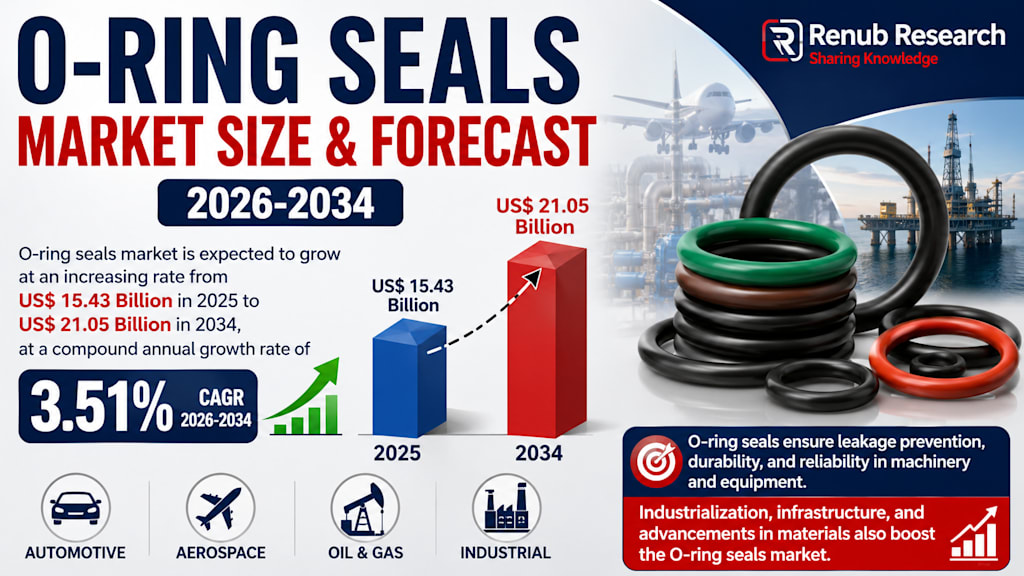
O-ring seals rarely make headlines, but they quietly keep some of the world’s most important machines running. These circular sealing components help prevent the leakage of liquids and gases between connected parts, which is why they are used across automobiles, hydraulic systems, pumps, valves, compressors, pipelines, medical devices, and aircraft systems. Their appeal comes from a mix of simplicity, durability, cost-effectiveness, and strong performance under changing temperatures and pressures. According to the provided Renub Research market outlook, the O-ring seals market is expected to expand from US$ 15.43 billion in 2025 to US$ 21.05 billion in 2034, at a CAGR of 3.51% between 2026 and 2034.
That growth profile makes sense when you look at how widely O-rings are used. They are not limited to one industry or one geography. Instead, they sit at the intersection of automotive production, industrial manufacturing, aerospace engineering, oil and gas operations, healthcare equipment, and energy infrastructure. The market’s underlying demand is being shaped by industrialization, infrastructure development, and steady improvements in seal materials that are more resistant to wear, chemicals, and heat.
Why O-ring seals continue to matter
At a practical level, the success of O-ring seals comes from how effectively they solve a basic but critical engineering problem: sealing. A good seal prevents failures, protects equipment, improves safety, and reduces maintenance costs. That is why O-rings are found in static as well as dynamic applications, where they must stay reliable despite vibration, pressure changes, movement, and environmental stress. The source also highlights that these seals are usually made from flexible materials such as rubber, silicone, nitrile, fluorocarbons, and other polymers, which gives manufacturers room to select the right composition for the operating conditions.
Their popularity is also tied to installation convenience. O-rings are generally easy to use, efficient, and long-lasting, which keeps them relevant even as more advanced sealing options enter the market. In many applications, buyers are not looking for the most complex solution; they are looking for the most dependable one. That is where O-ring seals continue to win attention.
Automotive and transportation remain the biggest visibility driver
One of the clearest growth engines for the market is the automotive and transportation sector. O-ring seals are used in engines, fuel systems, braking systems, air conditioning systems, and hydraulic systems, where leak prevention is directly tied to performance and safety. As the global production of passenger vehicles, commercial vehicles, and electric vehicles rises, demand for sealing components rises with it. The shift toward electric mobility adds another layer of opportunity because EV batteries and electrical systems require protection from moisture and contaminants.
This is not just about volume; it is also about performance expectations. Automakers are under pressure to improve fuel efficiency and reduce emissions, which pushes them toward higher-performance sealing materials. The source points to Freudenberg’s introduction of a polyurethane-based material in October 2023 as an example of how suppliers are responding with alternatives to conventional PTFE-based seals. That kind of innovation matters because the automotive industry often sets the pace for broader material adoption.
Industrial manufacturing gives the market a long runway
Another major force behind the market is the expansion of industrial and manufacturing activity. O-ring seals are widely used in machinery, pumps, compressors, hydraulic systems, and other industrial equipment because they help maintain operational efficiency while lowering maintenance needs. As construction, chemical processing, power generation, and heavy machinery manufacturing continue to expand, the demand for dependable sealing solutions grows in parallel.
This is where O-rings become more than a commodity part. In large industrial settings, downtime is expensive. A minor sealing failure can trigger a much larger operational problem, so manufacturers and plant operators tend to favor components that are proven, durable, and easy to replace. The source also notes that advanced additive manufacturing developments, including Inkbit’s TEPU 50A elastomer, are helping broaden the range of materials that can substitute for molded or cast silicones and rubbers in prototyping and related applications. That reflects a wider trend: the sealing market is not standing still, even though the product itself looks simple.
Oil and gas, aerospace, and energy keep the performance bar high
Some of the most demanding applications for O-ring seals are found in oil and gas, aerospace, and energy. These environments put seals under extreme temperatures, high pressure, chemical exposure, and constant reliability demands. In oil and gas, O-rings are used in pipelines, drilling equipment, valves, and pressure systems. In aerospace, they are needed in aircraft engines, fuel systems, hydraulic systems, and landing gear parts. In energy, they support sealing in high-pressure, high-temperature operations such as exploration, pipelines, valves, and power generation plants.
This is one of the reasons the market tends to reward high-performance materials. The source stresses that synthetic rubber O-ring seals are popular because they combine durability, flexibility, and resistance to heat, chemicals, and pressure. Nitrile rubber, silicone, fluorocarbon, and EPDM are among the commonly used options. In aerospace especially, the need for seals that can tolerate harsh operating conditions means that manufacturers must meet tighter standards and rely on advanced material formulations.
Healthcare and machinery expand the market beyond the obvious sectors
It is easy to think of O-ring seals as industrial or automotive parts, but the source makes it clear that their role in healthcare and machinery manufacturing is also significant. In medical devices such as syringes, infusion pumps, ventilators, and diagnostic equipment, O-rings help maintain leak-tight performance and prevent contamination. Because these applications depend on hygienic compatibility and accuracy, the materials used must meet strict safety standards. Rising healthcare infrastructure and increasing demand for advanced medical devices are both supporting this segment.
Machinery manufacturing is another strong demand base. Hydraulic and pneumatic systems depend on seals that can prevent fluid and gas leakage while preserving efficiency. Pumps, compressors, and other heavy machinery all benefit from O-rings that reduce maintenance costs and improve overall performance. As manufacturing complexity rises, so does the need for reliable sealing components that can hold up under demanding operating conditions.
The market is healthy, but it is not without pressure points
Even with broad demand, the market faces meaningful challenges. The first is raw material volatility. O-ring seals depend on rubber, silicone, and other specialty materials that are often linked to petrochemical feedstocks. Because crude oil pricing influences these inputs, swings in energy markets can quickly affect manufacturing costs and profitability. Supply chain disruptions add another layer of uncertainty, especially when transportation, labor, or geopolitical issues interfere with availability.
The second challenge is competition from alternative sealing technologies. Gaskets, mechanical seals, and more advanced sealing systems can outperform O-rings in certain extreme applications. That means O-ring manufacturers cannot rely on tradition alone. They need to keep improving material performance, durability, and resistance to temperature and pressure if they want to defend share in the most demanding end markets.
Segmentation shows how broad the opportunity really is
The source breaks the market into two main types: synthetic rubber and thermoplastic elastomer. On the application side, the list spans electrical and electronic products, aerospace equipment, energy, food and beverages, healthcare and medical, automotive and transportation, machinery manufacturing, and other uses. That segmentation tells a simple story: O-ring seals are not a niche line item. They are a core industrial input with reach across nearly every major physical-economy sector.
The geographic scope is equally broad, with coverage across North America, Europe, Asia Pacific, Latin America, and the Middle East & Africa. Key markets highlighted in the source include the United States, Canada, the United Kingdom, India, Saudi Arabia, and others. The player list also shows a market with strong global competition, including AB SKF, NOK Corporation, Zhongding Group, ElringKlinger AG, Freudenberg & Co. KG, Hutchinson SA, and Parker Hannifin Corporation.
Regional demand follows industry strength
The United States stands out as a mature market because of demand from automotive, aerospace, oil and gas, and manufacturing. Advanced manufacturing facilities, industrial automation, R&D activity, and infrastructure investment all help sustain seal demand there. Saudi Arabia, by contrast, is more heavily shaped by oil and gas operations, which need durable seals for equipment used in harsh environments. The source also points to strong industrial diversification efforts in the country as an additional support factor.
The broader takeaway is that regional demand usually mirrors industrial structure. Where there is strong energy activity, advanced manufacturing, aerospace production, or vehicle output, O-ring seals tend to find a durable home. That makes the market resilient, even if individual end-use sectors move at different speeds over time.
Final thoughts
The O-ring seals market may not be flashy, but it is deeply tied to the real economy. From cars and aircraft to industrial plants, healthcare devices, and energy systems, these small components carry a big share of responsibility. The forecast growth from US$ 15.43 billion in 2025 to US$ 21.05 billion in 2034 reflects more than just steady replacement demand; it reflects a world that is building more machines, moving more fluids, handling more pressure, and demanding more reliability from every part in the chain.
That is why the market still has room to expand. Automotive electrification, industrial modernization, aerospace production, and energy infrastructure all favor better sealing performance. At the same time, suppliers that can manage raw material risk and keep innovating in materials will be best positioned to benefit from the next phase of growth. In a market built on preventing failure, consistency is the real competitive advantage.
About the Creator
Enjoyed the story? Support the Creator.
Subscribe for free to receive all their stories in your feed.
Comments
There are no comments for this story
Be the first to respond and start the conversation.