
NVIDIA’s Founder Has Power. He Doesn’t Have a Lock.
A fake “Huang handover” story is a useful governance case: one man’s judgment built the company, and the board still holds the fuse.
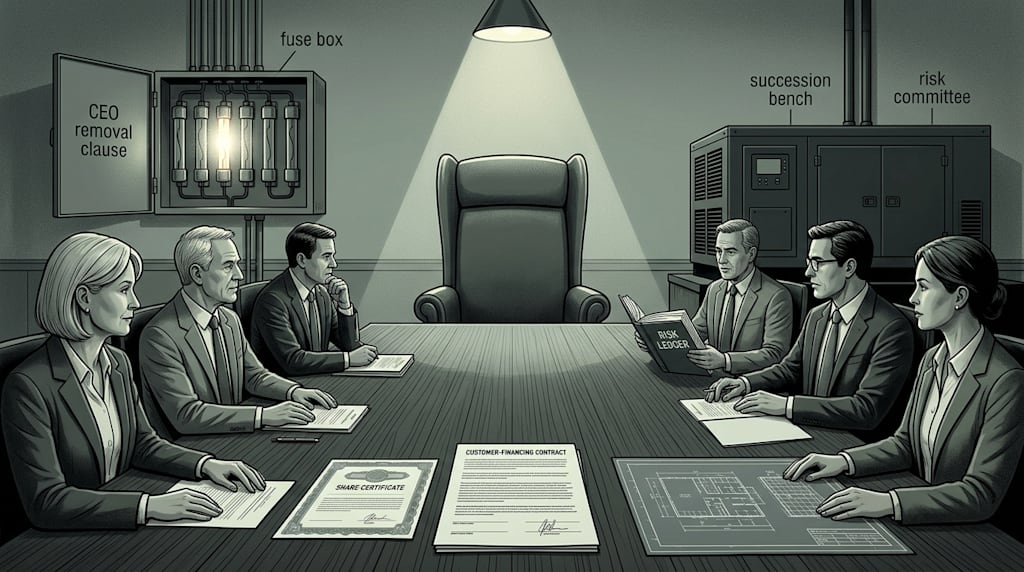
The boundaries of founder authority: NVIDIA governance through a speculative “Huang handover” scenario
Status note: This article is governance commentary. It uses a speculative scenario that has circulated online. In reality, Jensen Huang remains NVIDIA’s CEO, Colette Kress remains CFO, and NVIDIA has announced no leadership change. The scenario’s claims about a $250 billion financial guarantee for an OpenAI Ohio data-center project, later cut to about $105 billion to $120 billion, and a 97% internal employee poll urging Huang to stay lack reliable public sourcing. Public reporting is closer to a proposed NVIDIA investment intent of up to $100 billion in OpenAI. That is not a financial guarantee for an Ohio data-center project. The scenario is useful for the governance questions it raises.
1. A scenario that reads like news
The hook is the question underneath the fake headline: what happens to a multi-trillion-dollar company that has spent more than three decades concentrating information and decision rights around one founder?
The scenario’s answer is dramatic. Huang’s power is “reputational” rather than “structural,” so once his reputation fails, his fall is sudden. That claim has some insight, but it is overdramatized. Governance analysis should not stop at “the hero leaves, the empire collapses.” It should ask three narrower questions. Where does a founder-CEO’s power actually come from? How does a CFO’s risk-control style relate to a founder’s expansion style? And how much force do board provisions designed to prevent founder entrenchment carry in practice?
Once those questions are separated, the scenario becomes a usable writing case rather than a fake news item.
2. Huang has no structural control bloc. He has factual power.
On the public governance record, NVIDIA does not use dual-class shares to amplify a founder’s voting power. It has a single class of stock, one share one vote. Huang directly and indirectly holds about 3.58% of the equity, below institutional holders such as BlackRock at about 7.43% and Vanguard at about 7.31%. The board has 11 directors, 10 of them independent. Huang is the only non-independent director and sits on no committee. The board has no chairman. A lead independent director, Stephen Neal, presides over oversight. The charter allows the board to remove the CEO by majority vote with or without cause.
This structure means Huang cannot block his own removal through a controlling voting bloc or a board-seat arrangement. His power is not legal control. It comes from long-run performance, technical judgment, organizational prestige, and sustained board support. That is factual power, not structural control.
But no structural control bloc does not equal fragile power. A CEO controls the agenda, aggregates information, appoints people, allocates budgets and capital, and narrates the company to outsiders. A CEO who has delivered repeated outperformance also gains board tolerance and shareholder acquiescence. Independent directors rarely move against a founder-CEO in good times when the market treats that founder as a core asset. A without-cause removal clause is legally available, but politically expensive. It is the board’s last fuse, not a daily switch.
The scenario is right that Huang cannot rely on equity to protect himself. It overreaches when it turns that into “once prestige fails, collapse is inevitable.” That reduces governance to a single-variable function of personal reputation.
3. The efficiency of reputational power, and its shadow
Huang’s management style over 33 years has been deliberately personal. The scenario describes a thin management layer, with direct reports once numbering as many as 60. Huang personally read frontline employees’ “five things” emails and reviewed compensation. Information and decision rights converged on one person. In good times, that flatness produced speed: fast strategic pivots, fast resource allocation, short chains of responsibility. From graphics processors to the CUDA ecosystem to system-level AI infrastructure, NVIDIA’s key turns carried the stamp of a founder’s judgment. Later success kept validating that judgment, which in turn deepened the organization’s dependence on it.
That is the positive loop of reputational power. Success reinforces authority, authority accelerates execution, and execution produces more success. The loop has a shadow. Information filtered upward can still be filtered. Reading frontline emails is not the same as independent verification. Successors struggle to grow under a founder’s shadow because the organization is used to one person making the final call. Boards can treat “NVIDIA without Huang” as unimaginable and delay real succession planning. When the external environment turns, concentrated risks that success once masked can surface at the same time.
The shadow is not destiny. Reputational power can be brittle or resilient. The difference is whether the company converts personal judgment into institutional capability while times are good. That means risk committees with real information rights, related-party review, customer-financing disclosure, a named succession bench, and a transition plan. Without that redundancy, founder authority is a single point of failure. With it, the founder remains central but is no longer the only support.
4. Kress’s risk control supports expansion
The scenario’s treatment of Colette Kress reveals a stylistic bias. It frames her cautious, risk-control-first style as suitable for a risk line but not for leading NVIDIA’s expansion, or even for defending what has already been built. The contrast is dramatic. It does not hold up.
A CFO asking how a guarantee is priced, how return on investment is calculated, and whether customer-financing exposure is too large is doing the job. In AI infrastructure expansion, where suppliers, customers, and financiers form a loop, concentration risk is concrete. Customer concentration, construction delays, canceled cloud orders, and receivables can turn apparently strong revenue into guarantee exposure. At that point, the CFO’s objection is not drag. It is the translation of an aggressive strategy into something financeable, auditable, and risk-bearing.
Expansion and risk control are not binary choices in a large company. The founder decides whether to fight. The CFO helps determine with what capital and what happens if the fight goes wrong. Setting the two against each other turns strategy execution into a hero and a brake pad. An interim CEO’s first task is usually not expansion but stabilizing customers, suppliers, employees, and board expectations. The scenario says Kress called customers and suppliers first to calm them and was described as a “pragmatist.” That is an asset in a transition, not a defect.
The “97% of employees want Huang to stay” internal poll, even if it existed, is a self-selected sample. It cannot represent shareholders, the board, or the company’s governance will. It can illustrate Huang’s prestige. It cannot prove Kress is unfit, and it cannot serve as a governance basis for removal or retention.
5. What the charter can do, and what it cannot
The scenario’s strongest factual point is the mismatch between NVIDIA’s governance design and the popular image of a founder with unchecked control. Single-class shares, a majority-independent board, a lead independent director, and a without-cause removal clause all point in one direction. The company is not legally arranged to let a founder entrench himself.
These provisions are insurance for the long term. They do not sound in normal times. They sound when authority breaks. The next question is what exists beyond the fuse. A company needs a backup generator, a succession bench, and a second source of credible decision legitimacy when the founder’s authority is no longer available.
A without-cause clause can remove a CEO legally. It cannot by itself produce a successor, reassure customers, hold suppliers, or keep strategy intact. Those tasks require preparation before the transition. A named succession pipeline matters. A board risk committee with real information rights matters. Disclosure routines for customer financing and related-party transactions matter. A transition plan that customers and suppliers can read matters. Without them, the clause is a legal switch attached to a dark building.
6. Build redundancy before you need it
NVIDIA’s success is not the product of one man’s judgment. It is the product of a technology roadmap, the CUDA ecosystem, the developer network, supply-chain execution, capital-market patience, and sustained board support. Attributing success entirely to personal charisma, and attributing collapse entirely to personal loss of prestige, are the same narrative laziness in opposite directions.
The risk of a founder-CEO is not that he is too strong. It is that the company has not prepared for the day he is no longer strong. Governance structure matters because it converts some judgments into processes, some relationships into contracts, some risks into disclosures, and some powers into transferable responsibilities while the founder is still there. Otherwise, the more successful the company, the more the organization depends on one person. The more it depends on one person, the harder succession becomes.
The scenario exposes two habits in how we talk about founder-CEOs. One is hero narrative: all success belongs to the founder’s judgment. The other is anti-hero narrative: once the founder falls, he was a house of cards with no structural protection. Both habits are lazy. A better account turns the personal myth back into an institutional question. Which powers come from law? Which come from performance and prestige? How does CFO risk control complement CEO expansion? Can the board build redundancy in good times?
Huang matters. He has mattered enough that for a long period NVIDIA’s information and decision rights revolved around him. The test of a mature company is not that it never needs a new CEO. The test is whether, when the change comes, customers do not panic, suppliers do not run, the board does not freeze, and strategy does not snap. Personal charisma can create a miracle. Institutional redundancy keeps the miracle from depending on one fuse.
About the Creator
Jin
Writer of reamstories
https://reamstories.com/jin
Enjoyed the story? Support the Creator.
Subscribe for free to receive all their stories in your feed. You could also become a paid subscriber, letting them know you appreciate their work.
Comments
There are no comments for this story
Be the first to respond and start the conversation.