
Nvidia’s Doom Prophecy Is Smooth. That Doesn’t Make It True.
A close read of the story that says Nvidia is already dead inside, and why its causal chain has more gaps than it admits.
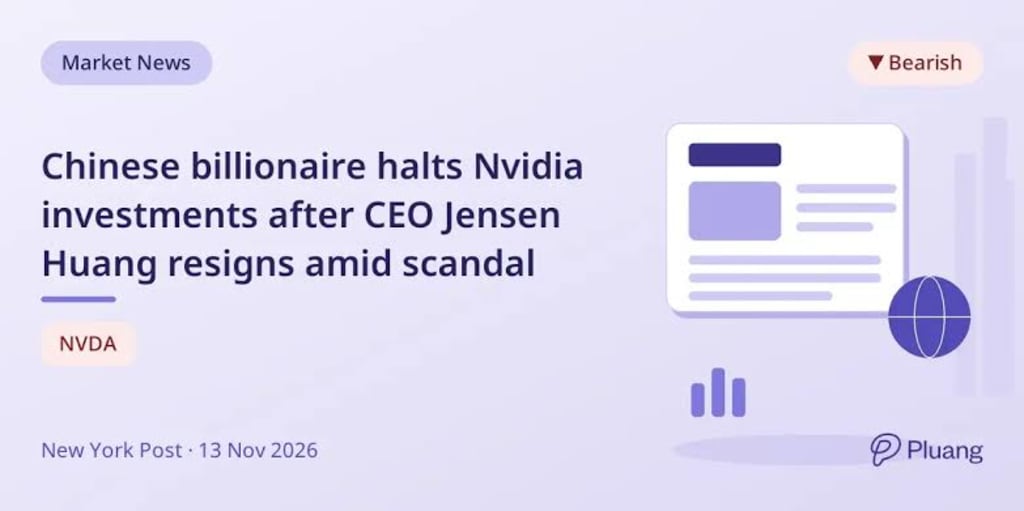
A popular story about Nvidia’s future moves fast. A new CEO cuts 20% of staff and freezes hiring. He calls it efficiency. Then he sells or closes the gaming GPU unit and goes all in on AI. The stock rises. He trims R&D and the supply chain, raises the dividend, and keeps his job. In 18 to 24 months, the stock recovers in a burst. Tech media and finance bloggers then explain that American tech wins because of its system, not its people. Anyone who missed the bottom is low-cognition. America is about to reach AGI. Anyone who watched Boeing knows the next act. The company becomes a stock machine. The stock looks better while the company dies inside. The new flagship slips, so the company reheats the old CEO’s leftovers. Quality fails. A generation of products is recalled. Executives focus on moving headquarters closer to a mistress.
The story has force. It borrows from patterns that have happened: financialization, founder exit, stock price detaching from product, innovation slowing under monopoly. Boeing is the obvious example. A forceful story is not a valid causal chain. “Open-and-shut” skips several steps. Take them one at a time.
The standard script exists, but Nvidia is not a standard company
A new CEO cuts staff, cuts non-core units, goes all in on the main line, and pumps the stock. HP, IBM, and GE have run that play. Nvidia cannot be fitted with it directly.
Gaming GPUs no longer lead revenue. In fiscal 2024, data center was more than 80% of revenue and gaming was under 10%. Cutting gaming makes financial sense. Gaming cards are CUDA’s historical door. A developer often meets CUDA on a GeForce card, not in a data center. CUDA’s toolchain, compilers, and libraries grew inside gaming drivers. Cutting gaming cards removes a developer anchor. That is an ecosystem gap, not a financial line item.
The R&D system is interlocked: architecture, compilers, libraries, frameworks, systems. The Blackwell delay involved packaging, memory, TSMC capacity, and cooling. Crude R&D cuts are not clean. They hit the AI main line. So a new CEO may not swing the knife.
The standard script explains financial moves. It cannot explain engineering inertia. Nvidia’s moat is not one chip. It is a developer ecosystem. Maintaining it costs a lot. Cutting it costs more.
Founder myth and identity essentialism
The prophecy turns Jensen Huang into one of the last pure righteous men. He loves technology, products, and the work. He has no cult, no stock-price-first white-guy thinking. His death turns Nvidia into a vulgar, incompetent, blustering, rigid American white manufacturing firm.
Huang does shape Nvidia. At GTC 2024 he spent long stretches on liquid cooling, copper cables, and rack architecture. A CFO would not. He obsesses over cadence and engineering detail. Attributing Nvidia’s lack of total monopoly to “Chinese exam striver” is identity essentialism. It is not institutional analysis.
The direct reasons are competitive and structural. AMD, Intel, custom ASICs, and cloud chips all press on Nvidia. AMD’s MI300X shipped in 2024. Microsoft, Meta, and Google build accelerators. Antitrust and customer bargaining power constrain behavior. AI capex cycles move. Huang is one variable.
Boeing is often cited, and the comparison has weight. After the 1997 McDonnell Douglas merger, finance culture squeezed engineering. The 737 MAX’s MCAS masked an aerodynamic flaw to save training costs. The 777X slipped from 2020 to 2026. Those are decades of accumulation. Not one CEO change. Tying a company’s fate to one founder romanticizes governance. Nvidia has an engineering system, a CUDA moat, and supply chain relationships. They do not vanish with a CEO change. They also do not stay healthy just because the founder remains. The righteous myth and the demon myth are two sides of the same story.
The impossible triangle of “smelting AMD”
The most jumpy part of the prophecy: the new CEO and his political backers pass an AI chip act the next day, block new GPU makers outside China, and smelt AMD if needed.
US export controls do shape AI chips. October 2022, October 2023, December 2024. Blocking every non-China GPU maker is unrealistic. The EU Chips Act aims to double Europe’s global semiconductor capacity share by 2030. Japan’s Rapidus targets 2nm mass production in 2027. India has a semiconductor mission. The US cannot seal off its allies. Doing so pushes them into China’s supply chain. That does not serve US interests.
Smelting AMD is stranger still. AMD is one of the few US listed chip firms that can check Nvidia. US politics has no incentive to kill the only decent competitor. Antitrust Section 2 bars monopoly exclusion. It does not bar competition. Smelting AMD triggers antitrust and political backlash. Monopolists prefer controllable competition. Monopoly pays political costs.
The rhetoric and mechanism gap in financial nesting dolls
“GPU spot, options on GPU spot, options on options, packaged bonds of options, bonds of packaged bonds, options on bonds of packaged bonds, nesting dolls, infinite and endless, left foot stepping on right foot to ascend to the sky, until the building collapses.” The line is vivid. It captures the absurdity of financialization.
GPUs are not mortgage-backed securities. They are capital goods with depreciation and technology cycles. An H100 has a book life of three to five years. In use, new generations dilute its value in about two. Cloud providers state depreciation assumptions in filings. GPU financialization sits far below housing and bonds. No one is making packaged bonds of H100 spot options. GPU value anchors on rental prices and depreciation curves, not housing expectations.
Nvidia’s stock risk comes from an expected reversal in AI capex, not from derivative dolls. The 2008 comparison has specific institutional conditions and political windows. It is not a universal formula.
The limits of the Boeing comparison
Boeing is the strongest analogy in the prophecy. It shows how an engineering culture hollows out through mergers, finance, and regulatory capture. The merger timeline is specific. The regulatory failures are specific. The union fights are specific.
Analogy cannot replace analysis. Nvidia’s path depends on AI capex, competition, regulation, and governance. Not a CEO’s ethnicity or an AI company’s blog. Semiconductor rhythm, customer structure, and capital intensity differ from aerospace.
The Anthropic causal chain is too thin
Dario Amodei’s safety statements have commercial and public opinion side effects. Blaming the collapse of US tech manufacturing on one AI safety CEO is thin.
AI chip demand runs on cloud capex and the economics of training and inference. Microsoft’s fiscal 2025 capex exceeds $80 billion. Google and Amazon each sit in the $70 billion to $75 billion range. Claude will keep iterating. Procurement decisions happen in cloud providers’ committees, not on Anthropic’s blog.
Conclusion
A prophecy can read like a verdict. History usually reads like a revised draft. Huang still wears the leather jacket at launch events. TSMC’s CoWoS capacity is still booked. AMD’s MI300X is still shipping. Nvidia may die inside while the stock rises and then crashes. It is not open-and-shut. It depends on AI capex, competition, regulation, and governance. The righteous-man myth misses the slow variables: engineering systems, ecosystem lock-in, political costs, and cycle position.
About the Creator
Jin
Writer of reamstories
https://reamstories.com/jin
Enjoyed the story? Support the Creator.
Subscribe for free to receive all their stories in your feed. You could also become a paid subscriber, letting them know you appreciate their work.
Comments
There are no comments for this story
Be the first to respond and start the conversation.