
Nucleic Acid Methylation Market to Surpass US$ 9.19 Billion by 2033 as AI and Precision Medicine Accelerate Epigenetics Innovation
Advancements in epigenetics research, AI-powered methylation analysis, and rising demand for personalized medicine are transforming the future of disease diagnostics and drug discovery worldwide.

The global healthcare industry is witnessing a dramatic transformation driven by advances in genomics, artificial intelligence, and precision medicine. Among the most rapidly evolving areas within this ecosystem is the nucleic acid methylation market, a specialized segment of epigenetics that focuses on DNA and RNA methylation patterns and their role in gene regulation, disease development, and therapeutic innovation.
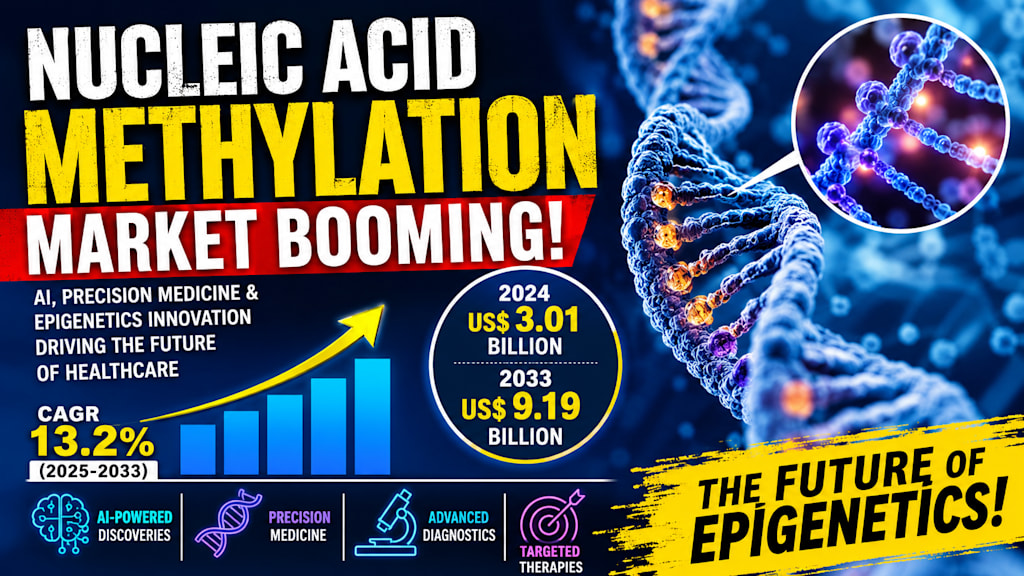
According to recent industry analysis, the Global Nucleic Acid Methylation Market is projected to grow from US$ 3.01 billion in 2024 to an impressive US$ 9.19 billion by 2033, expanding at a CAGR of 13.2% during the forecast period from 2025 to 2033.
This strong growth reflects the increasing demand for early disease detection, personalized medicine strategies, advanced sequencing technologies, and AI-driven molecular analysis tools. The market is becoming a critical pillar in cancer diagnostics, neurological disease research, and targeted drug discovery.
Understanding Nucleic Acid Methylation
Nucleic acid methylation refers to chemical modifications that occur when methyl groups are added to DNA or RNA molecules. These modifications influence how genes are expressed without altering the actual genetic sequence.
In simple terms, methylation acts like a biological switch that can activate or silence genes. Researchers now understand that abnormal methylation patterns are closely associated with cancer, cardiovascular diseases, neurological disorders, autoimmune conditions, and aging.
This growing understanding has turned methylation research into one of the most promising areas in modern biotechnology and precision healthcare.
AI is Revolutionizing Epigenetics Research
Artificial intelligence is rapidly becoming one of the biggest growth catalysts in the nucleic acid methylation industry. Modern sequencing technologies generate enormous volumes of epigenetic data, making traditional analysis methods increasingly difficult and time-consuming.
AI-powered algorithms now help researchers:
Detect complex methylation patterns
Predict disease progression
Identify treatment responses
Accelerate biomarker discovery
Improve diagnostic accuracy
One major breakthrough came in July 2024 when researchers from Cambridge University and University College London introduced an AI system capable of detecting 13 different types of cancer using DNA methylation analysis with an impressive 98.2% accuracy rate.
Such innovations could redefine early cancer screening and significantly improve survival outcomes worldwide.
As machine learning models continue to evolve, healthcare providers may soon integrate methylation-based AI diagnostics into routine clinical practice.
Rising Cancer Burden Fuels Market Expansion
Cancer remains one of the strongest drivers behind nucleic acid methylation research. Traditional diagnostic approaches often struggle with early-stage disease detection, while methylation biomarkers provide a highly sensitive alternative.
DNA methylation abnormalities can appear long before visible symptoms develop, making them extremely valuable for early screening and preventive healthcare strategies.
Healthcare systems globally are investing heavily in:
Liquid biopsy technologies
Cancer biomarker research
Molecular diagnostics
Precision oncology platforms
The increasing prevalence of cancer across both developed and emerging economies is therefore expected to sustain long-term demand for methylation analysis technologies.
Precision Medicine Creates New Growth Opportunities
The healthcare industry is rapidly moving away from generalized treatment models toward personalized therapeutic approaches tailored to individual genetic and epigenetic profiles.
Methylation analysis plays a central role in this transition.
By studying patient-specific methylation signatures, clinicians can:
Predict drug responses
Identify disease risks
Customize treatment strategies
Reduce adverse drug reactions
Improve therapy effectiveness
This personalized healthcare model is particularly important in oncology, neurology, and rare disease treatment.
As precision medicine adoption accelerates globally, nucleic acid methylation technologies are becoming increasingly essential in clinical research and pharmaceutical development.
Technological Innovations Driving Market Growth
Rapid advancements in sequencing and bioinformatics technologies are significantly improving the efficiency, speed, and affordability of methylation analysis.
Some of the most influential technologies shaping the market include:
Next-Generation Sequencing (NGS)
NGS remains one of the most powerful tools for large-scale methylation analysis. It enables researchers to study methylation patterns across entire genomes with remarkable precision.
Bisulfite Sequencing
Bisulfite sequencing continues to be widely used for detecting methylated cytosines in DNA samples and remains a gold standard in epigenetic research.
Mass Spectrometry
Mass spectrometry technologies are helping scientists identify complex epigenetic modifications with greater sensitivity and accuracy.
AI-Powered Bioinformatics Platforms
Modern AI-driven software solutions are simplifying complex data interpretation, reducing human error, and accelerating clinical research workflows.
Together, these technologies are making nucleic acid methylation analysis more scalable and commercially viable.
Pharmaceutical Industry Expands Investment in Epigenetics
Biotechnology companies and pharmaceutical giants are significantly increasing their investments in epigenetic drug discovery.
Researchers are now exploring therapies targeting methylation regulators, including m6A inhibitors, for diseases such as:
Cancer
Alzheimer’s disease
Parkinson’s disease
Autoimmune disorders
Metabolic diseases
Several pharmaceutical companies are also partnering with academic institutions to develop advanced methylation-based therapies and companion diagnostics.
This collaboration between academia and industry is expected to generate substantial innovation throughout the forecast period.
Challenges Continue to Impact Market Adoption
Despite strong growth prospects, the nucleic acid methylation market still faces several important challenges.
High Technology Costs
Advanced sequencing systems, reagents, and bioinformatics tools often require substantial investment, limiting accessibility for smaller laboratories and healthcare facilities.
Complex Data Interpretation
Methylation datasets are extremely large and highly complex. Interpreting this information accurately requires specialized expertise and sophisticated computational tools.
Limited Clinical Awareness
Many healthcare professionals still have limited familiarity with methylation-based diagnostics and therapies, slowing clinical adoption rates.
Regulatory Hurdles
Regulatory approval processes for new epigenetic diagnostic technologies can be lengthy and expensive, particularly in highly regulated healthcare markets.
Addressing these challenges will be essential for broader commercialization and clinical integration.
North America Maintains Market Leadership
North America currently dominates the global nucleic acid methylation market due to:
Strong biotechnology infrastructure
Heavy R&D investments
Advanced healthcare systems
Presence of leading biotech firms
High adoption of precision medicine
The United States remains the largest contributor, supported by extensive cancer research initiatives and widespread use of next-generation sequencing technologies.
Government funding programs and private investments continue to strengthen the region’s leadership position.
Europe Continues Strong Research Momentum
Europe also represents a major growth hub for nucleic acid methylation technologies.
Countries such as Germany, the United Kingdom, and France are investing heavily in:
Genomics research
AI-driven healthcare
Personalized medicine
Cancer diagnostics
Germany, in particular, has emerged as a leading center for epigenetics innovation thanks to its strong pharmaceutical ecosystem and world-class research institutions.
Collaborative research partnerships between academia and industry are accelerating commercialization opportunities across the region.
Asia-Pacific Emerging as a Fast-Growing Opportunity
The Asia-Pacific region is expected to witness rapid market growth during the forecast period.
Countries including:
China
India
Japan
South Korea
are significantly expanding their biotechnology capabilities and healthcare research infrastructure.
India’s growing pharmaceutical sector, rising healthcare investments, and increasing adoption of precision medicine are creating major opportunities for nucleic acid methylation technologies.
Government-backed genomics initiatives and improved access to advanced sequencing tools are further supporting regional expansion.
Saudi Arabia Strengthens Healthcare Innovation
Saudi Arabia is also emerging as a promising market for epigenetics research and precision healthcare technologies.
The country’s long-term healthcare modernization initiatives are encouraging investments in:
Molecular diagnostics
Biotechnology research
AI-driven healthcare solutions
Genomics infrastructure
As healthcare systems across the Middle East increasingly adopt advanced diagnostic technologies, demand for methylation analysis tools is expected to grow steadily.
Key Segments Shaping the Market
The nucleic acid methylation market includes several important product and application segments.
By Product & Services
Kits & Reagents
Enzymes
Instruments & Software
Consumables
Services
By Type
DNA Methylation
RNA Methylation
By Technology
Next-Generation Sequencing
Bisulfite Sequencing & PCR-Based Techniques
Microarray-Based Methylation Analysis
Mass Spectrometry
Hybridization-Based Detection
By Application
Drug Discovery & Personalized Medicine
Clinical Diagnostics
Research Applications
By End Use
Pharmaceutical & Biotechnology Companies
Academic & Research Institutes
Hospitals & Diagnostic Laboratories
Each segment continues to experience innovation as research applications expand globally.
10 Recent Developments in the Nucleic Acid Methylation Industry
1. Alida Biosciences Launches EpiPlex Platform
In February 2025, Alida Biosciences introduced EpiPlex, a sequencing technology capable of simultaneously identifying RNA modifications and gene expression patterns.
2. New England Biolabs Introduces EM-seq v2
In January 2025, New England Biolabs launched an upgraded enzyme-based alternative to bisulfite sequencing with improved workflow efficiency and reduced DNA damage.
3. Thermo Fisher Scientific Expands Epigenetics Portfolio
Thermo Fisher Scientific strengthened its molecular diagnostics solutions with enhanced methylation analysis capabilities for cancer research applications.
4. Illumina Advances AI-Based Sequencing Analysis
Illumina integrated AI-powered analytics into sequencing workflows to improve methylation data interpretation and accelerate genomic insights.
5. Agilent Technologies Enhances Bioinformatics Solutions
Agilent expanded its epigenetics software tools to support more advanced methylation profiling and biomarker discovery.
6. Roche Invests in Precision Oncology Research
Roche increased investments in precision medicine platforms focused on methylation-based cancer diagnostics and treatment monitoring.
7. Bio-Rad Laboratories Expands PCR Solutions
Bio-Rad launched advanced PCR technologies designed to improve sensitivity in methylation detection workflows.
8. Exact Sciences Accelerates Liquid Biopsy Research
Exact Sciences continued developing methylation-based liquid biopsy technologies for early cancer detection.
9. Abcam Strengthens Epigenetics Reagent Portfolio
Abcam expanded its research reagent offerings supporting DNA and RNA methylation studies globally.
10. Academic Partnerships Drive Innovation
Leading universities and biotech companies formed multiple partnerships to accelerate AI-driven epigenetics research and clinical translation.
Final Thoughts
The nucleic acid methylation market is rapidly evolving into one of the most influential sectors within modern biotechnology and precision medicine.
With expanding applications in cancer diagnostics, personalized therapeutics, AI-driven molecular analysis, and epigenetic drug discovery, the industry is positioned for substantial long-term growth.
Although challenges such as high costs, regulatory complexities, and data interpretation barriers remain, ongoing technological innovation and rising global healthcare investments are expected to unlock enormous opportunities over the next decade.
As healthcare increasingly shifts toward predictive, preventive, and personalized medicine, nucleic acid methylation technologies may become foundational tools for the future of disease diagnosis and treatment worldwide.
About the Creator
Enjoyed the story? Support the Creator.
Subscribe for free to receive all their stories in your feed.
Comments
There are no comments for this story
Be the first to respond and start the conversation.