
Nucleic Acid Amplification Testing Market Set to Surpass US$ 23.79 Billion by 2033 as Molecular Diagnostics Transform Global Healthcare
Rapid Advances in PCR, Point-of-Care Testing, and Precision Medicine Are Driving Strong Growth Across the Global Nucleic Acid Amplification Testing Industry

The healthcare industry is undergoing a significant transformation as molecular diagnostics become an essential component of modern disease detection and patient management. Among the most important technologies leading this transformation is Nucleic Acid Amplification Testing (NAAT), a diagnostic method that enables the rapid and accurate detection of genetic material from viruses, bacteria, and other pathogens.
From identifying infectious diseases to supporting cancer diagnosis and genetic testing, NAAT technologies have become indispensable tools in healthcare systems worldwide. Their importance became especially evident during the COVID-19 pandemic, when molecular testing emerged as the gold standard for detecting SARS-CoV-2 infections.
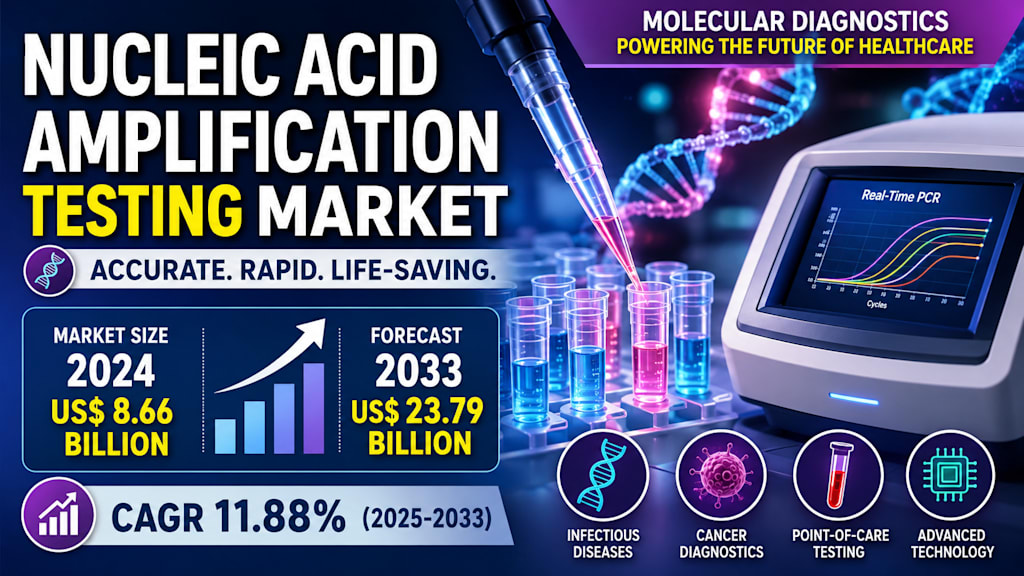
According to Renub Research, the global Nucleic Acid Amplification Testing Market was valued at US$ 8.66 Billion in 2024 and is projected to reach US$ 23.79 Billion by 2033, expanding at a remarkable CAGR of 11.88% between 2025 and 2033. This growth reflects the increasing demand for highly sensitive diagnostic tools, technological innovation, and the growing prevalence of infectious and chronic diseases worldwide.
Understanding Nucleic Acid Amplification Testing
Nucleic Acid Amplification Testing is a molecular diagnostic technique that detects specific DNA or RNA sequences by amplifying genetic material to measurable levels. Unlike traditional diagnostic methods, NAAT can identify pathogens even when present in extremely low quantities.
Several technologies fall under the NAAT umbrella, including:
Polymerase Chain Reaction (PCR)
Isothermal Nucleic Acid Amplification Technology (INAAT)
Ligase Chain Reaction (LCR)
Digital PCR
Loop-Mediated Isothermal Amplification (LAMP)
These technologies offer exceptional sensitivity and specificity, enabling healthcare providers to diagnose diseases at earlier stages and initiate treatment more quickly.
As healthcare systems continue shifting toward precision medicine, NAAT has become a cornerstone technology supporting personalized healthcare strategies worldwide.
Growing Burden of Infectious Diseases Fuels Market Expansion
One of the primary drivers of market growth is the increasing prevalence of infectious diseases across the globe.
Diseases such as tuberculosis, influenza, hepatitis, HIV, respiratory infections, sexually transmitted infections, and emerging viral outbreaks require accurate and rapid diagnostic tools. NAAT technologies provide healthcare professionals with the ability to detect pathogens quickly, improving patient outcomes and reducing transmission risks.
The COVID-19 pandemic demonstrated the value of molecular diagnostics on an unprecedented scale. Millions of PCR-based tests were conducted daily worldwide, highlighting the importance of scalable and highly reliable testing platforms.
The lessons learned during the pandemic continue to influence healthcare policies and investments, driving further adoption of advanced molecular diagnostic technologies.
Point-of-Care Testing Revolutionizing Diagnostics
Healthcare providers increasingly seek diagnostic solutions that deliver results closer to the patient. This demand is accelerating the transition toward point-of-care (POC) testing.
Traditional laboratory testing often requires sample transportation and lengthy processing times. In contrast, point-of-care NAAT systems enable healthcare professionals to obtain highly accurate results within minutes.
These portable diagnostic platforms are particularly valuable in:
Emergency departments
Primary care clinics
Rural healthcare settings
Airports and transportation hubs
Community healthcare centers
Rapid molecular testing improves clinical decision-making, reduces treatment delays, and enhances patient satisfaction.
As miniaturization technologies continue advancing, point-of-care NAAT devices are expected to become increasingly common across healthcare environments worldwide.
Rising Adoption in Oncology Diagnostics
Cancer diagnosis represents another major growth avenue for the NAAT market.
Modern oncology increasingly relies on molecular profiling to identify genetic mutations associated with various cancers. NAAT technologies help physicians detect biomarkers that guide targeted therapies and personalized treatment plans.
Applications include:
Lung cancer diagnostics
Breast cancer screening
Colorectal cancer testing
Hematological malignancies
Liquid biopsy analysis
The growing emphasis on precision oncology is creating substantial demand for advanced nucleic acid amplification technologies capable of detecting even minute genetic abnormalities.
As cancer incidence continues rising globally, molecular diagnostics will play an increasingly vital role in early detection and treatment optimization.
Technological Innovation Accelerating Market Growth
Continuous innovation remains one of the strongest drivers of industry expansion.
Diagnostic companies are investing heavily in research and development to improve testing speed, sensitivity, automation, and affordability.
Recent technological advances include:
Digital PCR Technology
Digital PCR provides greater sensitivity and precision than conventional PCR methods, allowing accurate quantification of low-abundance genetic material.
Loop-Mediated Isothermal Amplification (LAMP)
LAMP technology eliminates the need for complex thermal cycling, enabling faster and more portable testing solutions.
Automated Molecular Platforms
Fully integrated systems streamline sample preparation, amplification, and result analysis, reducing laboratory workload and human error.
AI and Data Integration
Artificial intelligence and advanced analytics are being incorporated into molecular diagnostic workflows, enhancing result interpretation and supporting clinical decision-making.
These innovations continue to expand the applicability of NAAT technologies across healthcare sectors.
Automation and High-Throughput Systems Transform Laboratories
Clinical laboratories face growing pressure to process increasing test volumes while maintaining accuracy and efficiency.
To address these challenges, laboratories are investing in automation and high-throughput molecular diagnostic systems.
Modern automated platforms offer several advantages:
Reduced manual intervention
Faster turnaround times
Improved workflow efficiency
Higher testing capacity
Enhanced result consistency
Automation is particularly important for large hospitals, reference laboratories, and public health institutions managing extensive testing demands.
The trend toward laboratory automation is expected to remain a major growth driver throughout the forecast period.
Emerging Infectious Diseases Create New Opportunities
The emergence of new infectious diseases continues to create demand for rapid molecular diagnostic solutions.
Recent outbreaks involving monkeypox (mpox), avian influenza, and other viral threats have highlighted the need for scalable diagnostic capabilities.
Healthcare organizations and governments increasingly recognize the importance of preparedness and surveillance systems capable of rapidly detecting new pathogens.
As a result, diagnostic manufacturers continue developing specialized NAAT products targeting emerging infectious diseases.
The approval of molecular tests for monkeypox and other newly emerging pathogens demonstrates how quickly the industry can respond to evolving public health challenges.
Market Challenges Remain
Despite strong growth prospects, the industry faces several challenges.
High Equipment and Testing Costs
Advanced NAAT systems require sophisticated instruments, specialized reagents, and highly trained personnel.
For healthcare providers in low- and middle-income countries, these costs can present significant barriers to adoption.
Smaller hospitals and laboratories may struggle to justify the investment required for advanced molecular diagnostic infrastructure.
Complex Regulatory Environment
Regulatory approval processes remain rigorous and time-consuming.
Manufacturers must demonstrate:
Clinical accuracy
Sensitivity
Specificity
Reproducibility
Safety compliance
Meeting regulatory requirements often requires extensive clinical validation studies, increasing both development costs and time-to-market.
Nevertheless, regulatory oversight remains essential to ensuring diagnostic quality and patient safety.
Regional Market Insights
United States
The United States remains one of the largest NAAT markets globally.
Strong healthcare infrastructure, significant biotechnology investments, favorable reimbursement systems, and extensive research activity support continued growth.
The country's leadership in molecular diagnostics innovation continues to attract investment and drive technology adoption.
United Kingdom
The UK market has experienced substantial growth due to increased molecular diagnostic deployment within the National Health Service (NHS).
COVID-19 accelerated adoption, and ongoing investments in biotechnology research continue supporting market expansion.
India
India is emerging as one of the fastest-growing markets.
Government initiatives focused on tuberculosis control, infectious disease management, and healthcare modernization are driving increased utilization of molecular diagnostics.
The expansion of testing infrastructure into rural and underserved regions further supports growth opportunities.
United Arab Emirates
The UAE continues investing heavily in healthcare innovation and advanced diagnostics.
Strong government support, growing healthcare expenditures, and strategic partnerships with global healthcare organizations contribute to market development throughout the region.
Competitive Landscape
The global NAAT market remains highly competitive, with major industry participants focusing on product innovation, strategic partnerships, acquisitions, and geographic expansion.
Leading companies include:
F. Hoffmann-La Roche Ltd
Becton, Dickinson and Company
Danaher Corporation
Abbott Laboratories
Illumina, Inc.
Siemens Healthineers
bioMérieux SA
Novartis AG
Bio-Rad Laboratories, Inc.
Seegene Inc.
These organizations continue investing in advanced molecular technologies to strengthen their market positions and address evolving healthcare needs.
10 Recent Industry Developments Shaping the Market
1. Abbott Laboratories
Expanded rapid molecular diagnostic offerings, strengthening point-of-care infectious disease testing capabilities.
2. Roche Diagnostics
Continued investment in automated PCR platforms designed to improve laboratory efficiency and throughput.
3. Bio-Rad Laboratories
Advanced digital droplet PCR technology applications, enhancing molecular testing sensitivity and precision.
4. Siemens Healthineers
Expanded molecular diagnostics portfolio through innovation and strategic healthcare partnerships.
5. Danaher Corporation
Strengthened molecular diagnostics capabilities through continuous platform improvements and workflow automation.
6. Illumina
Enhanced genomic analysis solutions supporting precision medicine and personalized healthcare initiatives.
7. bioMérieux
Focused on expanding infectious disease diagnostics through advanced molecular testing technologies.
8. Seegene
Introduced multiplex molecular assays capable of simultaneously detecting multiple pathogens.
9. Becton, Dickinson and Company
Expanded integrated diagnostic solutions supporting hospital and laboratory testing environments.
10. WHO-Approved Mpox Diagnostic Advancement
In October 2024, the World Health Organization approved the first diagnostic test for mpox, marking an important milestone in global disease surveillance and outbreak management.
Future Outlook
The future of the Nucleic Acid Amplification Testing market appears exceptionally promising.
Growing awareness regarding early disease detection, increasing prevalence of infectious and chronic diseases, expanding precision medicine applications, and continuous technological advancements are expected to sustain robust market growth over the coming decade.
Furthermore, increasing healthcare investments in emerging economies and the widespread adoption of point-of-care molecular diagnostics will unlock new growth opportunities for manufacturers and healthcare providers alike.
As healthcare systems increasingly prioritize speed, accuracy, and personalized care, NAAT technologies are expected to become even more deeply integrated into clinical practice worldwide.
Final Thoughts
Nucleic Acid Amplification Testing has evolved from a specialized laboratory technique into one of the most critical pillars of modern diagnostics. Whether detecting infectious diseases, identifying cancer biomarkers, or supporting public health surveillance, NAAT technologies continue to reshape healthcare delivery across the globe.
With the market projected to grow from US$ 8.66 Billion in 2024 to US$ 23.79 Billion by 2033, the industry is entering a period of sustained innovation and expansion. As diagnostic technologies become faster, more accessible, and increasingly precise, NAAT will remain at the forefront of global healthcare transformation for years to come.
About the Creator
Enjoyed the story? Support the Creator.
Subscribe for free to receive all their stories in your feed.
Comments
There are no comments for this story
Be the first to respond and start the conversation.