
North America Processed Meat Market Set for Steady Growth Through 2034 as Demand for Convenient Protein Foods Rises
Consumers Continue Choosing Ready-to-Eat and High-Protein Meat Products While Brands Push Innovation, Premiumization, and Clean-Label Strategies

The North America processed meat market is entering a new phase of transformation as consumers increasingly prioritize convenience, protein-rich diets, and ready-to-eat meal options. From premium jerky and deli meats to innovative chicken sticks and gourmet sausages, processed meat products are evolving rapidly to match changing consumer lifestyles and expectations.
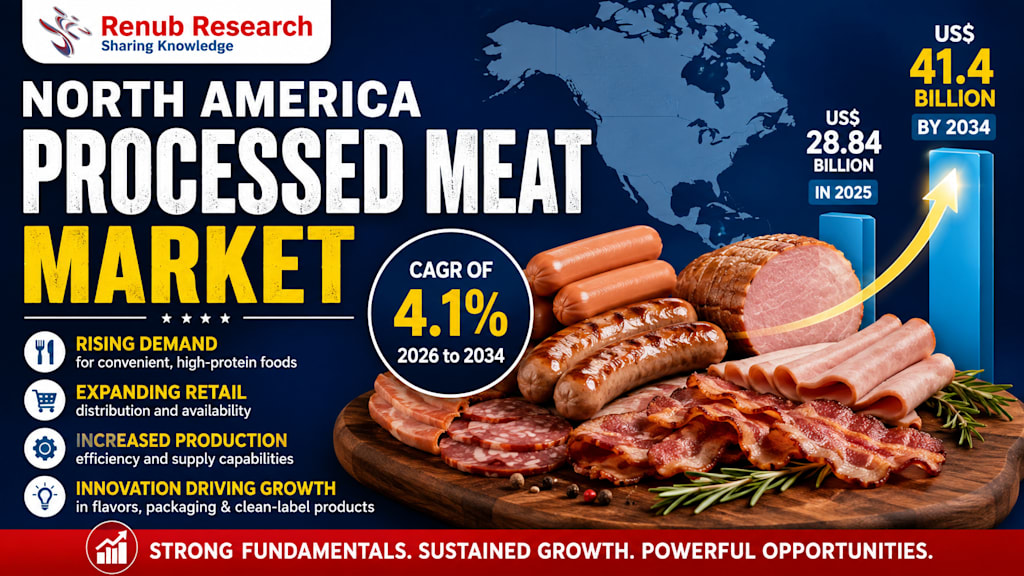
According to Renub Research, the North America processed meat market is projected to grow from US$ 28.84 Billion in 2025 to US$ 41.4 Billion by 2034, expanding at a CAGR of 4.1% between 2026 and 2034. The market’s growth is being fueled by rising demand for convenient food products, stronger cold-chain infrastructure, retail expansion, and continuous product innovation.
Processed meat products remain deeply embedded in North American food culture. Popular products such as bacon, sausages, deli meats, hot dogs, ham, jerky, and ready-to-cook meats continue to maintain strong demand across supermarkets, convenience stores, restaurants, and online retail platforms.
At the same time, manufacturers are modernizing their offerings to address growing consumer concerns around nutrition, ingredient quality, and sustainability.
Why the Processed Meat Industry Continues to Expand
One of the biggest drivers behind the market’s growth is the increasing popularity of protein-focused diets and portable meal solutions. Consumers with busy schedules are looking for food products that are quick, filling, and easy to consume without sacrificing taste.
This shift has helped meat snack categories gain enormous momentum across North America. High-protein meat sticks, jerky, and snack packs are now widely marketed toward fitness enthusiasts, office workers, travelers, and consumers following keto or low-carb diets.
Brands are also moving aggressively into the “better-for-you” category by reducing artificial additives and introducing cleaner ingredient lists. In May 2025, New Primal launched rotisserie-seasoned chicken sticks made with all-natural ingredients, highlighting how brands are repositioning meat snacks as healthier convenience foods rather than traditional processed products.
The snackification trend is especially important because younger consumers increasingly prefer smaller meals throughout the day instead of traditional breakfast, lunch, and dinner routines. Processed meat products fit naturally into this evolving eating behavior.
Another major growth factor is the expansion of production infrastructure and processing capacity across the region. Meat producers are investing heavily in automation, packaging technology, and supply-chain optimization to meet rising demand more efficiently.
A significant example came in August 2024, when Cargill acquired two case-ready meat plants from Infinity Meat Solutions in Rhode Island and Pennsylvania. The facilities can produce up to 2 million pounds of beef and pork products weekly, strengthening the company’s ability to supply grocery retailers with packaged meat products.
These investments help retailers reduce labor-intensive in-store meat preparation while improving consistency, packaging quality, and inventory management. Advanced cold-chain logistics and faster distribution systems are also helping companies maintain freshness and improve shelf life.

Premiumization Is Changing Consumer Expectations
Beyond convenience, consumers are increasingly willing to spend more on premium processed meat experiences.
This premiumization trend is transforming the market as brands introduce gourmet flavors, artisanal products, organic ingredients, and globally inspired seasonings. Products that once focused mainly on affordability are now competing on taste sophistication, sourcing quality, and culinary appeal.
Consumers are showing growing interest in smoked meats, marinated products, specialty sausages, and craft jerky made with premium cuts and unique flavor combinations.
For example, in September 2025, meat snack company Carnal expanded its lineup with Beef Sticks and Umami Cut Beef Jerky featuring ingredients such as fermented black garlic, aged soy, and spring black truffles. The company positioned the products as elevated snack experiences with steak-like textures and richer flavor profiles.
This movement toward premium offerings reflects broader food industry trends where consumers increasingly seek restaurant-quality experiences at home.
Social media and influencer marketing are also playing a major role in shaping purchasing decisions. Younger consumers are more likely to experiment with bold flavors and specialty products after discovering them online through food creators, athletes, and lifestyle influencers.
In another notable example, YouTube creator MrBeast partnered with Jack Link’s in September 2025 to launch a new line of meat snacks that included Turkey Mini Sticks, Original Beef Mini Sticks, and Teriyaki Beef Jerky. The collaboration demonstrates how entertainment personalities are becoming powerful marketing partners for food brands targeting younger demographics.
Convenience Remains the Market’s Strongest Advantage
Despite changing health trends, processed meat continues to maintain one key advantage over many alternative protein categories: convenience.
Ready-to-eat and ready-to-cook meat products fit seamlessly into modern lifestyles where consumers often have limited time for meal preparation. Products requiring minimal cooking or preparation remain especially attractive to working professionals, students, and families.
Retailers are responding by expanding refrigerated snack sections, grab-and-go offerings, and packaged meal kits that include processed meat products.
The rise of online grocery shopping and food delivery services has further accelerated the market’s reach. Consumers can now easily order deli meats, sausages, and prepared protein snacks through digital platforms with same-day or next-day delivery options.
Convenience stores are also becoming increasingly important sales channels, particularly for portable meat snacks. Protein-rich snacks have become highly popular among commuters and travelers seeking quick alternatives to sugary snacks or fast food.
Meanwhile, foodservice operators continue relying heavily on processed meat products because of their consistency, storage efficiency, and versatility across menus.
Health Concerns Continue to Challenge the Industry
While the market outlook remains positive overall, the processed meat industry still faces serious challenges related to consumer health concerns.
Numerous studies linking processed meat consumption to risks such as heart disease, obesity, and certain cancers have encouraged many consumers to reduce intake or seek healthier alternatives.
Sodium content, preservatives, nitrates, and artificial ingredients remain major areas of concern among health-conscious shoppers.
As a result, food manufacturers are under growing pressure to reformulate products while maintaining taste, texture, safety, and shelf stability. This process is often expensive and technologically demanding.
Many brands are now emphasizing labels such as:
- Reduced sodium
- No added nitrates
- Antibiotic-free
- Hormone-free
- Organic
- Minimally processed
- Clean-label ingredients
These labeling strategies are becoming increasingly important purchasing factors, especially among younger consumers and higher-income households.
The rise of plant-based proteins also presents long-term competition for traditional processed meat producers. Although demand for meat products remains strong overall, alternative protein brands continue attracting consumers looking for perceived healthier or more sustainable food options.
Still, processed meat companies are adapting rather than retreating. Many firms are investing in hybrid products, cleaner formulations, and more transparent sourcing practices to retain consumer trust.
Rising Costs and Supply-Chain Pressures Impact Manufacturers
Another major challenge affecting the industry is supply-chain volatility and rising operational costs.
The processed meat industry relies heavily on stable livestock production and transportation systems. However, factors such as feed inflation, labor shortages, disease outbreaks, fuel costs, and packaging expenses continue creating uncertainty for producers.
Cold storage and energy costs have also increased significantly in recent years, placing additional pressure on manufacturers’ profit margins.
At the same time, regulatory oversight surrounding food safety, labor practices, and environmental standards continues becoming more complex across North America.
To remain competitive, companies are investing in automation, production efficiency, and diversified sourcing networks.
Improved technology is helping processors optimize operations while reducing waste and maintaining product consistency. Automation is particularly important as labor shortages continue affecting food manufacturing facilities throughout the region.
United States Leads the Regional Market
The United States remains the dominant force in the North America processed meat market due to its large consumer base, advanced retail infrastructure, and strong demand for convenience foods.
American consumers continue purchasing substantial quantities of deli meats, bacon, sausages, jerky, and ready-to-cook products across supermarkets and foodservice channels.
The country’s mature cold-chain logistics systems and large-scale production facilities provide manufacturers with significant advantages in distribution and efficiency.
Premiumization trends are also especially strong in the United States, where consumers increasingly seek gourmet meat snacks, artisanal cured meats, and globally inspired flavors.
Although plant-based alternatives continue growing, traditional processed meat products remain deeply integrated into mainstream American diets.
Canada Focuses on Cleaner Labels and Premium Products
Canada’s processed meat market is experiencing steady expansion driven by consumer demand for convenient protein foods and premium packaged meat products.
Canadian consumers are particularly responsive to clean-label products and healthier formulations. This has encouraged manufacturers to reduce sodium levels, eliminate unnecessary additives, and introduce minimally processed offerings.
Canada’s strong domestic livestock production also supports supply stability for meat processors.
At the same time, sustainability and animal welfare concerns are becoming more influential in purchasing decisions. Producers are increasingly adopting improved sourcing practices and environmentally conscious production strategies to align with evolving consumer expectations.
Mexico Emerges as a Fast-Growing Market
Mexico is rapidly becoming one of the most promising processed meat markets in North America due to rising urbanization, growing disposable incomes, and expanding modern retail infrastructure.
Traditional products such as ham, sausages, chorizo, and canned meats continue seeing strong demand among Mexican consumers.
The expansion of supermarkets, convenience stores, quick-service restaurants, and food delivery platforms is further accelerating market growth.
Manufacturers are also investing in packaging innovation and shelf-life improvement technologies to better serve both urban and rural markets.
While price sensitivity remains an important factor in Mexico, rising consumer demand for convenient, protein-rich foods is expected to sustain long-term growth.
The Future of the Processed Meat Industry
The North America processed meat market is likely to remain highly competitive and innovation-driven over the next decade.
Companies that successfully balance convenience, flavor, nutrition, and transparency will be best positioned for future growth.
The industry is no longer relying solely on traditional processed meat products. Instead, brands are evolving toward premium experiences, cleaner formulations, portable snacking formats, and digitally driven marketing strategies.
As consumer expectations continue shifting, processed meat companies must adapt quickly to remain relevant in an increasingly health-conscious and competitive food environment.
However, one thing remains clear: convenience and protein demand continue to be powerful forces shaping the future of food consumption across North America.
With steady projected growth through 2034, the processed meat industry is expected to remain a major part of the region’s evolving food economy.
Final Thoughts
The North America processed meat market is undergoing a significant transformation fueled by changing lifestyles, premiumization trends, and growing demand for convenient protein solutions. While health concerns and supply-chain challenges continue creating pressure, innovation across flavors, clean-label ingredients, and packaging technologies is helping the industry maintain momentum.
As consumers continue prioritizing convenience without compromising taste and quality, processed meat brands that embrace transparency, product innovation, and evolving dietary preferences are likely to lead the next era of market growth.
About the Creator
Enjoyed the story? Support the Creator.
Subscribe for free to receive all their stories in your feed.
Comments
There are no comments for this story
Be the first to respond and start the conversation.