
North America Limestone Market Set to Reach US$ 45.29 Billion by 2033 as Infrastructure and Green Construction Demand Accelerate
Rising infrastructure investments, environmental applications, and advanced mining technologies are reshaping the future of the North American limestone industry

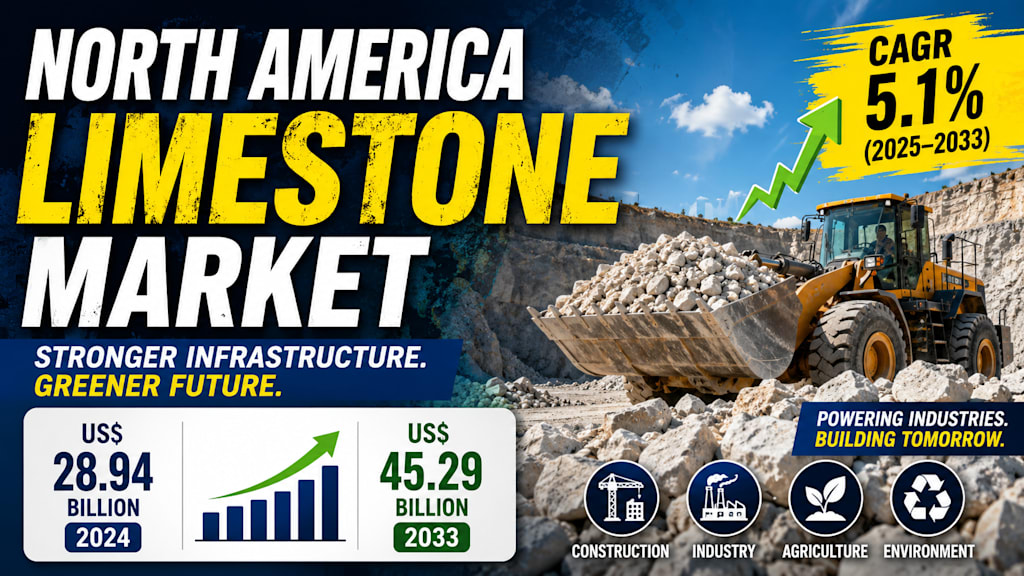
The North American limestone market is entering a strong growth phase as infrastructure modernization, urban development, and sustainable industrial practices continue to expand across the region. Limestone, one of the most essential raw materials used in construction, steelmaking, agriculture, and environmental management, is witnessing increasing demand from both public and private sectors.
According to Renub Research, the North America Limestone Market is projected to grow from US$ 28.94 billion in 2024 to US$ 45.29 billion by 2033, expanding at a CAGR of 5.1% during the forecast period from 2025 to 2033. The market’s growth is primarily driven by expanding construction activities, transportation infrastructure projects, technological advancements in mining operations, and increasing environmental applications of limestone.
Limestone Continues to Power North America’s Construction Boom
Limestone remains a critical ingredient in cement production, road construction, concrete manufacturing, and commercial infrastructure development. Across the United States, Canada, and Mexico, governments are increasing investments in highways, bridges, airports, ports, and housing projects. This surge in development is directly increasing limestone consumption.
Urbanization trends are also adding momentum to the market. Growing populations in metropolitan regions are creating strong demand for residential complexes, office spaces, industrial zones, and transportation networks. Since limestone is heavily used in cement and aggregates, every large-scale infrastructure initiative contributes significantly to market expansion.
The United States government’s infrastructure rebuilding initiatives have further strengthened market confidence. Massive investments in transportation, water systems, and public utilities are expected to create long-term opportunities for limestone suppliers and mining companies.
Canada is also witnessing significant construction momentum through national housing and infrastructure programs. Investments focused on affordable housing, public infrastructure, and sustainable development are expected to increase limestone demand over the coming decade.
Meanwhile, Mexico’s expanding industrial and urban development projects are supporting the country’s limestone consumption, particularly in cement manufacturing and road construction.
Environmental Applications Are Opening New Growth Opportunities
Beyond construction, limestone is increasingly being recognized for its environmental value. Industries are adopting limestone-based solutions to reduce pollution, improve water treatment systems, and restore soil quality.
One of the most important environmental applications is flue gas desulfurization, where limestone helps reduce sulfur dioxide emissions from coal-fired power plants. As governments strengthen environmental regulations and carbon reduction goals, industries are investing more in pollution-control systems that rely on limestone.
Agriculture is another rapidly growing application area. Farmers across North America use limestone to balance soil acidity, improve nutrient absorption, and increase agricultural productivity. Rising awareness about sustainable farming practices is supporting continued growth in agricultural limestone demand.
Water treatment facilities also rely on limestone for filtration and purification processes. Its natural neutralizing properties make it an effective and cost-efficient solution for wastewater treatment and industrial waste management.
As sustainability becomes a central focus across industries, limestone’s role in cleaner industrial operations is expected to grow substantially.
Technological Advancements Are Improving Mining Efficiency
The North American limestone industry is also benefiting from technological innovations in mining and processing operations. Automation, precision blasting, advanced crushing equipment, and real-time monitoring systems are helping companies improve productivity while reducing environmental impact.
Modern extraction technologies are enabling faster and more efficient limestone production. Automated systems reduce labor dependency and improve operational accuracy, while advanced processing equipment produces higher-quality limestone products for specialized industrial applications.
Technology is also helping mining companies improve sustainability performance. Reduced waste generation, optimized energy consumption, and lower emissions are becoming important competitive advantages for industry participants.
In addition, transportation and logistics innovations are improving supply chain efficiency, ensuring faster deliveries and better cost management across regional markets.
These advancements are allowing limestone producers to meet growing demand while maintaining operational profitability and environmental compliance.
Infrastructure Development Remains the Strongest Growth Driver
Infrastructure development continues to be the single largest growth catalyst for the North American limestone market. Governments throughout the region are prioritizing transportation modernization, urban renewal, and public utility upgrades.
Road expansion projects require massive quantities of crushed limestone for foundations, asphalt mixtures, and concrete production. Similarly, bridge construction and airport development projects rely heavily on limestone-based materials.
The growing emphasis on resilient and long-lasting infrastructure is increasing the use of durable construction materials such as limestone aggregates. Public-private partnerships and federal funding programs are expected to sustain infrastructure-related limestone demand well into the next decade.
Additionally, rising industrial construction activities—including factories, logistics centers, and energy facilities—are further contributing to market growth.
Challenges Continue to Impact the Industry
Despite strong growth prospects, the North American limestone market faces several operational and environmental challenges.
Public Opposition and Permitting Delays
Mining activities frequently encounter resistance from local communities concerned about land degradation, noise pollution, dust emissions, and environmental damage. Regulatory approvals for new limestone mining projects often involve lengthy review processes and environmental assessments.
Permitting delays can increase project costs and slow down production expansion plans. Companies must balance operational growth with community engagement and environmental responsibility.
Resource Depletion and Land Use Concerns
The gradual depletion of high-quality limestone reserves is another major challenge. Mining operations can significantly alter landscapes and ecosystems, leading to concerns regarding biodiversity loss, habitat destruction, and groundwater management.
As premium reserves become harder to access, mining companies may face rising extraction costs and increased regulatory scrutiny. Sustainable mining practices, land reclamation efforts, and environmental restoration initiatives are becoming increasingly important for long-term industry stability.
United States Leads the Regional Limestone Market
The United States remains the dominant force in the North American limestone industry due to its large-scale infrastructure spending, industrial base, and extensive limestone reserves.
Limestone plays a critical role in U.S. cement production, road construction, agriculture, steel manufacturing, and environmental protection systems. Rising demand for transportation infrastructure and housing development continues to support strong market growth.
Environmental applications are also expanding rapidly in the United States. Flue gas desulfurization systems used by power plants represent a significant limestone consumption segment.
Another interesting development emerged in 2024 when the U.S. Geological Survey identified substantial lithium reserves within the Smackover Formation—a limestone-rich geological structure spread across several southern states. This discovery could create additional industrial relevance for limestone-rich formations in the future.
Canada’s Limestone Market Benefits from Housing and Infrastructure Investments
Canada’s limestone industry is strongly supported by construction activities, infrastructure projects, and agricultural applications. The country possesses extensive limestone reserves, including major quarry operations capable of serving both domestic and export markets.
Government investments in affordable housing and public infrastructure are expected to sustain limestone demand over the coming years. Agricultural limestone applications also remain important due to Canada’s large farming sector.
However, the market faces competition from global limestone suppliers and must address environmental concerns associated with quarry operations and resource extraction.
Mexico’s Expanding Construction Sector Supports Market Growth
Mexico continues to emerge as an important contributor to the regional limestone market. The country’s growing urbanization and industrialization are increasing demand for cement, road materials, and construction aggregates.
Large limestone reserves in regions such as Quintana Roo support domestic production and industrial supply chains. However, environmental concerns and land-use disputes occasionally create tensions between industrial operators and regulatory authorities.
Balanced environmental regulations and sustainable mining strategies will play a crucial role in maintaining future market growth.
Market Segmentation Highlights
By Type
Magnesian Limestone
High Calcium Limestone
By Application
Industry Lime
Chemical Lime
Construction Lime
Refractory Lime
By End Use
Construction
Iron & Steel
Agriculture
Chemical
Others
By Country
United States
Canada
Mexico
Rest of North America
Key Companies Shaping the North America Limestone Industry
Several major companies are actively contributing to technological innovation, production expansion, and sustainability initiatives across the limestone market.
Holcim Limited
CEMEX S.A.B. de C.V.
Carmeuse
Imerys
United States Lime & Minerals Inc.
Mineral Technologies Inc.
The National Lime & Stone Company
10 Recent Developments from Leading Limestone and Construction Material Companies
1. Holcim Accelerates Green Construction Initiatives
Holcim Limited has continued investing in low-carbon cement technologies and sustainable building materials to reduce emissions across North America.
2. CEMEX Expands Sustainable Cement Production
CEMEX S.A.B. de C.V. announced additional investments in cleaner cement manufacturing and carbon reduction technologies.
3. Carmeuse Enhances Lime Production Efficiency
Carmeuse has adopted advanced automation systems to improve operational efficiency and reduce environmental impact.
4. Imerys Strengthens Industrial Mineral Operations
Imerys continues expanding its industrial mineral processing capabilities to support specialty limestone applications.
5. United States Lime & Minerals Focuses on Infrastructure Demand
United States Lime & Minerals Inc. has increased production focus to support growing U.S. infrastructure projects.
6. Mineral Technologies Advances Sustainable Processing
Mineral Technologies Inc. introduced efficiency-focused mineral processing solutions aimed at reducing waste generation.
7. CEMEX Promotes Circular Economy Programs
CEMEX S.A.B. de C.V. expanded recycling and circular construction material programs throughout North America.
8. Holcim Expands Eco-Friendly Building Solutions
Holcim Limited launched additional environmentally friendly construction products targeting sustainable infrastructure development.
9. Carmeuse Invests in Environmental Compliance Systems
Carmeuse enhanced emissions management systems across several production facilities.
10. Imerys Develops High-Performance Industrial Minerals
Imerys continues developing advanced mineral solutions for industrial and environmental applications.
Final Thoughts
The North American limestone market is entering a transformative decade driven by infrastructure expansion, environmental sustainability initiatives, and industrial modernization. As governments continue investing in transportation networks, housing, and clean industrial technologies, limestone demand is expected to remain strong across multiple sectors.
At the same time, environmental applications are creating new long-term opportunities beyond traditional construction uses. Companies that successfully integrate sustainable mining practices, advanced processing technologies, and eco-friendly production methods are likely to gain significant competitive advantages.
While challenges such as permitting delays, environmental concerns, and resource depletion remain important issues, the industry’s long-term outlook continues to appear highly positive.
With a projected market value of US$ 45.29 billion by 2033, North America’s limestone industry is positioned to play a critical role in shaping the future of sustainable infrastructure and industrial development.
About the Creator
Enjoyed the story? Support the Creator.
Subscribe for free to receive all their stories in your feed.
Comments
There are no comments for this story
Be the first to respond and start the conversation.