
North America Household Refrigerators and Freezers Market Set to Reach US$ 32.74 Billion by 2033 as Smart Appliances and Energy Efficiency Drive Consumer Demand
Rising adoption of connected home technologies, premium refrigeration systems, and sustainable cooling solutions is reshaping the North American household appliance landscape through 2033.

North America Household Refrigerators and Freezers Market Outlook
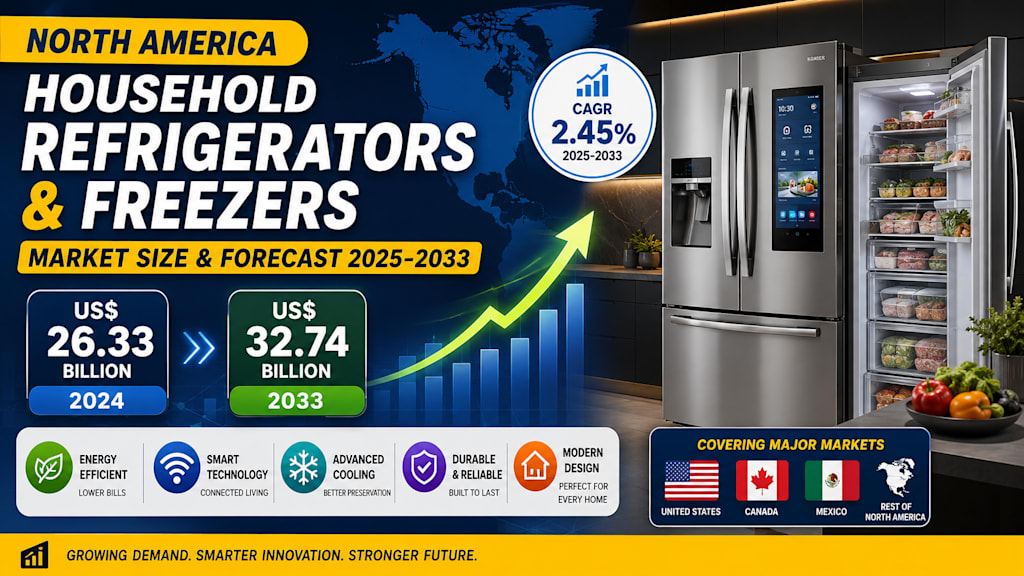
The North America Household Refrigerators and Freezers Market is entering a new phase of transformation as consumers increasingly prioritize convenience, energy efficiency, smart connectivity, and advanced food preservation technologies. According to Renub Research, the market is expected to grow from US$ 26.33 billion in 2024 to US$ 32.74 billion by 2033, expanding at a CAGR of 2.45% during 2025–2033.
Household refrigerators and freezers remain among the most essential appliances in modern homes. Their primary purpose is to preserve food quality, extend shelf life, and reduce food waste. Refrigerators typically operate between 34°F and 40°F, while freezers maintain temperatures at or below 0°F to preserve frozen food products effectively.
Over the years, these appliances have evolved from simple cooling devices into sophisticated kitchen hubs featuring artificial intelligence, Wi-Fi connectivity, touchscreen interfaces, food inventory management, and energy-saving technologies. As households across the United States, Canada, and Mexico embrace digital lifestyles, the demand for innovative refrigeration solutions continues to rise.
The market is further supported by urbanization, increasing disposable incomes, rising consumption of frozen foods, and growing awareness regarding sustainable living. Manufacturers are investing heavily in advanced cooling technologies, eco-friendly refrigerants, and intelligent storage solutions to meet changing consumer expectations.
Why Refrigerators and Freezers Continue to Be Essential in Modern Homes
Consumer habits have changed dramatically over the last decade. Families are purchasing groceries in larger quantities, meal-prepping more frequently, and seeking ways to reduce food spoilage.
These evolving consumption patterns are increasing the need for larger-capacity refrigerators and freezers with flexible storage compartments. Features such as humidity-controlled drawers, dual cooling systems, temperature-controlled zones, and customizable shelving are becoming increasingly attractive to buyers.
Moreover, as food prices continue to fluctuate, consumers are placing greater importance on preserving food for longer periods. Refrigerators and freezers help households minimize waste while maximizing grocery value, making them indispensable appliances in North American homes.
Key Growth Drivers Transforming the Market
Growing Demand for Energy-Efficient Appliances
One of the strongest growth drivers in the North American household refrigerators and freezers market is the increasing demand for energy-efficient products.
Consumers are becoming more conscious of electricity consumption and environmental sustainability. Rising utility costs have encouraged households to invest in appliances that reduce energy usage while maintaining optimal performance.
Manufacturers are responding by introducing ENERGY STAR-certified refrigerators equipped with:
High-efficiency compressors
Advanced insulation technologies
Smart temperature controls
Adaptive cooling systems
Eco-friendly refrigerants
Government initiatives and utility rebate programs across North America are also encouraging consumers to replace older, energy-intensive appliances with modern energy-saving alternatives.
A notable example is Panasonic’s launch of its PRIME+ Edition Premium Refrigerators in 2024. These refrigerators feature PRIME Fresh, PRIME Freeze, and nanoe X technologies designed to preserve food freshness while improving hygiene and energy efficiency.
As environmental regulations become stricter, energy-efficient refrigeration systems are expected to dominate future appliance purchases.
Smart Home Integration Accelerating Product Upgrades
The rapid growth of smart home ecosystems is significantly influencing refrigerator and freezer purchases.
Modern consumers increasingly seek appliances that seamlessly integrate with connected home environments. Smart refrigerators now offer features such as:
Wi-Fi connectivity
Voice assistant compatibility
Remote monitoring
Touchscreen displays
Internal cameras
Inventory management systems
AI-driven meal recommendations
These features allow homeowners to manage food inventories, receive maintenance alerts, and monitor appliance performance directly from smartphones.
Samsung’s 2025 global rollout of AI-powered smart refrigerators illustrates the industry's direction. The company expanded its “Screens Everywhere” vision by introducing AI Home displays and enhanced AI Vision Inside technology capable of recognizing food items and assisting with meal planning.
The combination of artificial intelligence and household appliances is expected to create new revenue opportunities for manufacturers throughout the forecast period.
Changing Food Consumption and Lifestyle Trends
Modern lifestyles are increasingly demanding convenience-oriented kitchen solutions.
Busy work schedules, growing consumption of frozen foods, online grocery shopping, and meal-preparation trends have increased the need for larger and more versatile refrigeration systems.
Consumers are now prioritizing:
Larger storage capacity
Flexible shelving systems
Quick-cooling zones
Fresh produce preservation drawers
Multi-temperature compartments
The trend is particularly evident among younger households and urban professionals seeking appliances that support healthier eating habits while reducing food waste.
As consumers spend more on premium groceries and fresh produce, demand for advanced food preservation technologies is expected to continue rising.
Challenges Affecting Market Expansion
Premium Pricing and Affordability Concerns
Despite technological advancements, affordability remains a major challenge for the market.
Smart refrigerators and premium freezers often carry significantly higher price tags due to advanced features, sophisticated electronics, and innovative cooling technologies.
Middle-income consumers frequently hesitate to upgrade because of:
High upfront purchase costs
Installation expenses
Maintenance concerns
Economic uncertainty
As a result, many households continue using older appliances longer than expected, delaying replacement cycles and limiting overall market growth.
Manufacturers must balance innovation with affordability to expand adoption across broader consumer segments.
Supply Chain Disruptions and Component Shortages
The appliance industry remains vulnerable to global supply chain disruptions.
Shortages of semiconductors, electronic components, steel, aluminum, and refrigeration materials have impacted production schedules and product availability.
Challenges include:
Rising manufacturing costs
Shipping delays
Inventory shortages
Increased retail prices
These disruptions can delay new product launches and negatively affect consumer purchasing decisions.
Although supply chain conditions have improved compared to previous years, manufacturers continue to face uncertainties that may influence future growth rates.
Market Analysis by Equipment Type
Single Door Refrigerators and Freezers
Single-door refrigerators remain popular among students, small families, apartment residents, and consumers seeking affordable refrigeration solutions.
These units offer:
Lower purchase costs
Compact dimensions
Reduced energy consumption
Easy installation
Growing urbanization across North America continues to support demand for space-efficient refrigeration products.
Double Door Refrigerators and Freezers
Double-door models account for a substantial share of household purchases.
Consumers prefer these systems because they offer:
Larger storage capacity
Better food organization
Separate cooling zones
Improved accessibility
Top-freezer, bottom-freezer, and side-by-side configurations remain particularly attractive to middle-income households seeking a balance between functionality and affordability.
Wine and Beverage Coolers
Demand for wine and beverage coolers is steadily increasing among premium consumers.
These specialized cooling systems help maintain ideal storage conditions for beverages while complementing modern kitchen aesthetics.
Growing interest in home entertainment and luxury kitchen upgrades continues to support this niche segment.
Market Analysis by Structure
Standard Depth Refrigerators
Standard-depth refrigerators remain highly popular due to their larger storage capacities and practical functionality.
Consumers appreciate their ability to accommodate large grocery purchases while maintaining accessibility and convenience.
Counter Depth Refrigerators
Counter-depth models are increasingly preferred in modern kitchen renovations.
These appliances provide:
Streamlined appearance
Better integration with cabinetry
Premium kitchen aesthetics
The growing popularity of custom kitchen designs is expected to support this segment's expansion.
Market Analysis by Capacity
12–17.9 cu/ft Segment
This segment appeals primarily to:
Singles
Couples
Small families
Apartment residents
Manufacturers continue incorporating advanced technologies into compact units, making them more attractive to urban consumers.
18–24.9 cu/ft Segment
The 18–24.9 cubic foot category remains one of the most popular capacity segments in North America.
Consumers favor these models because they provide:
Adequate storage space
Competitive pricing
Energy efficiency
Flexible organization options
French-door and bottom-freezer designs are particularly popular in this category.
Market Analysis by Price Range
US$900–US$1,999 Segment
This segment represents the largest consumer base.
Buyers receive a strong balance of:
Reliability
Storage capacity
Energy efficiency
Modern features
For many households, this category delivers the best value proposition.
US$2,000–US$3,499 Segment
Premium consumers increasingly gravitate toward this segment.
These models commonly include:
Smart connectivity
Advanced cooling technologies
Interior cameras
Touchscreen controls
Luxury finishes
Demand continues to grow among homeowners undertaking kitchen remodeling projects.
Country-Level Insights
United States
The United States remains the largest market in North America.
Factors driving growth include:
High household appliance ownership rates
Strong smart home adoption
Large suburban housing market
Preference for premium appliances
Consumers increasingly seek French-door and side-by-side refrigerators featuring connected technologies and customization options.
Hisense showcased its smart home ecosystem at CES 2024, highlighting the integration of home appliances with digital entertainment and connected living experiences.
Canada
Canadian consumers prioritize energy efficiency due to higher electricity costs and environmental awareness.
Popular features include:
ENERGY STAR certification
Frost-free operation
Larger freezer compartments
Smart connectivity
Urban markets are witnessing growing demand for premium French-door refrigerators, while compact models remain popular in smaller living spaces.
Mexico
Mexico is emerging as an important growth market due to rising disposable incomes and expanding middle-class households.
Demand is increasing for:
Single-door refrigerators
Top-freezer units
Frost-free technologies
Energy-efficient models
Urban consumers are increasingly upgrading to premium refrigeration systems as lifestyle expectations evolve.
LG Electronics' launch of the Signature Kitchen Suite product line in Mexico reflects growing demand for luxury kitchen appliances in the country.
10 Recent Developments Shaping the Industry
1. Samsung Electronics (March 2025)
Expanded its AI-powered refrigerator portfolio with AI Home screens and upgraded AI Vision Inside food recognition technology.
2. Panasonic Corporation (January 2024)
Introduced PRIME+ Edition Premium Refrigerators featuring PRIME Fresh, PRIME Freeze, and nanoe X technologies.
3. Hisense (January 2024)
Presented its smart home ecosystem and ConnectLife platform integration at CES 2024.
4. LG Electronics (July 2025)
Launched Signature Kitchen Suite products in Mexico targeting luxury residential developments.
5. Whirlpool Corporation
Continued expanding ENERGY STAR-certified appliance offerings focused on sustainability and operational efficiency.
6. GE Appliances
Enhanced smart refrigerator capabilities through advanced connectivity and remote diagnostics features.
7. Electrolux AB
Accelerated investments in eco-friendly refrigeration technologies utilizing lower-emission refrigerants.
8. Haier Group
Expanded premium refrigerator offerings featuring advanced storage flexibility and smart temperature management.
9. Bosch Home Appliances
Focused on premium built-in refrigeration solutions designed for modern kitchen remodeling projects.
10. Dacor Inc.
Strengthened its luxury appliance portfolio with high-end refrigeration systems emphasizing design and customization.
Competitive Landscape
The North American household refrigerators and freezers market remains highly competitive, with major manufacturers focusing on innovation, sustainability, connectivity, and premium design.
Key companies include:
Dacor Inc.
Dover Corporation
Electrolux AB
Frigidaire
GE Appliances
Haier Group
LG Electronics
Robert Bosch GmbH
Samsung Electronics
Whirlpool Corporation
These companies compete through product innovation, smart home integration, energy efficiency improvements, pricing strategies, and distribution network expansion.
Final Thoughts
The North America Household Refrigerators and Freezers Market is poised for steady growth through 2033, supported by rising consumer demand for energy-efficient appliances, smart home integration, and advanced food preservation technologies. While affordability concerns and supply chain disruptions remain challenges, manufacturers continue to innovate by introducing AI-powered features, sustainable cooling systems, and premium storage solutions.
As households increasingly embrace connected living and prioritize long-term energy savings, refrigerators and freezers are evolving from basic appliances into intelligent kitchen companions. With the market forecast to reach US$ 32.74 billion by 2033, industry participants that successfully balance innovation, sustainability, and affordability will be best positioned to capture future growth opportunities across the United States, Canada, and Mexico.
About the Creator
Enjoyed the story? Support the Creator.
Subscribe for free to receive all their stories in your feed.
Comments
There are no comments for this story
Be the first to respond and start the conversation.