
North America Fertilizer Market to Reach US$ 92.23 Billion by 2033 as Sustainable Agriculture and Precision Farming Gain Momentum
Rising Food Demand, AI-Based Farming Technologies, and Sustainable Fertilizer Solutions Are Transforming the North American Agricultural Industry

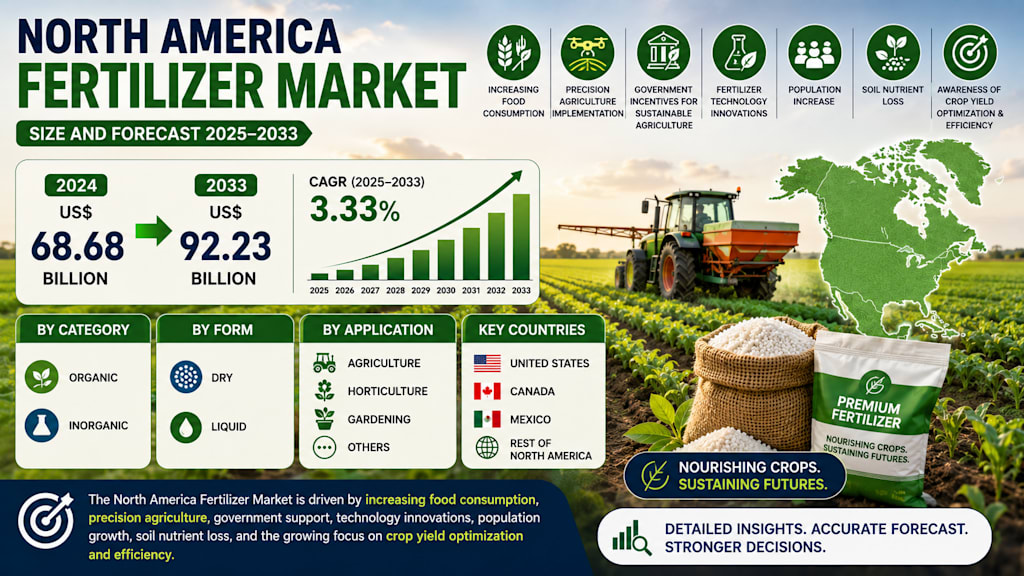
The North America fertilizer market is experiencing steady expansion as the agricultural sector increasingly focuses on improving crop productivity, soil health, and sustainable farming practices. According to Renub Research, the North America Fertilizer Market is projected to grow from US$ 68.68 billion in 2024 to US$ 92.23 billion by 2033, registering a CAGR of 3.33% from 2025 to 2033. Rising food demand, increasing implementation of precision agriculture, government support for sustainable farming, technological innovation in fertilizer production, and growing awareness regarding crop yield optimization are among the major factors supporting market growth.
Fertilizers remain one of the most important components of modern agriculture because they replenish nutrients in soil and help improve crop quality and agricultural productivity. Both organic and inorganic fertilizers are widely used across North America to support farming, horticulture, gardening, and commercial agriculture.
The market includes a wide range of products such as nitrogen, phosphate, potash, organic fertilizers, liquid fertilizers, dry fertilizers, and controlled-release nutrient solutions. These products are increasingly being integrated with advanced farming technologies to improve efficiency and sustainability throughout the agricultural sector.
Rising Food Demand Is Increasing Fertilizer Consumption Across North America
One of the biggest factors driving the North American fertilizer market is the growing demand for food caused by population growth and changing consumption patterns. Increasing food requirements in the United States, Canada, and Mexico are encouraging higher agricultural production, which directly increases fertilizer usage.
The uploaded report explains that fertilizers are essential for maintaining soil fertility and improving crop yields while supporting food security throughout the region.
Farmers are under increasing pressure to maximize productivity while maintaining long-term soil health. As agricultural land availability becomes more limited, improving crop efficiency through advanced fertilizers is becoming increasingly important.
The growing demand for grains, fruits, vegetables, biofuel crops, and commercial crops is therefore creating sustained long-term opportunities for fertilizer manufacturers throughout North America.
Precision Agriculture Technologies Are Reshaping the Industry
Precision agriculture is becoming one of the most influential trends within the North American fertilizer market. Farmers are increasingly using advanced technologies such as artificial intelligence (AI), drones, GPS-enabled equipment, Internet of Things (IoT) systems, and data-driven analytics to improve farming efficiency and reduce waste.
According to the uploaded report, AI-based solutions, IoT systems, and drones are helping optimize fertilizer application by improving precision and reducing unnecessary nutrient usage.
Precision farming technologies allow growers to apply fertilizers more accurately based on crop needs, weather conditions, and soil quality. This improves nutrient-use efficiency while reducing environmental impact and operational costs.
As farmers continue adopting digital farming tools, demand for advanced fertilizers compatible with precision application systems is expected to increase steadily during the forecast period.
The integration of technology and agriculture is also helping improve sustainability, resource management, and long-term agricultural productivity throughout the region.
Sustainability Is Becoming a Central Focus in Fertilizer Production
Sustainability has emerged as a major priority within the North American fertilizer industry. Environmental concerns, stricter regulations, and rising demand for sustainable agricultural products are encouraging both farmers and manufacturers to adopt eco-friendly fertilizer solutions.
The uploaded report highlights growing demand for organic fertilizers, slow-release fertilizers, and environmentally responsible nutrient management systems.
Controlled-release fertilizers are becoming increasingly popular because they reduce nutrient runoff and improve nutrient absorption efficiency. Organic fertilizers are also gaining traction as consumers and agricultural businesses focus more heavily on sustainable food production practices.
Global sustainability initiatives are also influencing fertilizer production strategies. The report notes that Morocco-based OCP Group announced plans in December 2022 to invest US$ 12.3 billion in renewable-energy-based fertilizer production by 2027.
Such developments reflect the broader industry shift toward cleaner fertilizer manufacturing processes and lower carbon emissions.
Technological Innovation Is Improving Fertilizer Efficiency
Technological innovation continues to transform fertilizer manufacturing and nutrient management across North America. Companies are investing heavily in advanced formulations that improve nutrient delivery, reduce waste, and enhance crop productivity.
Modern fertilizer technologies now include controlled-release nutrients, enhanced-efficiency fertilizers, bio-based nutrient solutions, and customized crop-specific formulations.
The report highlights how investments in renewable-energy-powered fertilizer production and sustainable nutrient technologies are helping improve long-term agricultural efficiency.
Fertilizer manufacturers are also focusing on improving compatibility with precision farming systems, irrigation technologies, and automated agricultural equipment.
Innovations in nutrient stabilization and soil-health enhancement are expected to play increasingly important roles as environmental regulations continue to tighten across North America.
Government Initiatives Are Supporting Domestic Fertilizer Production
Government support is another important factor contributing to market expansion. Authorities across North America are encouraging domestic fertilizer production, sustainable agriculture practices, and agricultural innovation through grants, policy incentives, and infrastructure investments.
According to the uploaded report, USDA grant programs and initiatives supporting fertilizer innovation and local manufacturing are helping strengthen regional supply chains while reducing dependence on imports.
Governments are also promoting sustainable farming practices to reduce environmental damage while maintaining agricultural productivity and food security.
Support for precision agriculture technologies, organic farming, and environmentally friendly nutrient management systems is expected to continue driving investment throughout the fertilizer industry.
Population Growth and Food Security Concerns Are Creating Long-Term Opportunities
The growing global population continues to place pressure on agricultural systems to produce more food using limited resources. This trend is creating long-term demand for fertilizers capable of improving crop productivity efficiently and sustainably.
The uploaded report highlights the May 2022 partnership between CF Industries and Mitsui & Co. to develop a blue ammonia manufacturing facility in the United States.
The project aims to reduce carbon emissions through carbon capture and sequestration technologies while supporting fertilizer production needs. Such initiatives demonstrate how the fertilizer industry is attempting to balance agricultural productivity with environmental sustainability goals.
As climate challenges and food security concerns continue increasing globally, efficient fertilizer technologies are expected to remain critical to agricultural development.
United States Fertilizer Market Continues to Expand Through Domestic Investments
The United States remains the largest fertilizer market in North America due to its extensive agricultural production and strong farming infrastructure.
According to the uploaded report, rising food demand, technological advancements, and sustainable farming practices are supporting steady fertilizer market growth in the country.
One important development highlighted in the report is Koch Fertilizer’s August 2022 investment of more than US$ 30 million to upgrade its nitrogen facility in Dodge City, Kansas.
The expansion increased urea ammonium nitrate production capacity by 35,000 tons annually to meet rising agricultural demand in western Kansas and eastern Colorado.
Such domestic investments are helping improve supply chain stability while strengthening local fertilizer manufacturing capabilities.
Canada Fertilizer Market Plays a Major Role in Global Supply
Canada remains one of the world’s largest fertilizer exporters, particularly in potash production. Saskatchewan and Alberta continue serving as key centers for fertilizer manufacturing and export activities.
The uploaded report highlights the August 2022 opening of a new fertilizer terminal blender in Minnesota by Archer-Daniels-Midland Company (ADM), aimed at improving fertilizer distribution throughout the northern U.S. Corn Belt and western Canada.
Canada’s fertilizer industry continues benefiting from advancements in precision agriculture, strong export demand, and sustainable farming innovations.
The country’s global importance within fertilizer supply chains is expected to remain strong due to increasing worldwide food production requirements.
Mexico Fertilizer Market Benefits From Agricultural Expansion
Mexico’s fertilizer market is growing steadily due to increasing agricultural activity and rising demand for crop productivity improvements.
According to the uploaded report, fertilizers play a crucial role in supporting important crops such as maize, sugarcane, and wheat.
Mexico continues relying heavily on fertilizer imports, although efforts are underway to strengthen local production capacity and reduce external dependence.
Government initiatives aimed at improving agricultural productivity and encouraging sustainable farming are expected to support continued market growth.
Volatile Raw Material Prices Continue to Create Industry Challenges
Despite positive growth trends, the North American fertilizer market continues facing major challenges related to fluctuating raw material prices.
The uploaded report explains that inputs such as ammonia, phosphate rock, potash, and natural gas are heavily affected by global supply-demand conditions, geopolitical tensions, energy prices, and trade restrictions.
Volatile raw material prices can significantly increase fertilizer production costs, making pricing less predictable for manufacturers and farmers alike.
Higher fertilizer costs may also reduce agricultural profitability and discourage optimal fertilizer application, potentially affecting crop yields and food production.
Supply Chain Disruptions Remain a Key Concern
Supply chain instability remains another major issue within the North American fertilizer industry. Port congestion, transportation delays, international trade dependencies, and geopolitical conflicts can disrupt fertilizer availability and increase price volatility.
According to the uploaded report, disruptions involving key raw materials such as potash and phosphate create challenges for farmers attempting to plan fertilizer purchases and crop production schedules.
The industry is therefore increasingly focusing on domestic production expansion and supply chain diversification to improve long-term resilience.
Recent Developments by Leading Companies
- OCP Group announced plans to invest US$ 12.3 billion in renewable-energy-powered fertilizer production by 2027.
- CF Industries and Mitsui & Co. partnered to develop a blue ammonia production facility in the United States.
- Koch Fertilizer invested over US$ 30 million to expand nitrogen production capacity in Kansas.
- Archer-Daniels-Midland Company (ADM) opened a new fertilizer terminal blender in Minnesota.
- Nutrien expanded focus on precision agriculture and sustainable crop nutrient solutions.
- Yara International strengthened low-carbon fertilizer and climate-smart agriculture initiatives.
- Mosaic Company continued investing in phosphate and potash production improvements.
- ICL Group expanded advanced specialty fertilizer and controlled-release nutrient technologies.
- BASF increased focus on sustainable agricultural input solutions and crop efficiency technologies.
- Fertilizer producers accelerated investment in organic and controlled-release fertilizer products.
Competitive Landscape Remains Highly Dynamic
The North American fertilizer market remains highly competitive with companies focusing on sustainability, production efficiency, precision agriculture integration, and supply chain optimization.
Major companies covered in the report include CF Industries Holdings Inc., ICL Group Ltd., Nutrien Ltd., Sociedad Química y Minera de Chile SA, BASF SA, The Andersons Inc., The Mosaic Company, and Yara International ASA.
Competition is increasingly centered around environmentally friendly production methods, advanced nutrient technologies, and long-term agricultural sustainability strategies.
Final Thoughts
The North America fertilizer market is evolving steadily as agriculture becomes increasingly technology-driven, sustainability-focused, and efficiency-oriented. Renub Research’s forecast of the market reaching US$ 92.23 billion by 2033 reflects the growing importance of advanced nutrient management solutions in supporting future food production needs.
As farmers continue adopting precision agriculture technologies and governments promote sustainable farming practices, demand for innovative fertilizer products is expected to remain strong. Although challenges related to raw material price volatility and supply chain disruptions continue affecting the industry, ongoing investments in cleaner production technologies and domestic manufacturing are likely to support long-term market stability and growth.
The future of the North American fertilizer industry will increasingly depend on balancing agricultural productivity, environmental sustainability, technological innovation, and food security objectives.
About the Creator
Enjoyed the story? Support the Creator.
Subscribe for free to receive all their stories in your feed.
Comments
There are no comments for this story
Be the first to respond and start the conversation.