
North America ATV & UTV Market Set to Reach US$ 16 Billion by 2033 as Recreation, Agriculture, and Electrification Drive Demand
Off-Road Mobility Enters a New Era with Smart Technology, Electric Vehicles, and Expanding Utility Applications Across North America

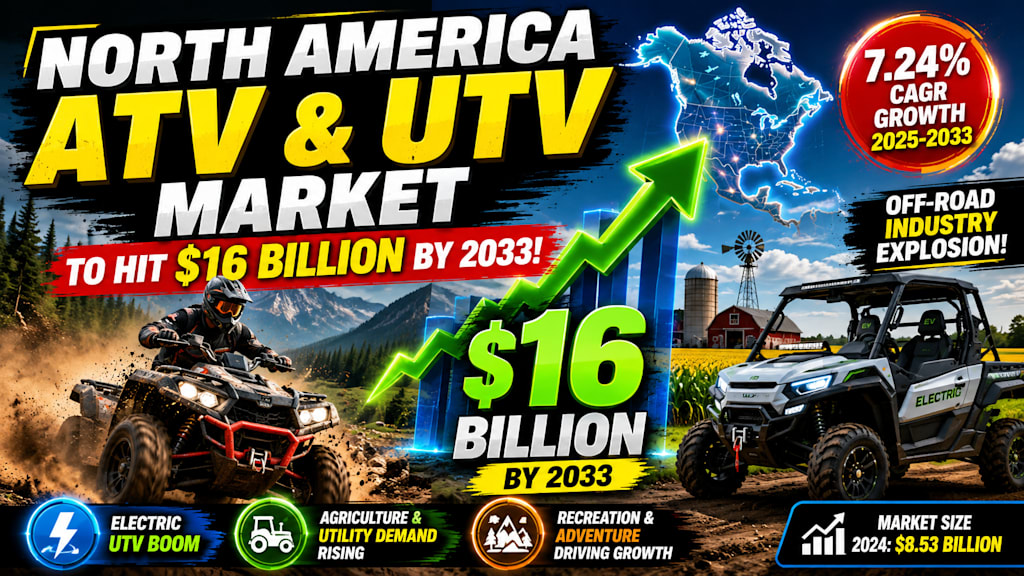
The North America ATV & UTV Market is entering a period of sustained expansion, fueled by increasing demand from recreational enthusiasts, agricultural operators, industrial users, and government agencies. According to Renub Research, the market is projected to grow from US$ 8.53 billion in 2024 to US$ 16 billion by 2033, registering a compound annual growth rate (CAGR) of 7.24% during 2025–2033.
The growing popularity of outdoor recreation, advancements in electric vehicle technology, increasing use of utility vehicles in agriculture and construction, and continuous innovation from manufacturers are creating favorable conditions for market growth. As consumers seek vehicles that combine durability, performance, and versatility, both All-Terrain Vehicles (ATVs) and Utility Terrain Vehicles (UTVs) are becoming essential tools for work and leisure alike.
Understanding the ATV and UTV Industry
ATVs and UTVs have evolved significantly over the past decade. Originally designed primarily for recreational trail riding and off-road adventures, these vehicles now serve critical roles in industries such as farming, forestry, mining, construction, emergency services, and tourism.
ATVs are generally smaller, designed for single-rider use, and excel in maneuverability across rugged terrain. UTVs, on the other hand, provide larger seating capacity, cargo space, and enhanced utility functions, making them particularly valuable for commercial and agricultural operations.
Their ability to access remote locations, transport equipment, and navigate challenging environments has made them indispensable in regions where traditional vehicles cannot operate efficiently.
Outdoor Recreation Continues to Fuel Market Expansion
One of the strongest drivers of the North American ATV and UTV market is the increasing popularity of outdoor recreation.
Consumers are spending more time participating in activities such as:
Trail riding
Hunting
Camping
Adventure tourism
Off-road racing
Wildlife exploration
The growing interest in outdoor experiences has significantly increased demand for high-performance off-road vehicles. Across the United States and Canada, investments in recreational parks, trail systems, and tourism infrastructure have expanded opportunities for ATV and UTV usage.
The economic significance of outdoor recreation is substantial. According to the U.S. Bureau of Economic Analysis, outdoor recreation contributes hundreds of billions of dollars annually to the U.S. economy. Off-road vehicle activities represent an important component of this ecosystem, supporting tourism businesses, equipment manufacturers, dealerships, and service providers.
As younger consumers increasingly prioritize experiences over material purchases, recreational vehicle demand is expected to remain strong throughout the forecast period.
Agricultural Applications Create Long-Term Demand
Agriculture remains one of the most important commercial markets for ATV and UTV manufacturers.
Farmers across North America rely on these vehicles for a wide range of operational tasks, including:
Livestock monitoring
Fence inspections
Equipment transportation
Crop surveillance
Irrigation management
Property maintenance
UTVs are especially popular because they can transport multiple workers and carry substantial cargo loads while navigating uneven terrain.
Compared to larger trucks and tractors, ATVs and UTVs offer greater fuel efficiency, lower operating costs, and improved accessibility in difficult-to-reach areas.
As labor shortages continue to challenge agricultural operations, farm owners increasingly seek equipment that improves productivity and reduces operational expenses. This trend is expected to support continued demand for utility-focused off-road vehicles.
Construction and Industrial Sectors Strengthen Market Growth
Beyond agriculture, industrial sectors are increasingly adopting ATV and UTV solutions.
Construction companies use these vehicles to transport workers, tools, and materials across large job sites. Mining operators utilize them for site inspections and logistics support. Forestry professionals rely on them to access remote areas and monitor land conditions.
Emergency response agencies and utility companies are also incorporating UTVs into their fleets. Their ability to operate during natural disasters, severe weather conditions, and in difficult terrain makes them valuable assets for public safety operations.
As infrastructure development projects continue throughout North America, demand from commercial and industrial sectors is expected to grow steadily.
Electrification is Reshaping the Industry
A major transformation underway in the ATV and UTV market is the shift toward electrification.
Manufacturers are introducing electric models designed to offer:
Reduced emissions
Lower maintenance requirements
Quieter operation
Improved energy efficiency
Enhanced environmental sustainability
Electric ATVs and UTVs are particularly attractive in recreational environments where noise reduction improves user experiences and minimizes environmental impact.
Growing government support for electric mobility is accelerating this transition. Investments in charging infrastructure and domestic electric vehicle production are encouraging manufacturers to expand their electric product portfolios.
The introduction of advanced electric platforms is expected to attract environmentally conscious consumers while opening new opportunities in commercial and government applications.
Smart Technology Becomes a Key Differentiator
Technology integration is becoming increasingly important in modern ATV and UTV design.
Today's premium models feature:
GPS navigation systems
Smartphone connectivity
Digital dashboards
Remote diagnostics
Vehicle tracking
Advanced suspension management
Driver assistance technologies
These innovations improve safety, convenience, and operational efficiency while enhancing the overall ownership experience.
Manufacturers are also incorporating predictive maintenance systems that help users identify mechanical issues before they become costly repairs. Such features are especially valuable for commercial operators who depend on vehicle uptime.
As connectivity becomes a standard expectation among consumers, smart technology will continue to influence purchasing decisions.
Safety Concerns Remain a Market Challenge
Despite strong growth prospects, safety remains a significant challenge for the ATV and UTV industry.
Accidents involving rollovers, excessive speeds, and improper vehicle usage continue to attract regulatory attention. Governments and safety organizations have responded by implementing stricter standards related to:
Vehicle design
Passenger protection
Helmet requirements
Age restrictions
Safety training programs
Manufacturers must invest heavily in research and development to meet evolving safety expectations while maintaining vehicle performance.
Modern vehicles increasingly include roll cages, seat belts, stability control systems, and enhanced braking technologies to improve occupant protection.
While these improvements enhance safety, they can also increase production costs and vehicle prices.
High Ownership Costs Can Limit Adoption
Cost remains another important challenge for the market.
Premium ATV and UTV models often require significant upfront investment. In addition to purchase prices, owners must consider:
Maintenance expenses
Fuel costs
Insurance premiums
Accessories and upgrades
Repair services
Electric vehicles may reduce long-term operating costs, but their initial purchase prices often remain higher than traditional gasoline-powered alternatives.
Limited dealer networks and service infrastructure in certain rural areas can further affect accessibility and ownership convenience.
Manufacturers are responding by introducing financing options and expanding dealer networks to improve market penetration.
United States Leads the Regional Market
The United States remains the dominant force within the North American ATV and UTV industry.
Several factors contribute to its leadership position:
Extensive off-road trail networks
Strong recreational culture
Large agricultural sector
Advanced dealership infrastructure
High consumer purchasing power
The country also serves as a hub for product innovation and manufacturing investment. Major companies frequently launch new models in the U.S. market before expanding into neighboring regions.
Growing adoption across farming, construction, emergency response, and tourism sectors ensures a diversified customer base that supports long-term market stability.
Canada Shows Strong Growth Potential
Canada represents one of the most attractive ATV and UTV markets in North America.
The country's vast rural landscapes and outdoor recreation culture create favorable conditions for vehicle adoption. Canadians frequently use ATVs and UTVs for:
Hunting
Trail riding
Forestry operations
Agricultural activities
Tourism experiences
Cold-weather durability and multi-terrain capability are particularly important purchasing factors.
Interest in electric off-road vehicles is also increasing as environmental sustainability becomes a greater priority among consumers and policymakers.
Government support for infrastructure development and trail expansion is expected to further strengthen market demand.
Mexico Emerges as a Fast-Growing Opportunity
Mexico is becoming an increasingly important market for ATV and UTV manufacturers.
Agriculture remains a major growth driver, particularly in rural regions where these vehicles provide affordable transportation and operational support.
At the same time, adventure tourism is expanding rapidly. ATV excursions through deserts, forests, mountains, and coastal destinations are attracting domestic and international visitors.
Manufacturers are tailoring products to meet local requirements by offering durable and cost-effective models capable of handling demanding operating conditions.
As rural development initiatives continue and tourism investment increases, Mexico is expected to contribute significantly to regional market growth.
Competitive Landscape Intensifies
Competition within the North American ATV and UTV market remains intense.
Leading manufacturers continue to invest heavily in:
Product innovation
Electrification
Safety technologies
Dealer expansion
Customer experience improvements
Key market participants include:
American Honda Motor Co., Inc.
Yamaha Motor Co., Ltd.
Arctic Cat Inc.
Polaris Industries Inc.
BRP Inc.
Suzuki Motor of America Inc.
Kawasaki Heavy Industries Ltd.
Daymak Inc.
Kubota Corporation
Deere & Company
10 Recent Industry Developments
1. Polaris Expands Electric Off-Road Portfolio
Polaris continues expanding its electric powersports lineup through strategic investments in battery technology and sustainable vehicle development.
2. Honda Enhances Rider Safety Technologies
Honda has introduced advanced rider-assistance features and improved stability systems across several off-road vehicle platforms.
3. BRP Advances Electric Vehicle Strategy
BRP has accelerated development of electric recreational vehicles as part of its long-term sustainability roadmap.
4. Yamaha Introduces Connectivity Features
Yamaha continues integrating digital dashboards, smartphone connectivity, and intelligent monitoring systems into premium models.
5. Kawasaki Expands Utility Vehicle Lineup
Kawasaki has strengthened its commercial UTV offerings targeting agricultural and industrial customers.
6. Kubota Focuses on Agricultural Mobility Solutions
Kubota has introduced utility-focused models designed specifically for farming operations and property management applications.
7. Deere & Company Increases Smart Fleet Integration
John Deere continues integrating connected technologies and data-driven fleet management capabilities into utility vehicle operations.
8. Daymak Strengthens Electric Vehicle Development
Daymak is expanding electric mobility offerings aimed at environmentally conscious recreational and commercial users.
9. Arctic Cat Enhances Performance Platforms
Arctic Cat continues upgrading suspension systems and performance capabilities to improve off-road handling and rider comfort.
10. Industry-Wide Investment in Electrification
Leading manufacturers across North America are investing heavily in battery systems, charging technologies, and hybrid powertrain development to meet future consumer demand.
Final Thoughts
The North America ATV & UTV Market is entering a transformative decade characterized by technological innovation, electrification, and expanding utility applications. With the market forecast to grow from US$ 8.53 billion in 2024 to US$ 16 billion by 2033, opportunities are emerging across recreation, agriculture, construction, forestry, and tourism.
Electric powertrains, connected vehicle technologies, enhanced safety systems, and increasing consumer interest in outdoor experiences are reshaping the competitive landscape. While challenges related to safety regulations, ownership costs, and infrastructure remain, manufacturers continue to innovate and adapt to changing market demands.
As North America embraces smarter and more sustainable mobility solutions, ATVs and UTVs are expected to play an increasingly important role in both work and recreation, positioning the industry for strong long-term growth through 2033.
About the Creator
Enjoyed the story? Support the Creator.
Subscribe for free to receive all their stories in your feed.
Comments
There are no comments for this story
Be the first to respond and start the conversation.