
No, the Quants Didn't Steal Your Trade
8 Brutal Truths About Order Matching, Price Collars, and the Physics of the A‑Share Exchange
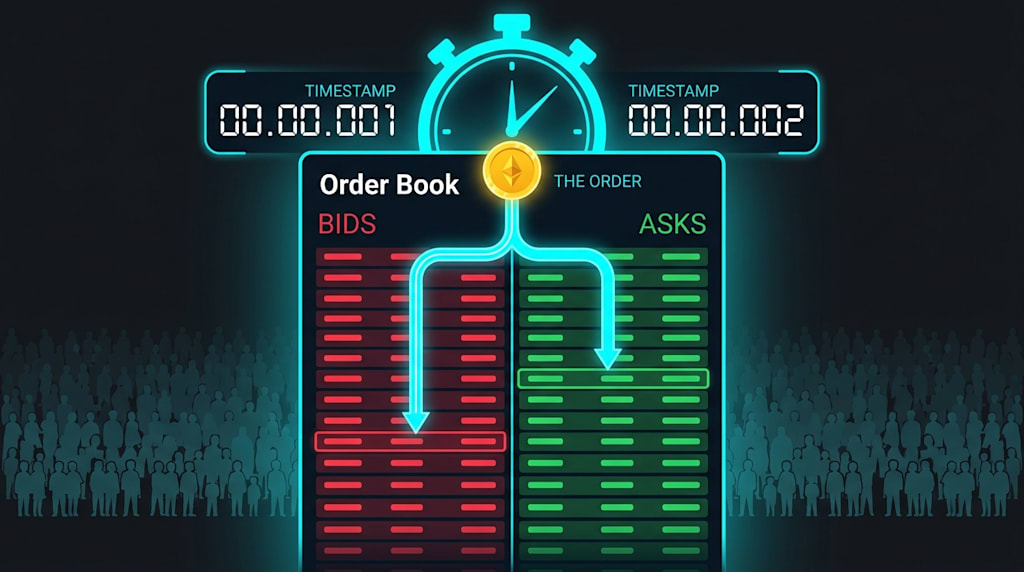
Opening: One Question
During continuous trading on the A‑share market, a stock has no resting orders—bid and ask are both zero.
The exchange "simultaneously" receives two orders:
A buy order for 100 shares, limit ¥10.00
A sell order for 100 shares, limit ¥9.00
The stock closed at ¥9.60 yesterday. The most recent trade today was at ¥9.30.
What is the traded price after these two orders are matched?
Did a number come to mind?
¥10.00? ¥9.00? ¥9.50? ¥9.60? ¥9.30?
I've asked this to quant interns, new brokerage staff, and retail investors with three-plus years of experience.
Over ten years, almost no one got it right on the first try.
The correct answer is not a price.
During continuous trading, it is physically impossible for two orders to arrive at the exchange at the same time.
The order that arrives first sets the price. The one that arrives later accepts it.
One simple fact. And it keeps most people outside the rules of the game.
Why This Matters
There are over 200 million A‑share accounts in China.
This is not a niche market for a few hundred quant funds. It is a mass‑participation wealth activity. For a market with 200 million participants, the basic matching rules should be common knowledge.
They are not.
Most participants build their understanding on fantasy. When they lose money, they blame market makers, quants, or the exchange for "rigging" the system. They never blame themselves for not knowing how orders queue, how prices form, or how market data flows.
The eight rules below are shameful not to know if you work in the industry. If you don't, you should still learn them. They won't guarantee you profits. They will let you lose with your eyes open.
Rule №1: There Is No "Simultaneous"—Only "Who Arrives First"
The exchange's matching engine is a single‑lane road.
Every order entering the system gets a nanosecond‑level timestamp. Even two orders one microsecond apart get sequenced.
Back to the opening question.
If the buy order arrives first—with an empty book, the ¥10.00 buy order becomes the new best bid. Then the ¥9.00 sell order arrives. It sees the best bid at ¥10.00 and trades at ¥10.00.
If the sell order arrives first—the ¥9.00 sell order becomes the new best ask. Then the ¥10.00 buy order arrives. It sees the best ask at ¥9.00 and trades at ¥9.00.
There is no ¥9.50 "middle price." No averaging algorithm. The market only recognises physical time order.
Your brain needs to think at the engine's speed, not your screen's refresh rate.
Rule №2: Want to Change Your Price? Cancel and Queue Again
Many retail investors believe: "I placed an order. I want to adjust the price. Can I just modify it in place? It's my order—the exchange can give me some leeway, right?"
No.
A‑share exchanges do not offer priority‑preserving order modification. Your order has two fates: executed, or cancelled.
After cancellation, your order disappears from the book. If you re‑enter at a new price, it is a brand‑new order. It queues behind every order already resting.
No cutting. No VIP lane. No "I only changed the price, not the quantity, so I should keep my priority."
You cancel. You give up your spot. Re‑enter. Start from scratch.
Rule №3: The Exchange Doesn't Sell "Advanced Features"
Open your trading app. Do you see conditional orders? Stop‑loss/take‑profit orders? Iceberg orders? TWAP/VWAP algorithms?
Yes.
But these are simulated by your broker's front‑end software. The exchange does not provide them.
A‑share exchanges recognise only two basic order types: limit orders and market orders. There is no official "auto‑order," "strategy order," or "iceberg order" from the exchange. The Shenzhen Exchange once briefly supported a temporary price‑collar order storage mechanism. That was scrapped.
Every conditional order you place is your broker's system watching the market for you. When your condition is met, it sends a new limit or market order to the exchange on your behalf.
And that new order, when it hits the exchange, queues from scratch.
Iceberg orders are the same—your broker splits them into small pieces. Each piece, when it arrives at the exchange, is an independent, brand‑new order that needs to queue. Nobody trades silently underwater without being seen.
Rule №4: Don't Spam Odd‑Lot Orders—Regulators Will Notice
Technically, the A‑share system accepts orders of one share.
But the rules have a hard requirement: when selling, any remaining balance of less than 100 shares (or 200 on the STAR Market) must be sold in a single order.
You cannot fire off 100 separate one‑share orders to manipulate the tape, annoy the book, or test the system.
Someone tried this before. The exchange didn't just reject the orders. They stepped in with inquiries and regulatory action.
You think you're exploiting a loophole. The regulator thinks you're crossing a line.
Rule №5: Market Orders Punch Through the Price Collar
During continuous trading, there is a price collar—orders cannot be placed too far from the current reference price, typically ±2%.
But market orders can break through it. A market order's job is to execute as fast as possible, and the rules let it bypass the collar.
The Shanghai Exchange adds one more layer: market orders must carry a protective limit price—the maximum buy or minimum sell price you are willing to accept. This protective limit itself is not constrained by the price collar.
This is how quantitative firms sweep the book or dump shares during sharp moves. They don't place a limit order two cents above the best bid. They use market orders with protective limits and floor the accelerator.
Not a violation. Legal firepower.
Rule №6: The "Golden Channel" for Limit‑Up Grabs Is Dead
A few years ago, renting a seat closest to the exchange's data centre improved your odds of grabbing a one‑day limit‑up stock at the open.
Not anymore.
The exchange's back‑end tracks each channel's win rate for grabbing limit‑ups. If a channel's success rate is abnormally high, the system flattens its priority.
You cannot hold a single "golden channel" and win every time.
Unless you collude internally—which is a major violation of law. By channel alone, the myth is dead.
Note: "grabbing limit‑ups" here means the instantaneous grab at the opening auction. Not the casual chase when you see the price approaching the limit during the session and try to jump in before it locks. You cannot define a "success rate" for the latter. Only the former can be defined—and that has already been neutralised.
Rule №7: No Off‑Exchange Dark Pool—All Trades Are Public
Some imagine a dark pool where quants do huge trades that retail investors never see—no disclosure, no price display.
A‑shares have no such thing.
All trades are either centralised auction trades or block trades. Block trades are fully disclosed after the close—who bought, who sold, at what price, for what quantity.
If you see a block trade at a significantly abnormal price, it almost certainly triggers an exchange inquiry. Nobody executes a massive trade in A‑shares without leaving a trace.
Rule №8: Quants Do Not Peek at Your Cards
This is the most stubborn conspiracy theory in A‑shares:
"Quant funds intercept my order before it reaches the exchange, peek at it, and jump ahead of me!"
It does not exist.
Here is how market data is generated:
Orders arrive at the exchange's matching engine → the engine matches them → trade data is generated → it is disseminated to all data vendors.
Quants can only see order information that the exchange has already disseminated. They cannot see any order still in transit.
So how do they race ahead?
Through prediction.
Using tick‑by‑tick order data, order‑flow velocity, and order‑book imbalance, quantitative models predict, at a probabilistic level, what the retail crowd will do next. They anticipate you are about to buy, so they raise the ask price a fraction ahead and sell to you. Statistical arbitrage based on public data. Not clairvoyance.
As for "brokers collecting retail orders and secretly feeding them to quants"—that would be a major violation of law, punishable by a decade or more in prison. The broker's ultra‑low‑latency desk and the retail client system are physically separated by design. They cannot, and would not dare, build such a backdoor.
Closing: Clearer Understanding, Fewer Mistakes
These eight rules do not teach you how to pick stocks, read candlesticks, or time the top and bottom.
They form the fundamental physics of your survival in A‑shares.
You can live without understanding relativity. Without understanding gravity, you will fall hard.
The next time your trade executes at an unexpected price, don't ask "but my order arrived first." Check the timestamp. The next time the book gets crushed, don't curse "the quants front‑ran me." Think about market orders piercing the price collar.
A market with 200 million participants has only one fair baseline: the rules.
You don't have to like them. You do have to know them.
About the Creator
Jin
Writer of reamstories
https://reamstories.com/jin
Enjoyed the story? Support the Creator.
Subscribe for free to receive all their stories in your feed. You could also become a paid subscriber, letting them know you appreciate their work.
Comments
There are no comments for this story
Be the first to respond and start the conversation.