
Next Generation Sequencing Market Is Transforming the Future of Precision Medicine
Faster sequencing technologies, AI-powered genomics, and expanding clinical applications are accelerating the global adoption of next-generation sequencing.

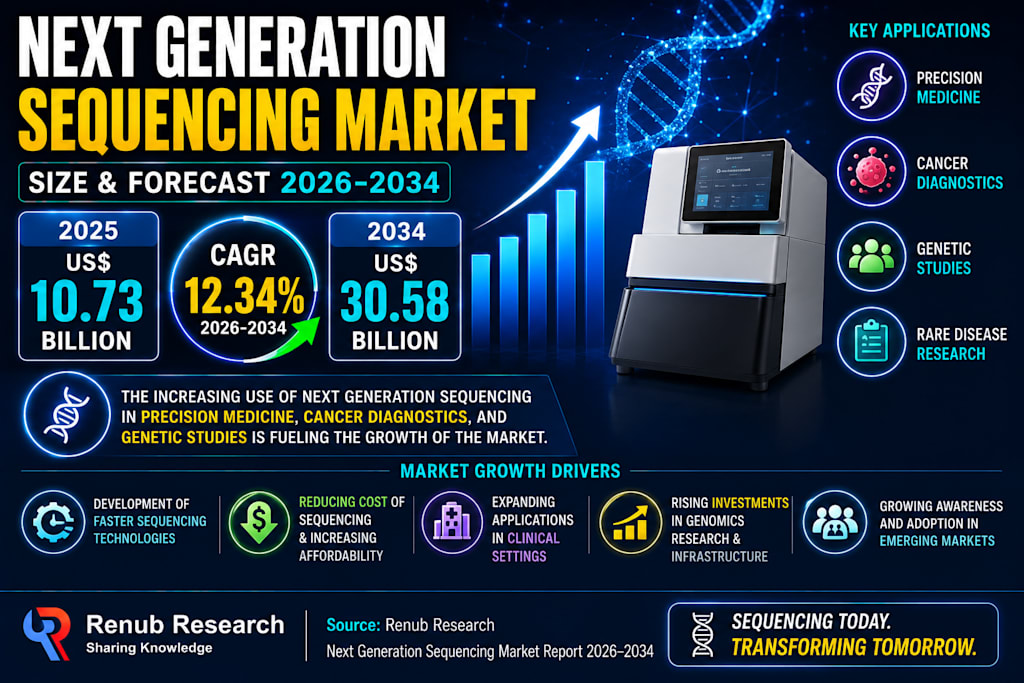
The global healthcare and biotechnology industries are entering a new era where diseases can be understood and treated at the genetic level. At the center of this transformation is Next Generation Sequencing (NGS), a revolutionary technology that is changing how scientists study DNA, diagnose diseases, develop medicines, and personalize healthcare treatments.
According to Renub Research, the Next Generation Sequencing Market is projected to grow from US$ 10.73 billion in 2025 to US$ 30.58 billion by 2034, expanding at a CAGR of 12.34% from 2026 to 2034. The market’s rapid growth is being driven by increasing adoption of precision medicine, rising use of genomics in cancer diagnostics, declining sequencing costs, and expanding applications across healthcare and life sciences.
NGS is no longer limited to advanced research laboratories. It is increasingly becoming a critical part of modern diagnostics, drug development, infectious disease monitoring, and personalized healthcare worldwide.
NGS is revolutionizing genetic analysis
Next Generation Sequencing is an advanced DNA sequencing technology that enables rapid and highly accurate analysis of genetic material. Unlike traditional sequencing methods, NGS can analyze millions of DNA fragments simultaneously, making it possible to sequence entire genomes, exomes, or targeted gene regions efficiently.
This capability has transformed genomics research by dramatically increasing sequencing speed while lowering costs and improving scalability.
NGS is widely used in cancer research, inherited disease diagnosis, infectious disease surveillance, precision medicine, drug development, agriculture, and evolutionary biology. It helps researchers identify genetic mutations, understand disease mechanisms, and develop targeted therapies tailored to individual patients.
The technology is also helping scientists better understand genetic diversity and improve crop development in agricultural biotechnology applications.
As sequencing technologies continue improving, NGS is becoming one of the most influential tools in modern biological and medical science.
Precision medicine is driving enormous demand
One of the strongest growth drivers for the NGS market is the rapid rise of precision medicine and personalized healthcare. Modern healthcare is increasingly shifting away from generalized treatment approaches toward therapies tailored to an individual’s genetic profile.
NGS allows clinicians to identify genetic mutations associated with diseases such as cancer, cardiovascular disorders, and inherited conditions. This helps physicians select targeted therapies that improve treatment effectiveness while reducing side effects.
The growing global burden of chronic diseases and genetic disorders is increasing demand for accurate early diagnosis, further accelerating adoption of sequencing technologies.
Pharmaceutical companies are also heavily relying on NGS for companion diagnostics, biomarker discovery, and personalized drug development.
The report highlights a major collaboration announced in April 2025 between Illumina and Tempus AI aimed at accelerating clinical adoption of NGS tests through AI-powered evidence generation and multimodal data integration.
This collaboration reflects the growing convergence between artificial intelligence and genomics in the future of healthcare.
Declining sequencing costs are expanding accessibility
One of the most important reasons for the rapid expansion of the NGS market is the continuous decline in sequencing costs. Early-generation sequencing technologies were extremely expensive and largely restricted to specialized research institutions.
Modern NGS platforms are significantly faster, more accurate, and capable of processing multiple samples simultaneously, making sequencing more practical for hospitals, research laboratories, and diagnostic centers.
Advancements in automation, bioinformatics software, sequencing chemistry, and computational analysis have improved efficiency while lowering operational expenses.
Portable and compact sequencing analyzers are also making genomic testing more accessible in resource-limited environments. As costs continue decreasing, industries beyond healthcare — including agriculture, pharmaceuticals, and biotechnology — are increasingly adopting NGS technologies.
The report notes that Roche introduced its breakthrough Sequencing by Expansion (SBX) technology in February 2025, combining ultra-fast sequencing chemistry with scalable sensor technology to support high-throughput genomic applications.
These advancements are helping move sequencing from specialized environments into mainstream healthcare systems.
Oncology and infectious disease diagnostics are accelerating adoption
NGS has become one of the most important technologies in cancer diagnostics and infectious disease monitoring. In oncology, sequencing enables identification of tumor-specific genetic mutations, helping clinicians diagnose cancers earlier and select personalized treatment strategies.
NGS also supports liquid biopsy technologies, allowing doctors to monitor cancer progression and treatment response through minimally invasive blood testing.
In infectious disease diagnostics, NGS can rapidly identify viruses, bacteria, and emerging pathogens. This capability became especially important during the COVID-19 pandemic, where genomic sequencing played a critical role in tracking viral mutations and monitoring variants.
The technology is also increasingly used for antimicrobial resistance monitoring and outbreak surveillance.
The report highlights MedGenome’s launch of MetaSeq in February 2026, a blood-based test designed to rapidly detect bloodstream infections using advanced genomics technologies.
As infectious disease monitoring becomes more important globally, NGS is expected to play an even larger role in public health systems.
High infrastructure costs remain a challenge
Despite falling sequencing costs, establishing NGS infrastructure still requires significant investment. Advanced sequencing instruments, laboratory equipment, specialized software, and data storage systems remain expensive for many healthcare institutions.
NGS laboratories also require specialized environments, highly trained staff, quality control systems, and ongoing equipment maintenance.
Developing countries often face major challenges in adopting sequencing technologies because of financial limitations and underdeveloped healthcare infrastructure.
Training personnel and implementing regulatory standards add further complexity and cost to large-scale adoption.
These barriers continue slowing NGS penetration in resource-constrained healthcare environments.
Genomic data analysis remains highly complex
One of the biggest operational challenges in the NGS industry is managing and interpreting massive volumes of genomic data. Sequencing platforms generate enormous datasets that require sophisticated bioinformatics tools and highly specialized expertise for accurate analysis.
Many hospitals and laboratories still face shortages of bioinformaticians, genomics experts, and computational biologists capable of handling advanced genomic workflows.
Inaccurate data interpretation can lead to incorrect diagnoses or ineffective treatment decisions, making analytical precision critically important.
Data privacy and security are also major concerns because genomic information is highly sensitive and requires robust protection systems.
The shortage of skilled professionals remains one of the biggest obstacles to widespread NGS adoption, especially in emerging markets.
NGS services are becoming increasingly important
The NGS services market is growing rapidly as healthcare institutions, pharmaceutical companies, and research organizations increasingly outsource sequencing operations to specialized providers.
Many organizations prefer outsourcing because it eliminates the need for costly equipment purchases and specialized staffing requirements.
NGS service providers offer a wide range of sequencing services, including whole genome sequencing, exome sequencing, RNA sequencing, and targeted sequencing. They also provide advanced data interpretation and bioinformatics analysis.
As genomics applications expand across healthcare, agriculture, and biotechnology, demand for professional sequencing services is expected to rise steadily.
Diagnostics are becoming a major growth segment
NGS diagnostics are becoming increasingly important because they offer fast, precise, and highly comprehensive genetic analysis. Hospitals and diagnostic laboratories are rapidly adopting sequencing-based tests for cancer detection, inherited diseases, infectious diseases, and rare genetic disorders.
Precision medicine initiatives are further accelerating adoption because sequencing-based diagnostics support personalized treatment strategies.
Advancements in sequencing technologies have also reduced turnaround times, making NGS more practical for routine clinical use.
Growing awareness about preventive healthcare and early disease detection is expected to continue driving rapid growth within the diagnostics segment globally.
Sequencing by synthesis remains highly dominant
Sequencing by Synthesis (SBS) continues to be one of the most widely used NGS technologies due to its high accuracy, scalability, and efficiency.
SBS technology detects nucleotides as they are incorporated into DNA strands, allowing highly precise sequencing. It is widely used in whole genome sequencing, transcriptome analysis, targeted sequencing, and clinical diagnostics.
Continuous improvements in chemistry, automation, and sequencing software are further strengthening the dominance of SBS platforms in the global NGS market.
Hospitals and clinics are increasing adoption
Hospitals and clinics are becoming one of the fastest-growing end-user segments in the NGS market. Healthcare providers are increasingly using sequencing technologies for cancer diagnostics, inherited disease screening, prenatal testing, and infectious disease detection.
NGS is helping hospitals improve diagnostic accuracy while reducing dependence on multiple traditional laboratory tests.
Governments and healthcare systems worldwide are also investing heavily in genomic medicine initiatives, supporting broader adoption of sequencing technologies within clinical settings.
As personalized medicine continues expanding, hospitals are expected to integrate NGS more deeply into routine patient care workflows.
The United States remains the global leader
The United States continues leading the global NGS market due to its advanced biotechnology sector, strong research infrastructure, and early adoption of precision medicine.
Major pharmaceutical companies, research institutions, and healthcare systems heavily rely on NGS for drug development, diagnostics, and genomics research.
Government support for genomic medicine programs and strong healthcare investment continue accelerating innovation throughout the country.
The report notes Roche’s February 2025 launch of its SBX sequencing platform in the United States, designed to improve sequencing scalability and signal clarity for clinical and research applications.
The United Kingdom is integrating genomics into public healthcare
The United Kingdom’s NGS market is expanding steadily due to strong government support and integration of genomics into the National Health Service (NHS).
National genomic programs are helping improve cancer diagnosis, rare disease detection, and prenatal testing capabilities.
Collaborations between academic institutions, biotech firms, and healthcare providers continue driving innovation in sequencing applications.
In May 2024, Azenta launched a new genomics laboratory in Oxford to expand NGS services and strengthen genomics research capabilities within the UK market.
India is emerging as a fast-growing market
India’s NGS market is growing rapidly due to improving healthcare infrastructure, rising awareness about genetic testing, and increasing demand for advanced diagnostics.
The country’s growing biotechnology and pharmaceutical sectors are increasingly adopting sequencing technologies for research and precision medicine applications.
Government genomic initiatives are also helping improve accessibility and encourage investment in genomic medicine.
The report highlights a January 2025 initiative launched by the Government of India in collaboration with Tata Memorial Hospital to develop Indian genomic datasets and research portals supporting global genomic research efforts.
Saudi Arabia is expanding genomic medicine investments
Saudi Arabia’s NGS market is expanding through large-scale healthcare modernization programs and increased investment in advanced medical technologies.
The country is increasingly using sequencing technologies for cancer diagnostics, inherited disease detection, and infectious disease monitoring.
Partnerships with international technology companies and research institutions are helping strengthen Saudi Arabia’s genomic research capabilities.
In June 2023, Thermo Fisher Scientific launched its Ion Torrent Genexus Dx Integrated Sequencer in Saudi Arabia to support affordable and rapid NGS testing in clinical laboratories.
Competition among major companies is intensifying
The global NGS market includes several major biotechnology and diagnostics companies competing across sequencing instruments, reagents, software, and genomic services. Key companies highlighted in the report include Illumina, Thermo Fisher Scientific, Pacific Biosciences, QIAGEN, Roche, Bio-Rad Laboratories, Takara Bio, Hamilton Company, Geneious, and BioMérieux.
Competition is expected to intensify further as sequencing technologies become faster, cheaper, and more integrated into clinical medicine.
Final thoughts
The Next Generation Sequencing market is becoming one of the most transformative sectors in global healthcare and biotechnology. According to Renub Research, the market’s projected growth from US$ 10.73 billion in 2025 to US$ 30.58 billion by 2034 reflects the enormous global demand for precision medicine, advanced diagnostics, and genomic innovation.
NGS is reshaping how diseases are diagnosed, monitored, and treated by enabling highly personalized healthcare strategies based on genetic information.
While infrastructure costs, data complexity, and talent shortages remain important challenges, continuous advancements in sequencing technologies, AI integration, and bioinformatics are expected to make genomic medicine more accessible and impactful in the years ahead.
About the Creator
Enjoyed the story? Support the Creator.
Subscribe for free to receive all their stories in your feed.
Comments
There are no comments for this story
Be the first to respond and start the conversation.