
Netherlands Shrimp Market 2026: Sustainability Push, Premium Processing & Strategic Supply Shifts
How responsible sourcing requirements, rising value added product demand and global trade dynamics are reshaping the Dutch shrimp sector

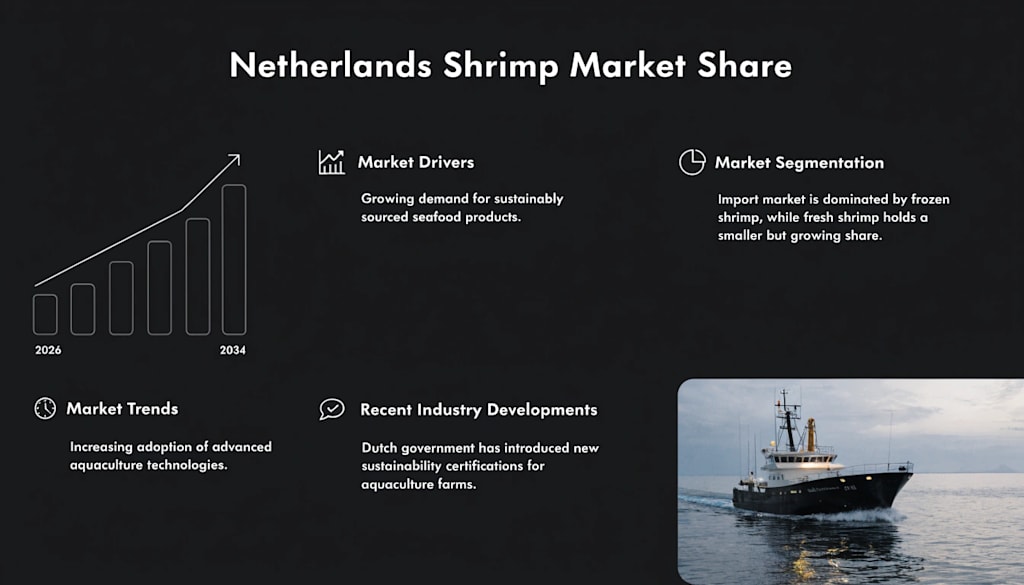
The Netherlands shrimp market is evolving steadily as retailers, foodservice operators and industrial buyers increasingly demand responsibly sourced, high value shrimp products that meet stringent environmental and labour standards. Shrimp — encompassing wild caught cold water shrimp (Pandalus borealis/Crangon crangon), farmed warm water varieties (Penaeus vannamei), as well as processed and value added forms — is deployed across supermarket frozen aisles, hospitality menus and packaged ready to eat meals to serve a broad range of consumers seeking convenience, premium quality and certified sustainability. According to IMARC Group, the market size reached USD 755.13 Million in 2025 and is projected to reach USD 1,069.21 Million by 2034, exhibiting a compound annual growth rate (CAGR) of 3.94% during 2026–2034. As European buyers enforce tighter due diligence and the Dutch processing sector invests in advanced, low emission production, shrimp has moved beyond a simple commodity to a strategic category where sustainability credentials, convenience and reliable supply chains determine market success.
What's Driving Market Growth?
Stricter Demand for Responsible Sourcing and Traceability. The push for responsibly sourced seafood is a fundamental driver shaping the Netherlands shrimp market. Buyers across retail and hospitality segments now demand clear documentation of practices that protect marine life and ensure fair working conditions. Local processors and retailers have responded by improving hatchery setups, adopting enclosed farming systems, and prominently communicating product origin to build consumer trust. Many farms are moving away from heavy antibiotic use to attract eco aware buyers, and smaller operators are pooling resources to share the costs of modern gear and certification. This move toward greener production and transparent labelling is gradually strengthening local supply and boosting Dutch shrimp exports within the European marketplace.
Convenience Driven Demand for Value Added and Ready to Use Products. Changing consumer lifestyles are accelerating the shift from basic frozen shrimp packs to seasoned portions, quick cook mixes, snack sized options and fully prepared meals. Larger processing plants now deploy advanced equipment to clean, sort and pack shrimp with minimal manual intervention. Many firms have forged close working relationships with major retail brands to supply store label packs that highlight Dutch sourcing, while premium tie ins with chefs and targeted promotions help expand sales in both domestic and export markets. Simultaneously, packaging is evolving to include more recyclable and reusable materials in alignment with EU waste reduction targets, and some firms are testing smart packaging solutions that extend shelf life.
Import and Price Dynamics Shifting Market Economics. Shrimp imports into the Netherlands reflect a price driven market. For the 12 month period ending August 2025, imports of frozen smoked or cooked shrimp reached US434.34 million**, with a **year on year value growth of 8.25%** while volumes remained largely flat (+0.24%)[reference:9][reference:10]. The average proxy price rose **7.99% to US8,211.51 per tonne during the same period. Notably, Ecuador overtook Venezuela as the top supplier to the Dutch market in 2025, with Ecuadorian shipments growing 35% while Venezuelan volumes declined by nearly 28% year on year. Morocco also emerged as a high growth alternative, with its imports skyrocketing 359% in value and 329% in volume over the same period. For the cold water shrimp segment specifically, import volumes grew at a more modest 2.98% over the same 12 month window.
Growing Market for Organic and High Welfare Products. The organic shrimp segment continues to show exceptional growth, with a compound annual growth rate of 26.23% from 2020 2024 despite a modest slowdown from 2023 to 2024. Market concentration has risen, with the Herfindahl Hirschman Index (HHI) increasing significantly between 2023 and 2024, indicating a trend towards consolidation among suppliers. In September 2024, Albert Heijn launched the Netherlands' first farmed shrimp with higher welfare standards and a reduced marine footprint, setting a new benchmark for responsible seafood sourcing in the domestic market. The success of premium organic products underscores the shifting preferences of Dutch consumers, who increasingly view certified sustainability as a baseline requirement rather than a differentiator.
Market Segmentation & Key Insights
By environment, the market divides into farmed shrimp and wild shrimp. While wild caught varieties from the North Sea and Wadden Sea remain culturally important and command premium prices, farmed shrimp—particularly imported tropical species—account for the majority of volume and value in the consumer segment.
By species, the market includes Penaeus Vannamei (whiteleg shrimp), Penaeus Monodon (giant tiger prawn), Macrobrachium Rosenbergii (giant freshwater prawn) and other varieties. Penaeus Vannamei dominates due to its efficient farming characteristics and broad consumer acceptance.
By shrimp size, grading categories span size grades from <21 to >70 count per kilogram, with medium grades (31 40 and 41 50) representing the highest retail sales volume.
By distribution channel, key routes include hypermarkets and supermarkets, convenience stores, hotels and restaurants, online sales and other channels. Supermarkets lead the consumer segment, while hotels and restaurants drive demand for processed and value added shrimp.
By province, major markets include Noord Holland, Zuid Holland, Noord Brabant, Gelderland, Utrecht, and others. The Randstad region (Amsterdam, Rotterdam, The Hague and Utrecht) accounts for the largest share of consumption and processing activity.
What the Opportunities Are?
Precision Data and AI Driven Farming Technologies. The introduction of AI powered applications such as Kampi, unveiled at the Global Shrimp Forum in Utrecht in August 2024, signals a new era of shrimp farm management. Real time data capture, dynamic precision feeding and predictive health monitoring allow farmers to optimise resource use, reduce mortality and lower environmental impact. Suppliers and processors who integrate advanced analytics into their supply chains can offer downstream buyers verifiable data on sustainability metrics, including water consumption, carbon footprint and feed conversion ratios—essential information for meeting Europe's increasingly strict green claims directive.
Responsible Sourcing Certification and Supply Chain Differentiation. Despite growing demand for certified products, significant gaps remain. Only about one third of global shrimp stocks are currently part of a Marine Stewardship Council (MSC) assessment or certified fishery improvement project. For the Dutch market, where retailers require clear proof of responsible practices, companies that secure robust certifications (ASC, MSC, GlobalG.A.P., organic) can command premium pricing and long term supply contracts. Smaller certification schemes and emerging technologies such as blockchain based traceability provide additional tools for suppliers to differentiate their products in a crowded marketplace.
Value Added Processing and Convenience Innovation. The growing appetite for ready to cook and ready to eat shrimp products—including seasoned portions, marinated skewers, coated or breaded items and snack packs—presents a significant opportunity for domestic processors. Manufacturers investing in advanced freezing technologies (such as individually quick frozen (IQF) systems), automated packaging lines and clean label ingredient formulations can capture a growing share of the convenience sector. Smart packaging that extends shelf life and reduces food waste further appeals to both retailers and environmentally conscious consumers.
Diversification of International Supply Sources. The shifting supplier landscape—with rapid growth from Ecuador and Morocco alongside the steep declines from traditional players like Venezuela—creates openings for importers to build more resilient and cost competitive supply chains. Companies that actively source from multiple regions, negotiate long term offtake agreements and invest in supply chain visibility will be better positioned to manage price volatility and potential trade disruptions. Morocco, in particular, offers high quality supply with impressive growth momentum, albeit at a premium price point currently above the market average.
RAS and Domestic Aquaculture Expansion. Although the Netherlands shrimp fleet is undergoing a government backed buyout and reduction in wild catching capacity, there is growing interest in recirculating aquaculture systems (RAS) as a sustainable, climate controlled method for producing shrimp locally. Dutch Vannamei B.V. and other innovative farmers are actively developing land based, lower environmental footprint production methods. Investors and technology providers focused on RAS design, biofloc systems, alternative feed formulations (including insect meal and algae) and waste valorisation can support the establishment of a premium domestically farmed shrimp segment that commands higher retail prices.
Recent News and Developments in Netherlands Shrimp Market
September 2024: Albert Heijn launched the Netherlands' first farmed shrimp with higher welfare standards and a reduced marine footprint. The product developed through years of supply chain collaboration strengthened sustainable practices in the Dutch shrimp market and set a new benchmark for responsible seafood sourcing.
August 2024: The AI powered app Kampi was introduced at the Global Shrimp Forum in Utrecht, Netherlands. Developed by Canadian and Ecuadorian experts, it improves shrimp farm management through dynamic precision farming, boosting efficiency, sustainability and real time decision making across the global shrimp sector.
September 2025: The fourth annual Global Shrimp Forum convened more than 580 industry stakeholders in Utrecht, focusing on climate smart farming practices, supply chain transparency and the industry's response to a fast changing global trade landscape. The forum also launched the Carbon Footprint of Farmed Shrimp: An Industry Guide.
Mid December 2025: 48 shrimp fishers had enrolled in the Netherlands Enterprise Agency's Shrimp Fishery Remediation Scheme, which aims to permanently reduce fishing pressure, protect Natura 2000 nature reserves and improve the economic outlook for the remaining fleet. Nearly one third of the country's 161 licensed vessels were expected to be phased out.
March 2026: Registration for the fifth Global Shrimp Forum was opened, with early bird tickets available for the gathering scheduled to return to Utrecht from September 1 3, 2026.
Why Should You Know About Netherlands Shrimp Market?
You should know about this market because it captures how sustainability regulation, processing technology and shifting global trade patterns converge to reshape a major European seafood sector. Shrimp is no longer just a bulk frozen commodity—it is increasingly a branded, certified product that reflects broader societal concerns about labour conditions, environmental impacts and consumer convenience. The Netherlands, as one of Europe's most important processing and re export hubs, sits at the centre of these changes, testing new business models that balance cost conscious procurement with premium certification requirements.
For investors, the Dutch shrimp market offers exposure to a stable growth food processing and trade category anchored in Europe's tightening due diligence laws, sustained consumer demand for convenient protein and the accelerating digitalisation of aquaculture management. The projected CAGR of 3.94% reflects steady baseline consumption, while higher growth sub segments—including organic certified shrimp (historical 26.23% CAGR), value added ready to cook products and RAS based domestic shrimp—provide differentiated upside.
For seafood traders, processing plant operators, retail buyers and technology partners, understanding market segmentation, certification pathways, price driven import dynamics and emerging supply countries helps shape intelligent procurement strategies, investment decisions and product development that deliver measurable sustainability, convenience and profitability outcomes.
In essence, the Netherlands shrimp market captures how responsible sourcing, convenience innovation and global supply shifts converge—making it a compelling area for investors, processors and technology providers seeking smarter approaches to seafood integrity, value added processing and supply chain resilience in one of Europe's most strategically located trading nations.
About the Creator
Thomas
Market Research Analyst | Industry Trends & Forecasting | Turning market data into clear, actionable business insights across global sectors.
Enjoyed the story? Support the Creator.
Subscribe for free to receive all their stories in your feed.
Comments
There are no comments for this story
Be the first to respond and start the conversation.