
Netherlands Higher Education Market: Digital Learning Surge, International Student Realignment & Institutional Technology Spend
How a 20.07% CAGR digital pivot, €1.5bn policy U turn and growing micro credential demand are reshaping the Dutch academic landscape

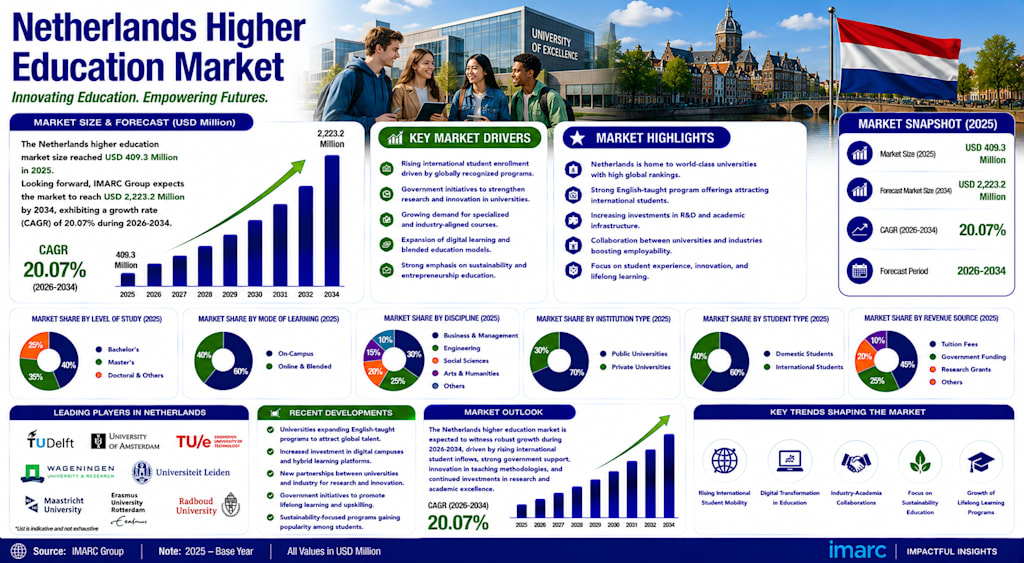
The Netherlands higher education market is undergoing a paradoxical yet rapid transformation: while physical enrollment figures face demographic headwinds, the market for technology enabled learning, institutional software and premium educational services is expanding at an explosive pace. The market encompasses a comprehensive ecosystem of educational services, from traditional degree programmes and online learning platforms to institutional management systems, student information systems (SIS), compliance solutions and digital credentialing services.
According to IMARC Group, the Netherlands higher education market size reached USD 409.3 Million in 2025 and is projected to reach USD 2,223.2 Million by 2034, exhibiting a stellar compound annual growth rate (CAGR) of 20.07% during 2026–2034 . Strong global rankings, a high demand for English taught programmes, government support for international students, robust research funding, industry collaboration and a diverse, skilled workforce are among the key drivers of the market's projected expansion . Yet beneath this headline growth lies a more nuanced story: domestic enrollment is contracting, international undergraduate numbers are falling for the third consecutive year, and the sector is simultaneously absorbing a historic funding reversal while accelerating its digital transformation.
What's Driving Market Growth?
Explosive Digitalisation and Software Modernisation. The single most powerful driver of the market's 20.07% CAGR is the massive, multi year investment cycle in educational technology, software platforms and digital infrastructure. Dutch universities, universities of applied sciences and community colleges are migrating from legacy on premises systems to cloud based student information management systems (SIMS), content collaboration platforms, data security and compliance tools, and comprehensive campus management solutions .
The €1.5bn Policy Reversal and Government Reinvestment. The Dutch higher education sector has experienced a dramatic political pivot. After enduring roughly €1.2 billion in funding cuts under the previous far right government—combined with measures to curb English taught degrees in a bid to reduce international enrollments—the incoming coalition government has presented a governing agreement that reverses these cuts . The change of tack will see €1.5 billion invested in education and science, with of that amount, €582 million earmarked for higher education, research and innovation .
Technology Driven Market Expansion Beyond Demographics. While physical student numbers face headwinds, the higher education technology market is decoupling from enrollment trends entirely. Institutions are investing in AI powered learning analytics, adaptive learning platforms, digital educational publishing, and learning management systems (LMS) irrespective of student count fluctuations. The Netherlands online education platforms market alone was valued at USD 1.5 billion, driven by digital learning adoption and flexible options, with over 1.6 million students projected to be enrolled in online courses .
Market Segmentation & Key Insights
By Component, the market is bifurcated into solutions (student information management systems, content collaboration, data security and compliance, campus management) and services (managed services, professional services). Solutions currently dominate, driven by the multi year modernisation cycle of institutional software stacks . By Deployment Mode, cloud based is the fastest growing segment, as institutions move away from expensive, difficult to maintain on premises infrastructure to scalable, subscription based cloud platforms .
By Course Type, major segments include arts, economics, engineering, law, science and others . Engineering and science remain the largest revenue generating segments, supported by the country's historic strengths in technology and research. By Learning Type, online is growing substantially faster than offline, though blended learning models dominate overall enrollment . By End User, the market is segmented into state universities, community colleges (hogescholen) and private colleges .
By Province, the market is distributed across Noord Holland, Zuid Holland, Noord Brabant, Gelderland, Utrecht and others . The Randstad provinces (Noord Holland, Zuid Holland and Utrecht) account for the largest share due to the concentration of major research universities.
What the Opportunities Are?
AI Powered Personalised Learning and Adaptive Platforms. Artificial intelligence is the most significant growth frontier in the Dutch higher education market. The Netherlands AI in Education Sector Market is seeing increasing adoption of personalised learning, adaptive content delivery and student performance analytics . Platforms are leveraging machine learning algorithms to adjust content difficulty, recommend resources and provide tailored feedback in real time . The Dutch EdTech market is projected to grow at over 24% annually, creating substantial runway for providers of AI driven educational software, chatbots and intelligent tutoring systems . Radboud University's NOLAI (National Educational AI Lab) pilot EdTech ecosystem, funded by the National Growth Fund, is conducting dozens of projects across Dutch schools to develop responsible, educational AI—including the generation of valid, reliable and clear exam questions—demonstrating the scale of public investment in this field .
EdTech Workspace and Startup Ecosystem Expansion. Utrecht has been established as a national EdTech hub, with a new EdTech workspace opened on the sixth floor of the Jaarbeurs Innovation Mile (JIM) in August 2025, providing dedicated space for startups and scale ups working on education innovation . The Dutch EdTech ecosystem report 2025 documented rapid growth across the sector, while the government allocated €220 million to enhance digital education initiatives . The pilot EdTech ecosystem launched by NOLAI represents a further multi year commitment to bridging schools, businesses and researchers in AI education .
Micro credentials and Lifelong Learning Infrastructure. The Dutch government is actively piloting micro credentials as a mechanism for lifelong learning, enabling flexible learning alongside work or other commitments, and making education more accessible and agile . The edubadges platform, a single digital credentialing service used across Dutch education, has issued tens of thousands of micro credentials since its launch in October 2020 .
International Student Retention and Language Integration Services. With the government allocating €154 million to universities of applied sciences and research universities within the talent strategy framework, there is emphasis on international student retention through Dutch language learning and labour market connection . Service providers offering tailored language instruction, job placement, housing support and integration programmes are positioned to capture this recurring funding stream.
Cloud Based Student Information and Campus Management Migration. The shift to cloud based deployment has created substantial demand for migration services, integration consulting and ongoing managed services for SIS platforms, campus management systems and compliance tools . With the Netherlands mandated to implement stricter data privacy and security protocols under GDPR and institutional governance requirements, vendors offering vertically integrated compliance solutions are well positioned for sustained growth.
Recent News and Developments in Netherlands Higher Education Market
April 2026: Education Minister Letschert confirmed that universities and universities of applied sciences would receive hundreds of millions of euros more for research, innovation and recruiting international students, with €582 million of the €1.5 billion cabinet package allocated to higher education, research and innovation .
February 2026: The new coalition government reversed the previous far right cabinet's policy curbing English taught degrees and rolled back approximately €1.2 billion in funding cuts, replacing them with a €1.5 billion investment package in education and science .
February 2026: Universities of the Netherlands (UNL) reported that international bachelor's enrollments were down by 3.6% and domestic enrollments fell by 3.3% in 2025/26, marking the third consecutive year of declining international student numbers, particularly from the European Economic Area .
January 2025: Dutch universities and Elsevier signed a new two year agreement to support research and promote open access. The deal grants Dutch researchers access to Elsevier's journals and 100% open access publishing, enhancing transparency in AI, privacy, text mining and user rights .
August 2025: A new EdTech workspace was opened in the Jaarbeurs Innovation Mile (JIM) in Utrecht, establishing the city as a national hub for education technology and providing dedicated workspace for education innovation startups and scale ups .
Why Should You Know About Netherlands Higher Education Market?
You should know about this market because it captures how technological modernisation, government policy volatility and structural demographic change intersect to create both challenges and explosive growth opportunities in one of Europe's most advanced education systems. The Netherlands higher education market is not a single story—it is two diverging narratives unfolding simultaneously. Physical enrollment is contracting, with the number of 16 to 22 year olds projected to fall by 10.6% by 2045, European bachelor's intake down 5%, and English language teaching restrictions only recently reversed after damaging sector confidence . Yet paradoxically, the market for higher education software, platforms and services is projected to quintuple from 409millionto2.2 billion in under a decade—a 20.07% CAGR.
For investors, the Netherlands higher education market offers exposure to a high growth technology services category decoupled from declining demographics, anchored in the multi billion euro digital transformation of Dutch universities and colleges, government backed AI and EdTech funding, and the structural shift toward cloud based, lifelong learning infrastructure. The €1.5 billion policy reversal and €582 million allocation to higher education signal not just a funding bump but a fundamental recognition that technology investment is essential to sector sustainability.
For education technology vendors, institutional administrators and government planners, understanding the segmentation between on premises and cloud deployment, between traditional degree programmes and micro credentialed lifelong learning, and between domestic contraction versus selective international enrollment strategies helps shape intelligent product development, partnership and resource allocation decisions.
In essence, the Netherlands higher education market captures how demographic decline, digital imperative and political realignment converge—making it a compelling area for technology investors, EdTech providers and policy strategists seeking smarter approaches to institutional modernisation, international student retention and future proofed learning infrastructure in one of Europe's most competitive and innovation oriented academic environments.
About the Creator
Thomas
Market Research Analyst | Industry Trends & Forecasting | Turning market data into clear, actionable business insights across global sectors.
Enjoyed the story? Support the Creator.
Subscribe for free to receive all their stories in your feed.
Comments
There are no comments for this story
Be the first to respond and start the conversation.