
Netherlands Diaper Market 2026: Premiumisation Surge, Circular EPR Shift & Silver Economy Growth
How a 6.44% CAGR sustainability mandate, convenience-led innovation and adult incontinence expansion are reshaping the Dutch hygiene landscape

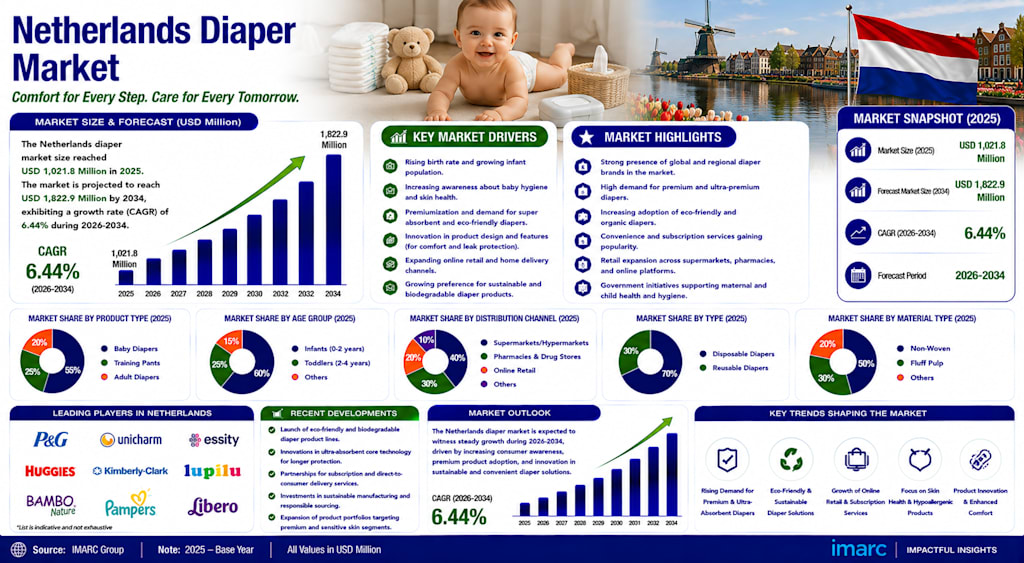
The Netherlands diaper market is undergoing a fundamental transformation as rising price pressures, aggressive private label gains and tightening circular economy regulations reshape the competitive landscape. The market encompasses nappies, pants and diapers for both infants and adults—serving a population of nearly 18 million where convenience, quality and increasingly environmental accountability drive purchasing decisions. According to IMARC Group, the market size reached USD 1,021.8 Million in 2025 and is projected to reach USD 1,822.9 Million by 2034, exhibiting a compound annual growth rate (CAGR) of 6.44% during 2026–2034. While volume growth remains muted, value expansion is being propelled by multiple converging forces: inflation driven price hikes, the rapid adoption of premium pants and training diapers, the rapid acceleration of e commerce and, most notably, the country’s first mandatory recycling targets under the Extended Producer Responsibility (EPR) scheme for diaper waste.
What’s Driving Market Growth?
Price Hikes and Premiumisation Pushing Value Growth. The most immediate driver of value growth is price inflation. In 2024, value sales of nappies/diapers/pants rose primarily due to price increases rather than any meaningful recovery in volume demand. Volume remains under pressure from declining birth rates and the increased adoption of reusable alternatives. Despite this, the category is seeing significant premiumisation. Convenience led innovation—particularly the shift from standard taped nappies to pull up pants—has fuelled the adoption of higher margin products that command premium prices. Pampers, the market leader, has driven this transformation with its Pants range, which emphasises both convenience and quality.
EPR Mandate: A Circular Economy Landmark for Diaper Waste. The Netherlands is facing an enormous environmental challenge from disposable diaper waste. Each year, the country generates 400 million kilograms of diaper waste, most of which is incinerated, causing significant environmental harm. In a landmark regulatory move, the Dutch government has introduced an Extended Producer Responsibility (EPR) scheme for diaper waste, requiring producers to take direct responsibility for the collection and recycling of used diapers. The target is to recycle 12.5% of diaper waste by 2028, which amounts to 110 kilotons. This move is the single most transformative force for the market: it forces manufacturers—including P&G and private label producers—to redesign products for recyclability, invest in waste processing infrastructure and incorporate post consumer recycled content. Sustainability is deeply ingrained in Dutch consumer culture, and the EPR mandate will accelerate the shift toward eco friendly diapers incorporating natural materials, recyclable packaging and biodegradable components. Brands and retailers are already responding. Kruidvat, the dominant private label player, has linked its high absorption nappies directly to sustainability claims, while major retailers are launching new eco positioned lines. The mandate also creates opportunities for reusable services: Amsterdam based Billie Wonder, which secured €600,000 in funding in 2025, has developed a circular diaper as a service (DaaS) model using water resistant and absorbent fabrics that replace single use waste, aligning with the broader push toward zero waste alternatives.
Adult Incontinence: The Fastest Growing Volume Driver. While babies still dominate the market in value terms, the fastest growing segment is adult incontinence. The Netherlands’ aging population—combined with falling stigma around incontinence—is driving sustained demand for pads, pants and nappies for elderly care. Euromonitor reports that the ageing population and greater acceptance of incontinence are driving category growth, with Essity maintaining market leadership while private label gains traction. The adult incontinence segment is set to accelerate innovation over the coming decade as the population ages further. In 2025, demand for adult incontinence products rose by approximately 7–9%, supported by rising healthcare awareness and the increasing elderly demographic. The adult diaper segment—encompassing pad, flat and pant types—is now a core pillar of the Netherlands diaper market alongside traditional baby products.
E Commerce: The Fastest Growing Channel. The retail distribution of diapers is shifting decisively toward digital platforms. E commerce has emerged as the fastest growing distribution channel for nappies, diapers and pants. Parents are increasingly shifting to bulk buying and online purchasing as population growth slows and household budgets tighten, with comparison sites accelerating online sales growth. Online diaper sales increased by approximately 9–11% year on year in January 2025, driven by subscription based purchasing models and the convenience of doorstep delivery. Subscription commerce—allowing parents to automate regular deliveries—builds deep customer loyalty and ensures recurring revenue for direct to consumer brands. E commerce is expected to continue expanding as parents seek cost savings and convenience. At the same time, offline retail remains formidable, with supermarket chains Albert Heijn and Jumbo retaining shopper loyalty through weekly convenience shopping.
Private Label Gains Ground Against Branded Leaders. The competitive landscape of the Netherlands diaper market is highly concentrated but shifting. Procter & Gamble Nederland (Pampers) remains the undisputed leader among branded manufacturers, holding a 34% share in 2025 (value), followed by Kimberly Clark at 13%, and AS Watson (owner of Kruidvat) at 10%. However, private label is gaining significant ground. As parents become more value conscious amid inflationary pressures, store brands—particularly those of Kruidvat and Albert Heijn—are expanding their share while investing in premium positioning. In 2025, Albert Heijn launched a new line of nappies under its own brand, “Extra Dry and Soft,” while Kruidvat used its retail strength to link high absorption to sustainability and performance gains. The penetration of private label in the category continues to rise, reflecting a cautious, value oriented consumer base that is increasingly willing to trade down from premium brands for comparable quality at lower prices.
Market Segmentation & Key Insights
By Product Type, the market is segmented into baby diapers (including disposable, training, cloth, swim pants, biodegradable) and adult diapers (pad, flat and pant types). Baby diapers currently dominate in value, but adult diapers are the fastest growing segment.
By Distribution Channel, key channels include online retail (fastest growing), supermarkets and hypermarkets (largest volume share), pharmacies and specialty stores, and B2B/direct sales. Parents’ shift to bulk and online buying as population growth slows is a defining trend. Brands operating in the Netherlands are investing in omnichannel capabilities to capture both the convenience of e commerce and the trust of physical retail.
By Application, the market is segmented into infant care and elderly care. Infant care remains the largest segment, but elderly care—driven by the aging population and reduced stigma around incontinence—is growing rapidly, with innovations in discreet, lifestyle oriented adult pants entering the market.
By Price Tier, the market includes economy, mid range and premium segments. Mid range dominates volume, but premium is the fastest growing, driven by convenience features such as pull up pants, wetness indicators and skin friendly materials. Sales of premium and eco friendly diapers grew by around 10–12% in 2025 (August 2025), reflecting a clear shift toward sustainable and high quality products.
What the Opportunities Are?
Sustainable & Biodegradable Materials Innovation. The EPR mandate for diaper waste (12.5% recycling target by 2028) and the strength of Dutch environmental culture create a powerful pull for eco friendly diapers. The transition to biodegradable superabsorbent polymers (bioSAPs) and plant based components is already underway. Manufacturers increased the use of biodegradable materials by approximately 8–10% in late 2025, aligning with environmental regulations and consumer preferences. Industry pioneers are looking to phase out conventional SAPs, which prevent composting and recycling and persist in landfills for centuries. There is significant opportunity for brands that can deliver true circularity—diapers that are either industrially compostable or designed for closed loop recycling systems.
Reusable & Circular Business Models (Diaper as a Service). While the market is dominated by disposables, the reusable segment is gaining traction among highly eco conscious Dutch households. The washable diaper as a service (DaaS) model—where customers pay a subscription and receive cleaned, reusable diapers—directly counters the environmental burden of disposables. Amsterdam based Billie Wonder, which secured €600,000 in 2025, is scaling this exact model using water resistant (PUL) and absorbent fabric combinations. This sector remains underpenetrated but offers high customer lifetime value, brand loyalty and alignment with circular economy goals, particularly as government pressure on disposable waste mounts.
Premium Adult Incontinence Solutions. The adult incontinence segment is poised for accelerated innovation as the population ages and stigma falls. There is strong opportunity for discreet, lifestyle oriented adult pants that normalise incontinence and allow wearers to maintain an active lifestyle. Euromonitor notes that Seni Active has positioned itself as a solution for an active lifestyle, with pants suitable for daily wear. Brands that combine high absorbency with discretion, comfort and skin health will capture the silver economy growth wave. The Dutch market’s reimbursement for prescription incontinence products adds an institutional channel dimension, but retail growth is driven by consumers seeking lifestyle appropriate solutions.
E Commerce & Subscription Models for Recurring Revenue. With e commerce already the fastest growing channel and parents turning to bulk buying as population growth slows, subscription commerce is a major growth frontier. Direct to consumer diaper subscription services offer predictable revenue, lower churn and direct consumer data. In January 2025, online diaper sales increased by approximately 9–11% year on year, driven by growing adoption of subscription based purchasing models. The ability to integrate subscription management with personalised delivery schedules, along with value added offerings such as loyalty rewards and eco refill reminders, will differentiate brands in a competitive digital marketplace.
Smart Diapers & IoT Enabled Monitoring. The Netherlands’ reputation as a tech savvy market creates fertile ground for smart diaper technology. Diapers embedded with moisture sensors that send real time alerts to smartphone apps reduce unnecessary changes, prevent diaper rash and provide parents with actionable data on their baby’s urination patterns. While still nascent, this segment appeals to premium seeking, convenience oriented parents and could command significant price premiums. For the adult incontinence segment, IoT enabled nappies could provide caregivers with real time updates, improving care quality in nursing homes while reducing labour costs.
Recycled Content & Circular Supply Chains. With EPR targets looming, brands that invest in closed loop recycling infrastructure—turning used diapers back into raw materials for new hygiene products—will capture first mover advantages. Producers will need to incorporate recycled content into packaging and absorbent cores, driving demand for recycled pulp, plastics and bioSAPs. The shift to a circular economy for diapers will not only satisfy regulatory requirements but also resonate with Dutch consumers who rank sustainability as a top purchasing consideration.
Recent News and Developments in Netherlands Diaper Market
January 2025: Online diaper sales increased by approximately 9–11% year on year, driven by growing adoption of e commerce platforms and subscription based purchasing models.
February 2025: Ontex launched its Dreamshields® technology for baby diapers across Europe, including the Netherlands. The innovation offers enhanced leakage protection, comfort and sustainability, featuring a unique channel design, SeconDRY® system and 360° protection while reducing CO₂ emissions and plastic use.
April 2025: Demand for adult incontinence products rose by nearly 7–9%, supported by the increasing elderly population and rising healthcare awareness, reflecting the growing importance of the silver economy for the diaper market.
August 2025: Sales of premium and eco friendly diapers grew by around 10–12%, reflecting a decisive shift toward sustainable, high quality products among Dutch consumers.
November 2025: Manufacturers increased the use of biodegradable materials by approximately 8–10%, aligning with tightening environmental regulations and growing consumer preferences for sustainable products.
2025: Amsterdam based Billie Wonder secured €600,000 in funding to scale its circular diaper as a service model, using reusable, washable fabrics to eliminate single use waste. The company actively sought additional investors to expand across the Netherlands.
Why Should You Know About Netherlands Diaper Market?
You should know about this market because it captures how regulatory enforcement (EPR), demographic aging and sustainability driven innovation intersect to reshape one of Europe’s most mature consumer hygiene markets. For investors, the Netherlands diaper market offers exposure to a high growth essential consumer category anchored in the unavoidable trends of an aging population, a tech savvy consumer base and a government mandated circular transition. The projected CAGR of 6.44% reflects steady value expansion driven by premiumisation and the increasing cost of sustainability compliance, while higher growth sub segments—including adult incontinence products (7–9% demand growth), eco friendly diapers (10–12% sales growth), e commerce and subscription models, and reusable DaaS platforms—offer differentiated upside.
For hygiene manufacturers, private label retailers, investors and circular economy innovators, understanding the segmentation between baby and adult segments, the fierce competition between branded leaders and private label players, the trajectory of e commerce penetration, and the compliance requirements of the 2028 EPR recycling target (12.5% of 110 kilotons) helps shape intelligent product design, distribution investment and supply chain decisions that deliver measurable regulatory compliance, environmental performance and consumer loyalty outcomes. The Dutch market serves as a bellwether: what begins in the Netherlands—EPR for diaper waste, reusable subscription models, premium pants adoption—often cascades across the European hygiene sector. In essence, the Netherlands diaper market captures how convenience, environmental accountability and demographic necessity converge—making it a compelling area for investors, manufacturers and circular economy pioneers seeking smarter approaches to waste free hygiene, sustainable growth and silver economy expansion in one of Europe’s most innovation ready consumer markets.
About the Creator
Thomas
Market Research Analyst | Industry Trends & Forecasting | Turning market data into clear, actionable business insights across global sectors.
Enjoyed the story? Support the Creator.
Subscribe for free to receive all their stories in your feed.
Comments
There are no comments for this story
Be the first to respond and start the conversation.